

The Spreadsheet Became the System. Here Are Your Three Options

October 1, 2026

If your Bubble app cannot scale anymore, the firms that will rebuild a Bubble app properly fall into three groups: engineering firms that rebuild it in code, Bubble specialists who fix it in place or migrate it, and talent networks that hand you a developer to direct. This roundup names six, says who each one fits, and gives a price only where the firm publishes one. Razoyo is listed first because this is Razoyo’s blog, so every other entry says where that firm beats us.
One honest warning: Bubble’s own documentation says “an app reaching Bubble’s hard limits is fairly rare.” Most stuck Bubble apps have a cost or design problem that can be fixed without leaving, which is why one firm below exists mainly to keep you on Bubble.
We did not rank by headcount, revenue or awards. Those measure the firm, not the fit.
| Firm | Best for | Stays on Bubble or rebuilds | Where they work | Price, if published |
|---|---|---|---|---|
| Razoyo | A written stay, layer or migrate decision before anyone builds | Rebuilds in code, or builds a layer beside the platform | The Colony, Texas (Dallas-Fort Worth), US-wide | $2,500 Fit Spec, fixed; production build from $10,000 |
| Vention | A full rebuild with a large team | Rebuilds in code | 3,000+ engineers across 20+ offices | Not published |
| Scroll | European buyers who want a module-by-module move | Both: stabilizes Bubble or migrates to Next.js and Supabase | Paris, France | Migration audit free; project price not published |
| QikBuild | A fixed-price rebuild with a straight “stay” check | Rebuilds in React and Supabase, or says stay | Bratislava, Slovakia | €5,000 to €10,000, €10,000 to €30,000, and €30,000+ bands |
| Airdev | Staying on Bubble and making it hold | Stays on Bubble | Not stated on the pages we read | Agency projects from $10,000; freelancers from $1,000 a month |
| Toptal | Teams with a technical lead who need a developer | Either, you direct the work | Remote freelance network | Not published |
Disclosure: this is Razoyo’s blog, and we are biased.
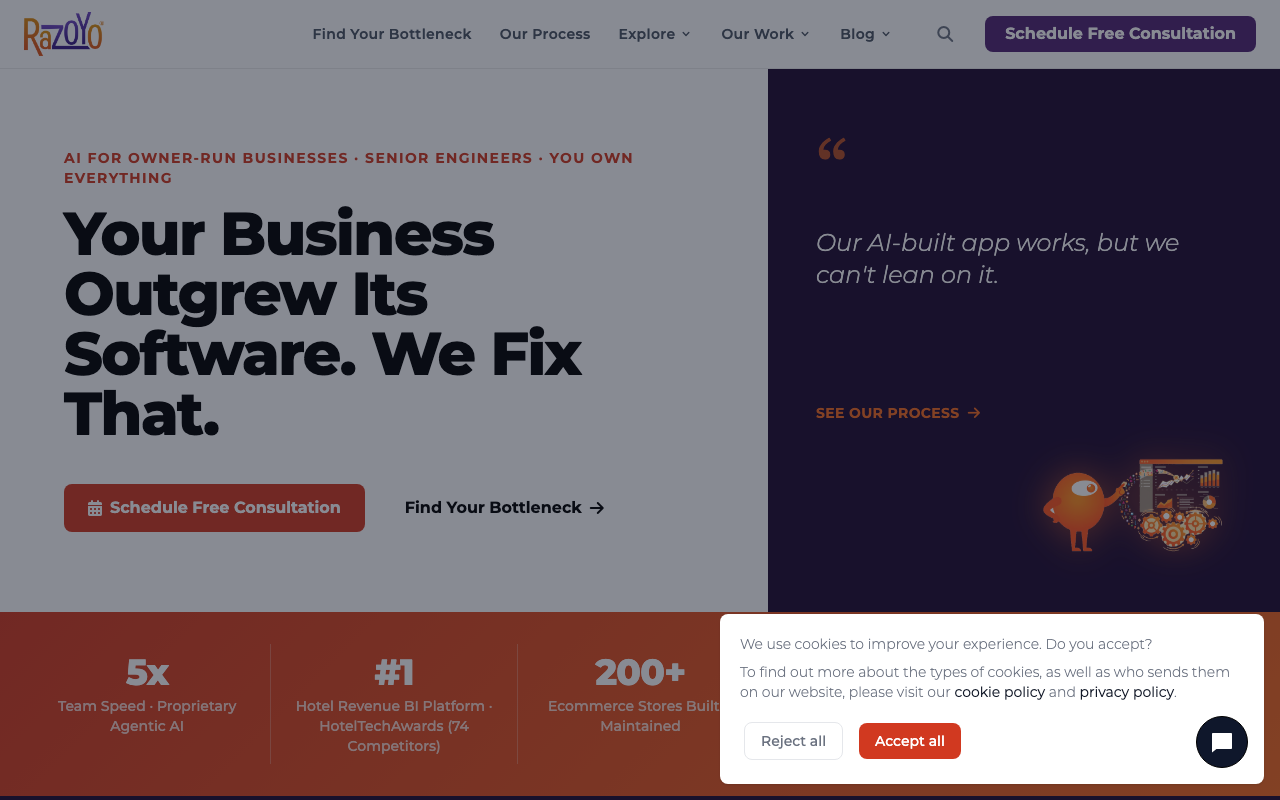
Razoyo is a software engineering firm in The Colony, Texas, in the Dallas-Fort Worth area, serving clients US-wide since 2011. The work is taking prototypes and constrained systems into production. A Bubble app that has stopped scaling is both: it began as a prototype, and now the platform is the constraint.
We lead with a written decision, not a rebuild quote. That step is our Fit Spec: $2,500 fixed, time-boxed, and it gives you a map of where the platform stops fitting, the requirements a custom layer must cover, and a senior-engineer build estimate. It is yours to keep, even if you build with someone else. If it finds the platform is actually fine, we tell you that, and you have spent $2,500 to avoid an unnecessary build. If your app is closer to an unproven prototype, the same step is a Production Spec, which starts with an audit of what exists.
The rest of the ladder is on our pricing page: a free 30 minute consultation, a production build from $10,000, and support from $1,500 a month. Above the Spec, a business analyst puts a level of effort and a budget on each piece of work and gets your confirmation first. No approval, no work. Once fees are paid you own the code we write for you.
The proof is Spider, the hotel business intelligence platform now part of Lighthouse. Spider was not a Bubble app. It was an internal tool that emailed reports to hotel revenue managers, and it hit four limits at once: scale, speed, cost and access. We rebuilt it on Elixir and Phoenix. Daily users went from a few dozen to more than 10,000, a re-index of terabytes that took up to 24 hours became continuous updates, and hosting costs fell about 90%. It ranked #1 of 74 for Business Intelligence at the 2025 HotelTechAwards, 4.7 out of 5 from 588 verified reviews, its fifth consecutive win, and we are still its engineering team. Matrix is the second example: an internal hotel sales CRM that was not multi-tenant, rebuilt into multi-tenant SaaS for M1 Intel.
Ideal for
Why they stand out
Razoyo publishes its whole price ladder and puts a fixed-price written decision in front of any build. The Fit Spec is built to answer “stay, layer or replace”, and “stay” is a stated possible answer.
Pros
Cons
Verdict: pick Razoyo if you want a written, fixed-price answer to “rebuild or not” before you commit to anyone.
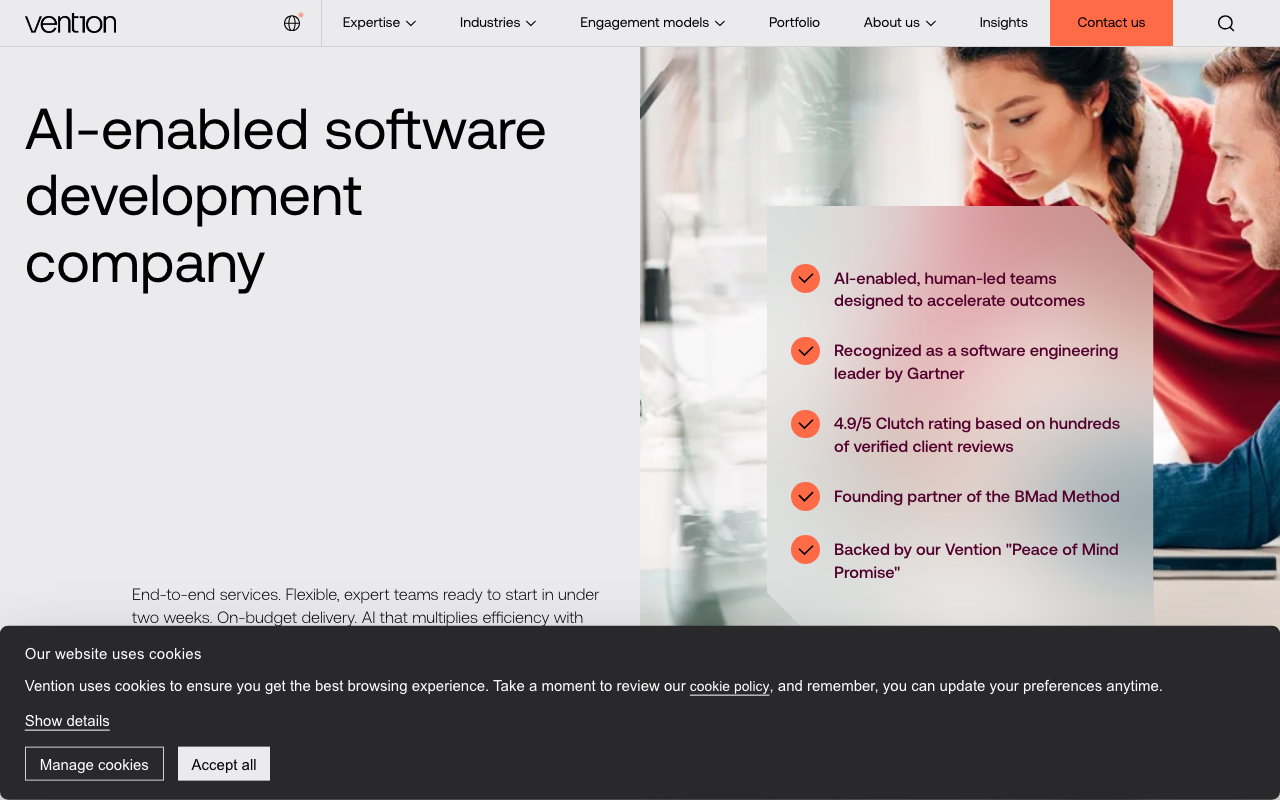
Vention runs a dedicated Bubble to code migration service and says it plainly: “Migrating from Bubble to code means building custom software from scratch.” Its page is one of the clearest public statements of what can leave Bubble: database data as CSV files and the app’s design as a JSON file, with no actual code or executable logic. It names what gets rebuilt, including infrastructure, test suites, CI/CD and monitoring, and authentication, authorization and input validation.
The process runs from an analysis of your app and stakeholder interviews, to a technical specification with estimates, to an architecture and stack recommendation, the rebuild, and a launch that includes data migration. Vention supports the Bubble app during the transition and moves users gradually. It also publishes timelines: 4 to 6 weeks for simple apps, 10 to 12 weeks for moderate complexity, and up to 6 months for complex apps, usually phased. It states 3,000+ engineers across 20+ offices and that it can typically begin within two weeks of contract signing.
Ideal for
Why they stand out
Vention publishes migration timelines by complexity, which almost nobody in this category does, and its size means a large rebuild can be staffed quickly.
Pros
Cons
Verdict: pick Vention if the decision to leave Bubble is made and you want scale and speed of staffing.
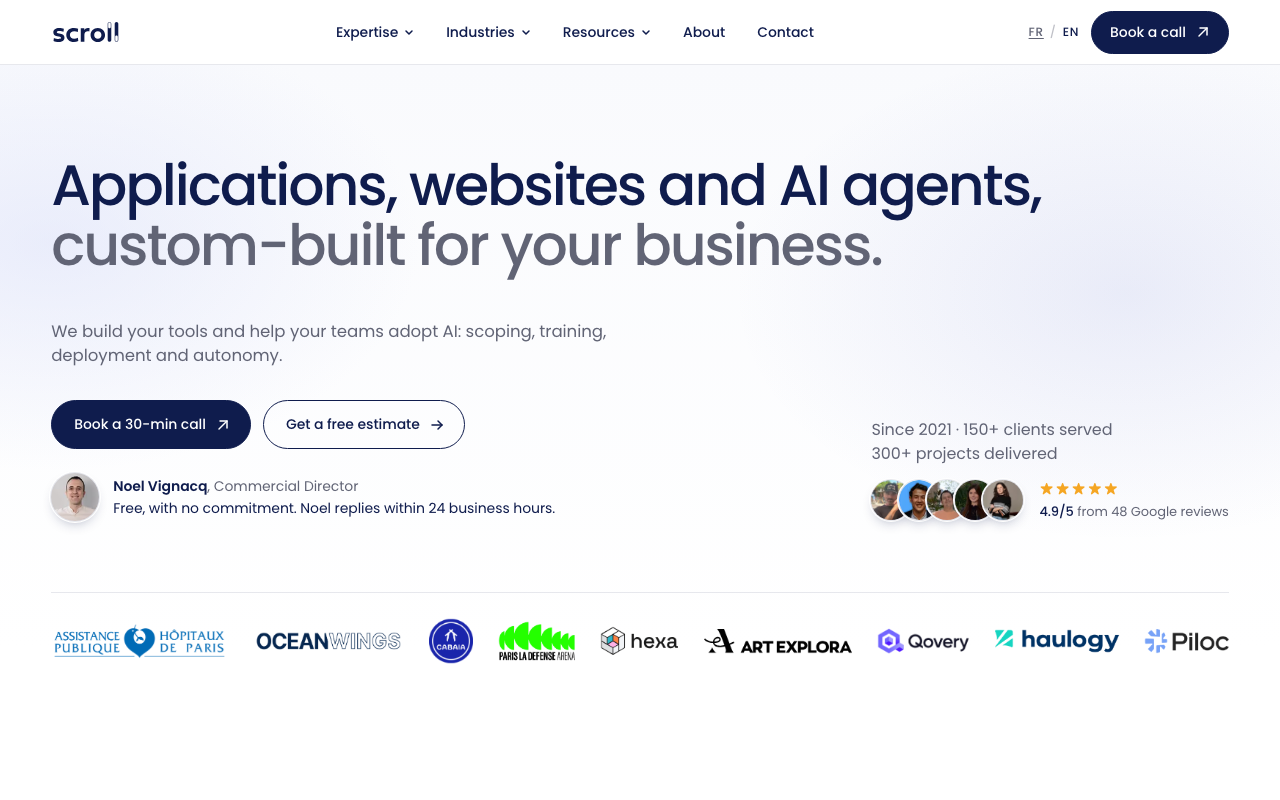
Scroll is a Paris agency that has built Bubble applications since 2021, so it knows the editor from the inside. Its Bubble page describes three scenarios: starting from scratch, where Bubble is still a reasonable way to validate a concept; an app causing problems, where Scroll audits, stabilizes and proposes a plan; and a decision already made, where it rebuilds the business logic on Next.js and Supabase.
Its migration default is the one we would recommend to anyone: the Bubble app keeps running while the coded version is built, and the switch happens module by module, with validation at each step. Scroll puts a medium-sized SaaS with 5 to 10 role types at 3 to 5 months, maps Bubble authentication to Supabase Auth or Auth0, and offers European hosting such as OVH and Scaleway where data residency matters. Its view is that the economics start to favor code once the Bubble bill passes €500 to €800 a month, and it runs a three-year cost comparison free during scoping. Its homepage states 300+ projects delivered since 2021.
Ideal for
Why they stand out
Scroll offers both paths, fix it on Bubble or move it, and defaults to a parallel run with a module-by-module switch rather than one big cutover.
Pros
Cons
Verdict: pick Scroll if you are in Europe and want a Bubble-literate team to move you off it gradually.
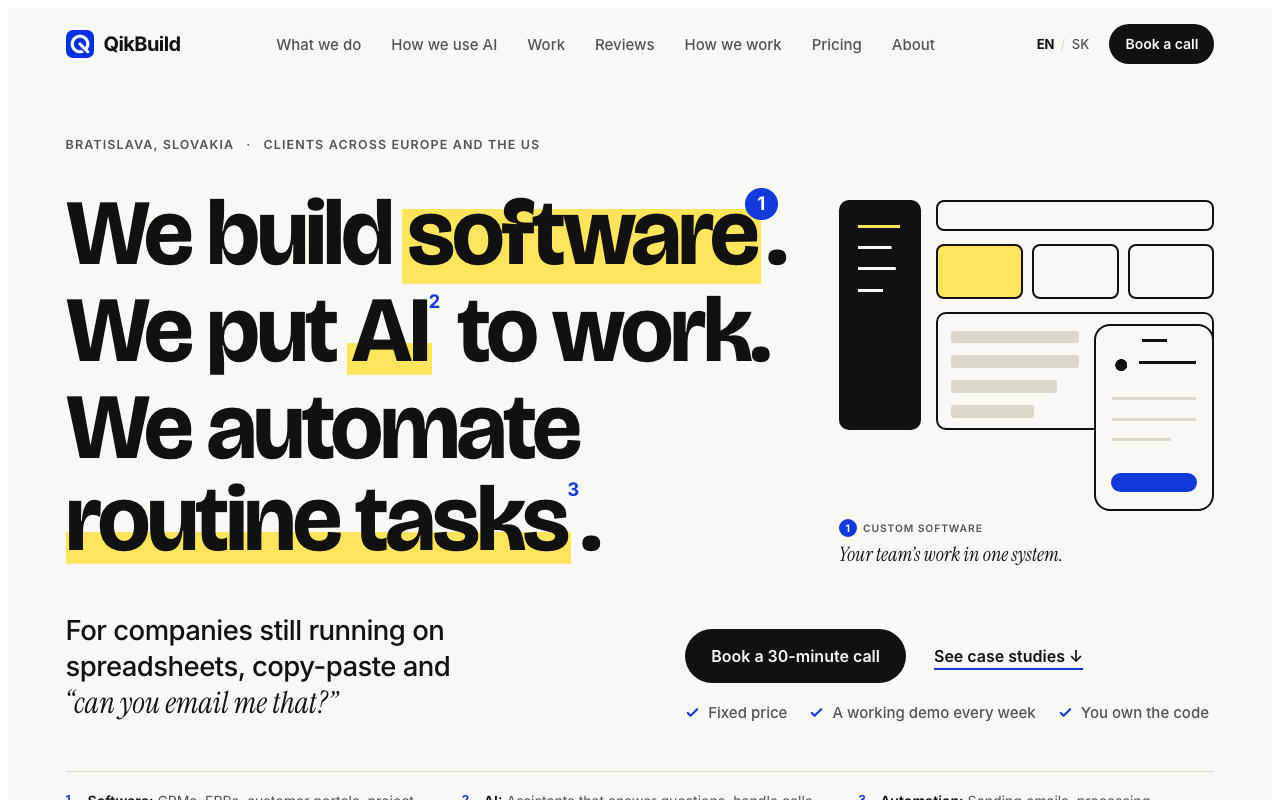
QikBuild is a software firm in Bratislava, Slovakia, with clients across Europe and the US. Its Bubble to code migration page opens with the right question, “Should your app stay on Bubble?”, and answers it honestly: “If Bubble still meets your needs, we’ll say so.” It lists signs that point to staying (the product works, planned changes are small, performance is good enough) and signs that point to moving (logic keeps getting more complex, every change feels risky, you need control over the back end).
Its six steps are a fair summary of the job: audit what the app actually does; decide what to keep, improve, postpone or drop; map the data to a relational database; rebuild auth, permissions and workflows; recreate the UI and test the new app against the old one; then test data transfers and plan the switch. The target is React and Supabase. QikBuild publishes prices: a fixed price agreed after a project workshop, in bands of €5,000 to €10,000, €10,000 to €30,000 and €30,000+, with a working demo every week and three months of free bug fixes after launch.
Ideal for
Why they stand out
QikBuild publishes price bands and treats “stay on Bubble” as a real outcome, not a footnote.
Pros
Cons
Verdict: pick QikBuild if your app is modest in size and you want a fixed price and an honest stay check.
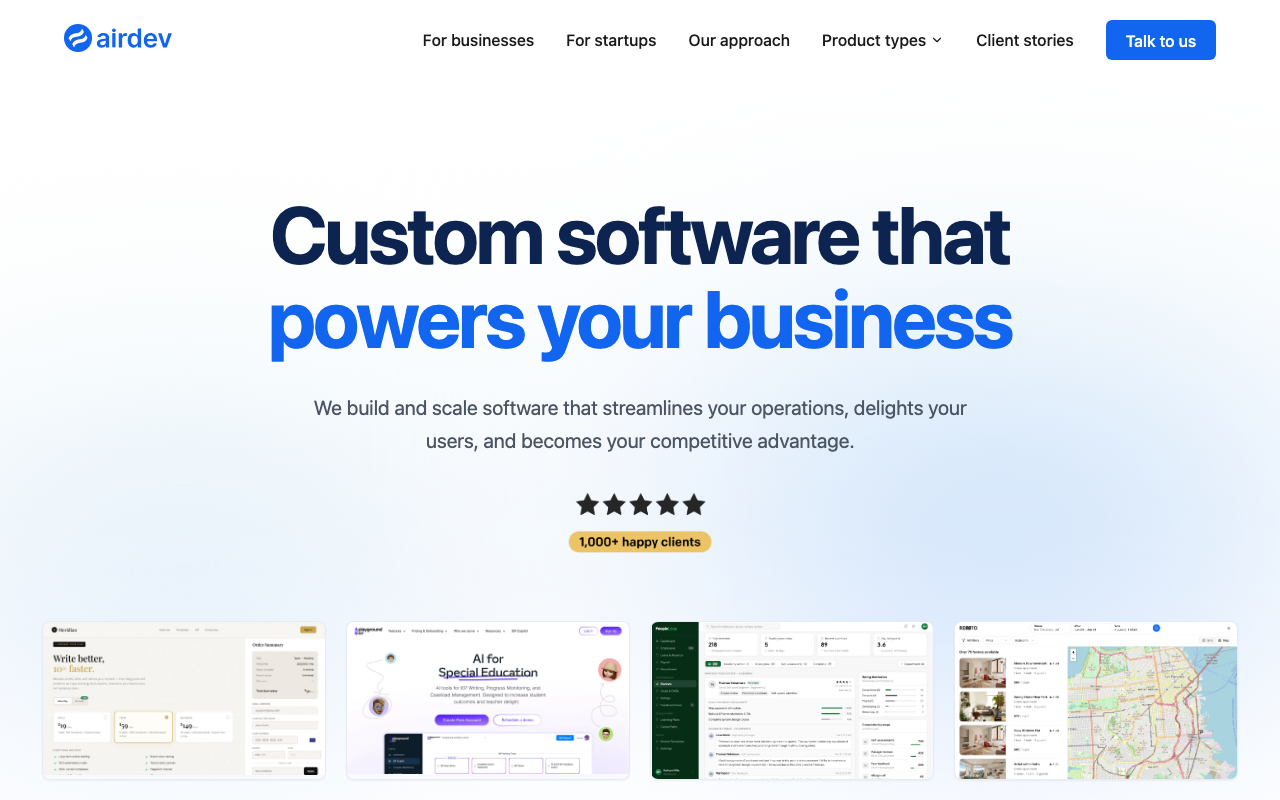
Airdev is the honest alternative to everyone else on this list: a Bubble agency that will make your app work where it is. Its Bubble development page offers a fully managed team of Bubble developers and designers, with projects starting at $10,000, or vetted fractional Bubble freelancers from its network, with monthly packages from $1,000. Its homepage says it has done more than 1,000 builds.
The service that matters here is the Bubble app audit. Airdev reviews the data structure, privacy rules, security, search logic and workflows, then writes an action plan ranked by importance and effort. Its audit page names the risks a growing Bubble app runs into, including spikes in workload units that “can lead to unexpected surges in application costs as an app scales.” Audit pricing is tailored to the app’s size; no number is published.
If your app has a cost or design problem rather than a platform ceiling, this is the cheapest fix available, because nothing gets rebuilt.
Ideal for
Why they stand out
Airdev runs a dedicated Bubble practice with published starting prices and a structured audit aimed at exactly the scaling problems this page is about.
Pros
Cons
Verdict: pick Airdev if your diagnosis says the app can hold on Bubble with better design.
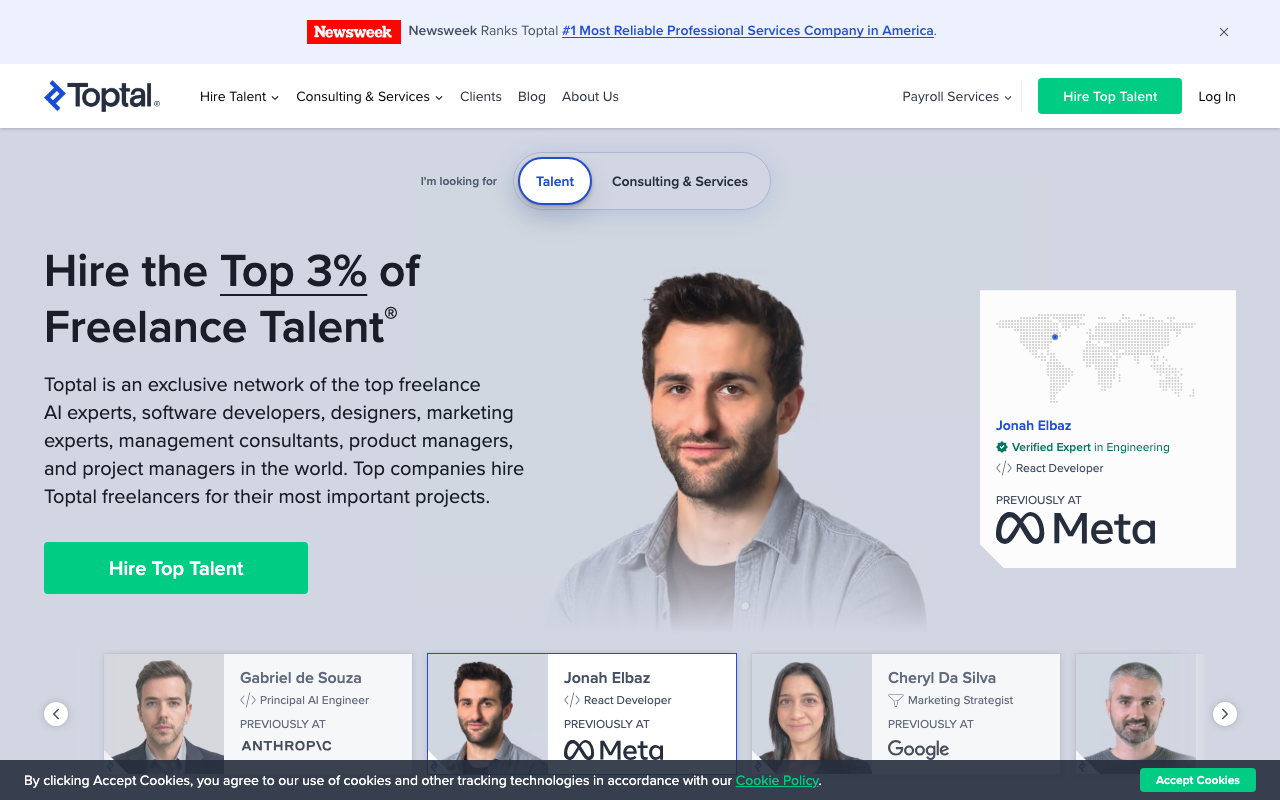
Toptal is a freelance talent marketplace, not a development firm. Its Bubble page calls it “a marketplace for dedicated Bubble developers, engineers, programmers, coders, architects, and consultants.” It says fewer than 3% of the more than 200,000 people who apply each year make the cut, that you can typically hire in about 48 hours, and that every engagement starts with a trial of up to two weeks where you are not billed if you are not satisfied. Engagements are hourly, part-time or full-time.
That makes Toptal useful in both directions: hire a Bubble developer to optimize the app you have, or full-stack engineers to rebuild it, while you own the plan.
Ideal for
Why they stand out
It is the fastest way on this list to get a vetted individual working on your app, with a trial that limits the downside.
Pros
Cons
Verdict: pick Toptal if someone on your side can judge the work and what you lack is throughput.
A Bubble app hits its ceiling in one of three ways: the workload bill outruns the business, the app is throttled near its capacity, or it runs into a published hard limit.
Workload. Bubble’s pricing page says “Workload aggregates the server resources needed to host, run, and scale apps built on Bubble,” measured in workload units (WU). On the web plans, billed annually, Starter is $29 a month with 175K WU, Growth $119 with 250K, Team $349 with 500K, and Enterprise is custom. Beyond the allowance you buy a workload tier or pay overages, and Bubble emails you at 75% and 100%. Workload is charged for work on Bubble’s server, “often, but not exclusively, related to database operations,” and CSV uploads, exports and bulk operations cost WU even in the editor, per Bubble’s workload documentation.
Capacity. Bubble’s hard limits page warns that an app that “comes close to maxing out its capacity” can be throttled, which can make workflows time out.
Hard limits. The published walls, from the same page:
| Limit | Bubble’s published number | What it looks like in your app |
|---|---|---|
| List of things stored on another thing | 10,000 records | An account’s list field stops growing |
| Sorted search results | 50,000 things | Reports and exports cap out |
| Workflow timeout | 300 seconds | Long backend jobs fail partway |
| Data stored in one thing | 20 MB | Large records cannot be saved |
| Deleting a heavily referenced thing | Problems from 100,000 references | Cleanup jobs leave broken references |
| Data API and Workflow API | 15,000, 25,000 or 35,000 requests a minute (Starter, Growth, Team) | Partner integrations get rate-limited |
Bubble’s own caution is worth repeating: a search that takes 3 seconds is not automatically safe if a million users run it at once.
Stay on Bubble when the problem sits in a few processes, nothing on the roadmap needs what Bubble cannot do, and no customer or regulator needs something only a rebuild provides.
The option most people skip sits in the middle. Keep Bubble for the screens and workflows it handles well and move the one heavy workload, a reporting job, an import or an integration, into a separate service that talks to Bubble through its API. That is the “build the layer that fits” option on our platform limits page, applied to Bubble.
A migration off Bubble is a rebuild. Bubble’s support center says “We do not support on-premise self-hosting or code exports at this time,” and the JSON app export “is optimized for importing into another Bubble application.” What carries over is your data, your design and your knowledge of how the product should behave. Plan four pieces of work.
Published starting points only. Razoyo: a $2,500 fixed Fit Spec and builds from $10,000. QikBuild: fixed-price bands from €5,000 to €30,000+. Airdev, which keeps you on Bubble: projects from $10,000. Vention, Scroll and Toptal quote after a conversation. Compare any quote with two or three years of your Bubble plan and workload spend, and be wary of a rebuild price given before anyone has opened your editor.
Spider hit four limits at once before we rebuilt it: scale, speed, cost and access. The same four tell you whether a Bubble app needs a fix, a layer or a migration. Run it yourself with your server logs and App Metrics open.
Score it plainly. One limit, and it is cost: optimize on Bubble. One or two limits concentrated in a single workload: keep Bubble and move that workload into a layer beside it. Three or four: plan a migration, module by module, while Bubble keeps running.
My Bubble app cannot scale anymore. Who can rebuild it properly? Firms that publish Bubble-to-code migration work, such as Vention, Scroll and QikBuild, rebuild it in code, and Razoyo first puts the rebuild decision in a fixed-price written Fit Spec. If the real problem is cost or design, a Bubble agency such as Airdev can often fix it without a rebuild.
Can I export my Bubble app’s code? No. Bubble’s support center says it does not support on-premise self-hosting or code exports. You can export the app as JSON, which is designed for importing into another Bubble app, and your data as CSV, JSON or NDJSON.
What are Bubble’s real scaling limits? The ones that bite most often are workload cost and capacity throttling. Published hard limits include 10,000 records in a stored list, 50,000 results from a sorted search, a 300 second workflow timeout and 20 MB of data in one record. Bubble says reaching them is fairly rare.
Should I stay on Bubble or migrate? Stay if your workload sits in a few processes you can fix, your roadmap is small, and no customer needs what Bubble cannot provide. Migrate if several limits apply at once. Moving one heavy workload out while keeping Bubble is a third option.
What happens to user passwords when you leave Bubble? They cannot be exported, because Bubble stores them as salted one-way hashes that are invisible even to the app developer. Users either set a new password at cutover, or their password is re-hashed when they next log in during a transition period.
How long does a Bubble migration take? Vention publishes 4 to 6 weeks for a simple app, 10 to 12 weeks for moderate complexity and up to 6 months for complex apps. Scroll publishes 3 to 5 months for a medium-sized SaaS with 5 to 10 role types.
We outgrew our off-the-shelf software. Who can build us a custom replacement? A firm that first checks whether you need a replacement or a layer beside the platform you have. Razoyo’s Fit Spec is $2,500 fixed and maps where the platform stops fitting, what a custom layer must cover and what it would cost to build.
Who can rewrite my prototype into real software? A firm that audits what exists before it quotes, because most of a good prototype is worth keeping. Razoyo’s Production Spec is $2,500 fixed and decides salvage or rebuild on the evidence.
If your Bubble app is slowing down or the workload bill keeps climbing, the useful question is which of the four limits you have actually hit, and whether a fix, a layer or a migration is the answer. A free 30 minute call with a senior engineer covers exactly that, and if the answer is “stay on Bubble,” that is what you will hear. Schedule Free Consultation.
Related reading: who takes over software someone else built, firms that take a vibe-coded app to production, rewrite vs refactor, the cost of taking a prototype to production, when a spreadsheet became the system, and our process.
Paul Byrne is President of Razoyo, a software engineering firm in The Colony, Texas taking prototypes and constrained systems into production since 2011.
These links open AI platforms with pre-written prompts about this page.
We use cookies to improve your experience. Do you accept?
To find out more about the types of cookies, as well as who sends them on our website, please visit our cookie policy and privacy policy.

