


Upwork Alternatives When You Need a Team That Owns the Result (2026)

October 29, 2026

Toptal describes itself as an exclusive network of top freelance talent, says fewer than 3% of applicants make the cut, and lets you hire hourly, part-time or full-time after a trial of up to two weeks. That is a strong offer if you already have a technical lead who can direct one engineer. If you have no developers at all, the Toptal alternatives worth comparing are the ones that cover what a freelancer does not: someone who decides what to build, and someone who keeps the app running after the person who built it moves on. This roundup names six, by type, and gives a price only where the firm publishes one. Razoyo is listed first because this is Razoyo’s blog, so every other entry says where that option beats us.
The real question: when the freelancer logs off, who owns the app?
| Option | Type | Best for | Who directs the work | Who keeps it running after launch | Price, if published |
|---|---|---|---|---|---|
| Toptal (the baseline) | Vetted freelance network | A technical lead who needs one more engineer | You | You, or the freelancer while engaged | Weekly fixed price; rates not published |
| Razoyo | US software engineering firm | No engineering team; one accountable partner from spec to support | Razoyo, on estimates you approve | The same Razoyo team, on a monthly retainer | Spec $2,500 fixed; MVP from $5,000; production from $10,000; support from $1,500/mo |
| Index.dev | Vetted talent network | One expert up to a 50-person team, fast | You, or Index.dev on larger delivery | You, with the hire | No upfront costs; rates not published |
| Howdy | Nearshore team provider (Latin America) | A long-term team in a US time zone | You | Your own full-time Howdy hires | Fee split published: 15% to Howdy |
| Headway | US product studio | Strategy, design and engineering in one crew | Headway, with your participation | Headway, or your team after handoff | Billed per two-week sprint; rates not published |
| Planet Argon | US maintenance and support consultancy | An app that already exists and must keep working | You set priorities; Planet Argon does the work | Planet Argon, on a monthly retainer | Monthly reserved time; rates not published |
| Go Fractional | Fractional executive network | A part-time CTO to direct developers you hire | Your fractional CTO | Whoever that CTO hires | CTO retainer from $5,000/month |
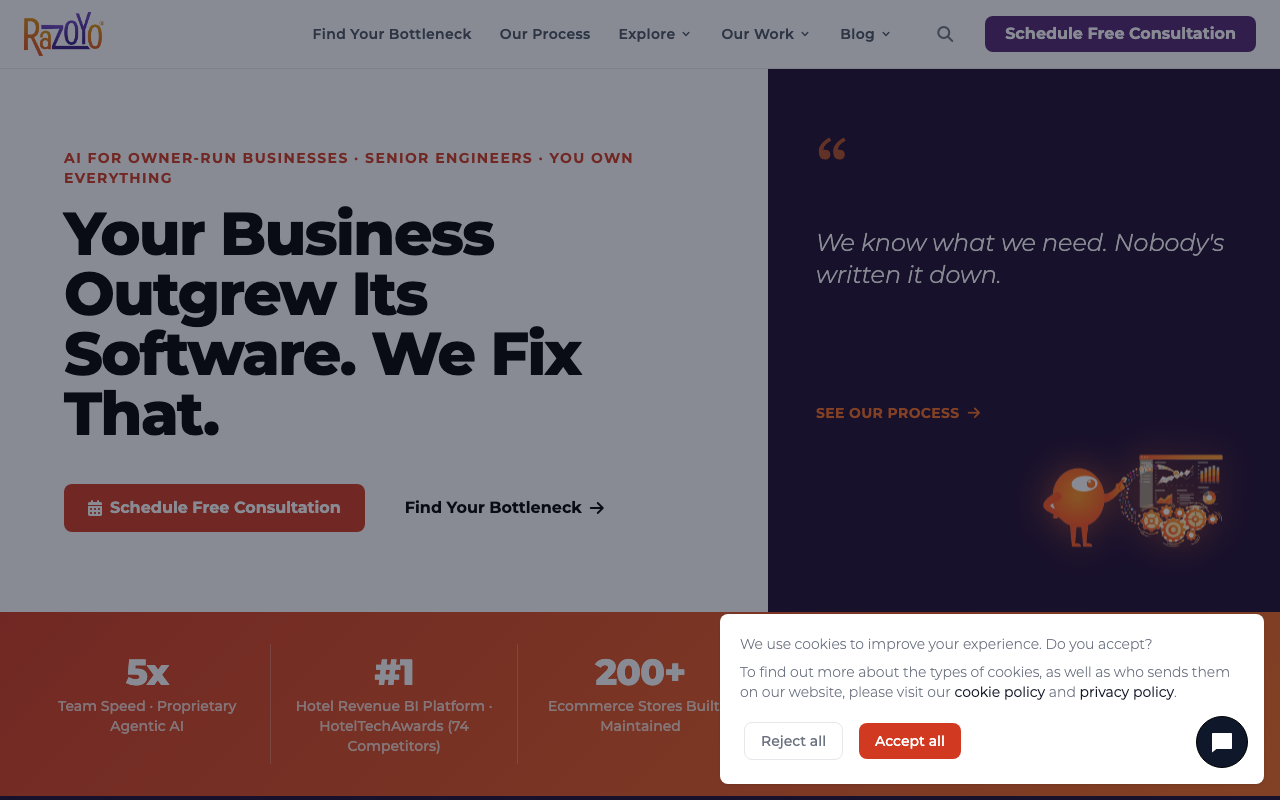
Disclosure: this is Razoyo’s blog, and we are biased.
Razoyo is a software engineering firm in The Colony, Texas, in the Dallas-Fort Worth area, serving clients US-wide since 2011. The work is taking prototypes and constrained systems into production, and then staying on them.
Toptal hands you an engineer and you decide what they build. We start by writing the product down. A System Spec is $2,500 fixed and time-boxed and produces a product brief, a PRD and a senior-engineer build estimate. You keep it whether or not you build with us. Then a $2,500 Requirements Package, a working MVP from $5,000 and production from $10,000. Above the Spec, a business analyst puts a level of effort and a budget on each piece of work and gets your confirmation first. No approval, no work. Every number is on our pricing page and our process page.
The “kept running” half is a monthly retainer from $1,500 with the same senior team. Our pricing page lists what it includes: three layers of testing on every change (code, acceptance and regression), your approval of every change on staging before it reaches production, and an emergency line with its own rate. AI agents handle triage around the clock, and a lead developer reviews every pull request before it merges. It runs month to month: thirty days’ notice to stop, fifteen to change the budget. Once fees are paid you own the code we write for you.
The proof is in how long we stay. Spider, the hotel business intelligence platform now part of Lighthouse, grew from an internal tool that emailed reports into a self-service platform used by more than 10,000 people a day, and we are still its engineering team. It ranked #1 of 74 for Business Intelligence at the 2025 HotelTechAwards. We also run Matrix, an internal hotel sales CRM we rebuilt into multi-tenant SaaS for M1 Intel. We have delivered systems for several Fortune 500 companies, always under NDA, so we name none of them.
Ideal for
Why they stand out
Razoyo publishes its whole price ladder, including support, and requires your sign-off on the cost of each piece of work before it starts. Our own pricing page says that if your project is simple and already well defined, a freelancer may be the right call, and that we will tell you so on the free call.
Pros
Cons
Verdict: pick Razoyo if nobody on your side can direct engineers and you want the same team defining, building and running the app.
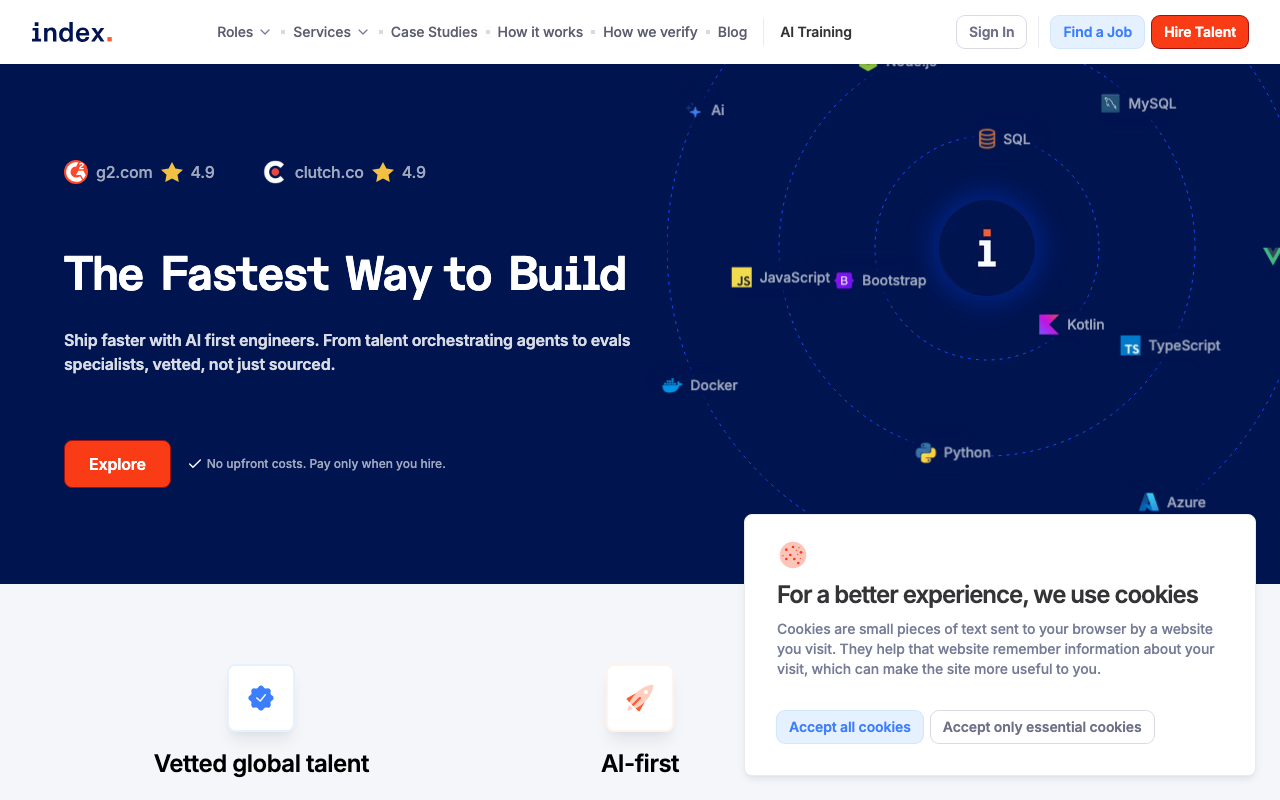
Index.dev is the closest like-for-like alternative here: a vetted talent network, with offices listed in San Francisco, London and Moldova. It says it draws on 30,000 human-interviewed engineers, with first candidates in 24 to 48 hours, and that it handles payroll and compliance in more than 160 countries.
It runs three engagement models. An individual expert joins your existing team. A larger build scales “from 5 to 50 engineers,” and Index.dev says it can build the project end-to-end or provide a dedicated unit. For AI-heavy work, it says plainly: “We don’t just supply the talent. We manage delivery.” Its five-step verification checks identity twice, at interview and again at the start of every engagement. Hiring carries no upfront cost (“Pay only when you hire”), and every engagement starts with a 30-day performance guarantee and an immediate replacement if the fit is wrong. It reports a 95% retention rate and an average engagement of 13 months.
Ideal for
Why they stand out
A 30-day guarantee runs longer than Toptal’s trial of up to two weeks, and the double identity check answers the candidate-switching risk its verification page describes.
Pros
Cons
Verdict: pick Index.dev if you have a technical lead and want a longer guarantee and a path to a whole team.
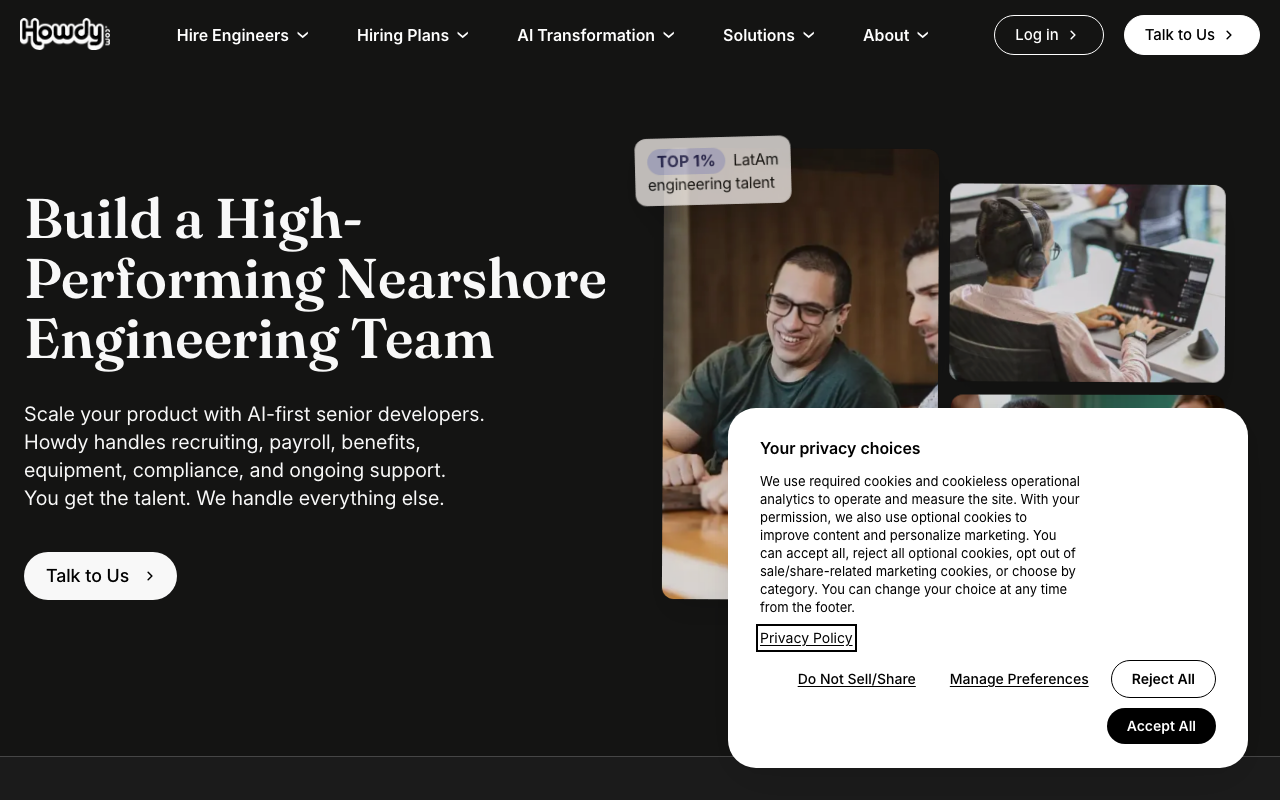
Howdy is headquartered in Austin, Texas, with an office in San Francisco, and it builds nearshore teams in Latin America, across Mexico, Colombia, Brazil, Argentina, Chile and Peru. Its homepage puts the model in one line: “You get the talent. We handle everything else.” That covers recruiting, payroll, benefits, equipment, compliance and ongoing support, and Howdy can act as Employer of Record.
Howdy says it “places professionals on a full-time basis with no end date,” and that the model is “not project-based or contract engagements.” Its recruiters are trained psychologists, fewer than 5% of candidates reach placement, and it reports 98% retention across 12,500 or more placements. Every hire is paired with a performance coach with ten or more years of engineering management experience, and has access to physical offices Howdy calls Howdy Houses. There are no startup, recruiting or cancellation fees and no long-term contract. Howdy publishes how its price splits: 85% goes toward the professional and 15% is Howdy’s fee. Recruiting typically takes four to six weeks.
Ideal for
Why they stand out
Retention is the product. A team that stays two years keeps the knowledge of your app in the building, which is the thing a rotating freelancer cannot give you.
Pros
Cons
Verdict: pick Howdy if you are building a lasting team and have someone to lead it.
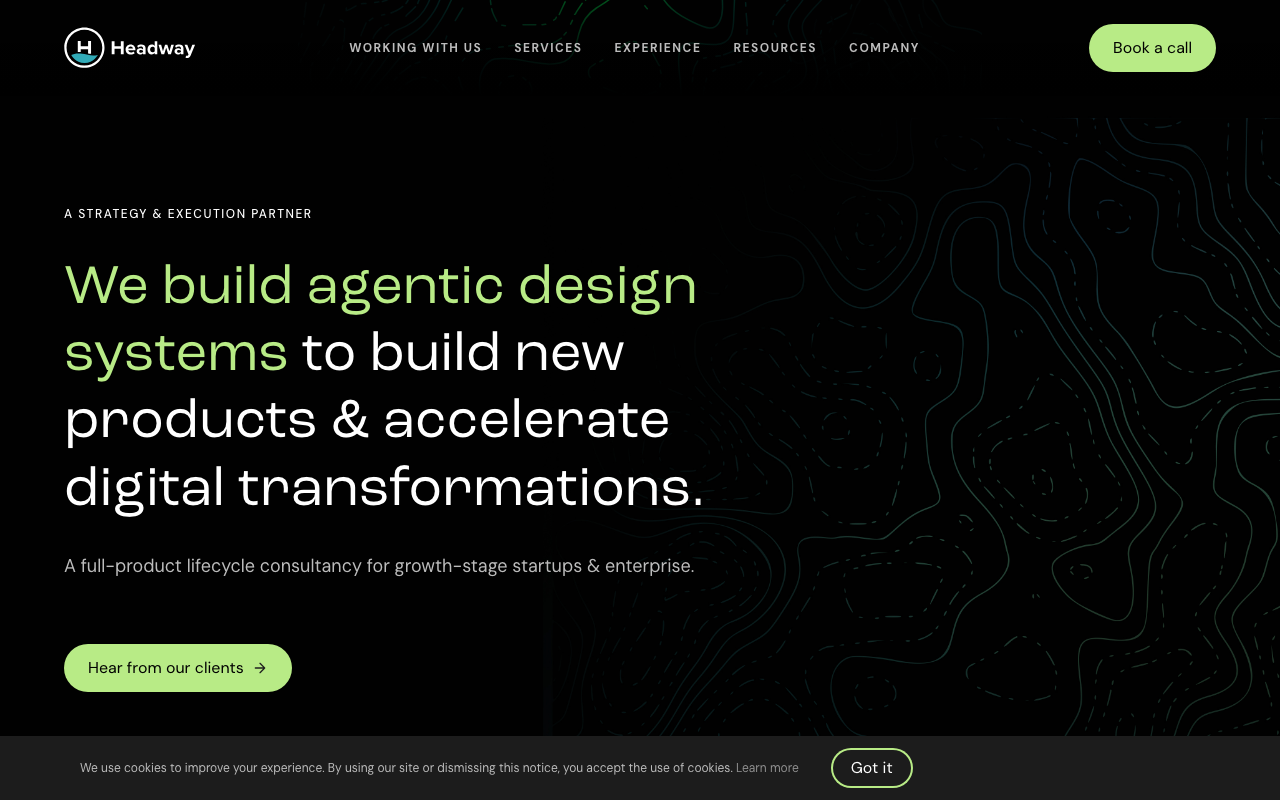
Headway is a full-cycle product studio founded in 2015 and based in Green Bay, Wisconsin. It works in four areas: design systems, digital transformation, new products and AI, for growth-stage B2B SaaS companies, mid-market teams and enterprise innovation groups. Its own line on the whole lifecycle: “A new bet needs speed and evidence. A system already in production needs consistency and maintenance.”
Strategy, design and engineering come in one crew, and its services page adds: “We can be your part-time CTO.” It lists ongoing work as well as launches, including “growing and maintaining an integrated digital mortgage platform.” Work runs in two-week sprints, and billing is synced to them: “We bill based on the number of crew that are active on the effort during the previous sprint.” It backs the work with a guarantee: within the first 45 days, invoke it and you are refunded 50% of your investment to date, and you keep everything created.
Ideal for
Why they stand out
Headway publishes how it works sprint by sprint, how it bills, and a refund guarantee in writing.
Pros
Cons
Verdict: pick Headway if you want a product studio that carries strategy and design as well as code, and you are at growth stage.
Planet Argon is a software consultancy founded in Portland, Oregon in 2002, and its focus is software that already exists. In its own words: “We help teams maintain, upgrade, and improve existing web applications.” Ruby on Rails is the specialty; it also works in Laravel, PHP, Python, JavaScript and React.
This is the option for the second half of the problem. If a freelancer built your app and is leaving, its retainer page is written for you: “Your Solo Developer Deserves Backup.” The retainer covers monitoring, security updates, bug fixes and performance work, and “more than one person knows your codebase.” It aims to respond to critical tickets within one hour during the work week. You get a weekly budget dashboard. Every new retainer starts with a 30-day trial, backed by a full refund if you are dissatisfied within 30 days. Contracts are annual with 30 days’ notice to end or adjust.
Ideal for
Why they stand out
Planet Argon publishes its response times, billing day and exit terms in its FAQ, so you know before you sign what happens when the app breaks.
Pros
Cons
Verdict: pick Planet Argon if the app is built and your risk is that nobody will be there when it breaks.
Go Fractional is a network of fractional executives, and its fractional CTO page speaks directly to the company this post is about: a founding team that is “business-side heavy” and needs “a credible technical leader to own architecture decisions, evaluate build-vs-buy tradeoffs, and speak to engineering talent and investors.”
It matches against 18,000 or more senior leaders, with pre-screened CTO candidates in as little as three days, each “pre-screened by veteran executive recruiters” on track record, technical depth, references and hands-on leadership. It reports a 98% match success rate, charges no recruiter fees, and matches replacements at no cost. It also publishes prices: a fractional CTO retainer starts at $5,000 a month, described as about 24 hours a month at a $209 average hourly rate. Interim, full-time coverage starts at $24,000 a month, and contract-to-hire lets you convert the person to a full-time hire.
Ideal for
Why they stand out
A fractional CTO fills the exact gap Toptal leaves, and Go Fractional publishes what that costs.
Pros
Cons
Verdict: pick Go Fractional if you want to keep hiring freelancers and need a senior person to make the technical calls.
Toptal is a freelance talent network: it screens engineers, matches you with one, and bills a weekly fixed price after a no-risk trial. Its published screening runs five steps, including a live screening and a test project of one to three weeks, and it reports a 98% trial-to-hire rate. It does not publish rates. It also offers consulting and says it “can also manage the project end-to-end.”
It is the right choice when you already have a technical lead who can write the tickets, review the pull requests and own the architecture, and what you lack is hands. Our roundup on taking a vibe-coded app to production says the same from the other side: with nobody on your side to judge the work, a freelancer is the riskiest route.
On Upwork you hire a person and manage the work; with an agency you hire an outcome and the agency manages the people. Per Upwork’s own page, posting a job is free, freelancers send proposals, and you pick hourly contracts or fixed-price milestones held in escrow. The client fee is 3% or 5% on the Basic plan, 8% or 10% on Business Plus.
What the marketplace does not include is anyone deciding what to build, testing it, or staying after the contract ends. Razoyo’s pricing page puts it this way: freelance listings are pricing “a single developer, no defined process for scope control.” That is a fine purchase when the scope is small and written down. It is a risky one when the scope lives in your head.
A firm that takes on the technical decisions, not just the coding. Above, Razoyo and Headway carry definition and delivery, Planet Argon carries the app once it exists, and Go Fractional supplies the person who directs a team you assemble. Toptal, Index.dev and Howdy assume someone on your side leads the engineers.
The test is one question: who writes down what gets built, and do you own that document? If the answer is “you,” you need a technical lead before you need a developer. Our page on what to hire instead of a technical cofounder walks through it, and custom systems covers what a first build usually looks like.
It takes a team that can change the app safely and recover quickly when a change goes wrong. The DORA research program measures this with five software delivery metrics, among them change fail rate and failed deployment recovery time, “the time it takes to recover from a deployment that fails and requires immediate intervention.” DORA’s research also finds that “speed and stability are not tradeoffs.”
In practice that means a staging environment, tests on every change, someone on call, and more than one person who knows the code. A single freelancer can do the first three. Nobody can do the fourth alone. If you inherited the app from a contractor who has gone, our comparison of firms that take over existing codebases is the next read.
Whoever the contract says, so get it in writing before work starts. Under US copyright law, work by an independent contractor is not automatically yours: the Copyright Office’s Circular 30 on works made for hire says a commissioned work counts as one only if it falls in one of nine listed categories and the parties sign a written agreement. Software is not among the nine, so an assignment clause carries the weight. Razoyo’s wording is that once fees are paid you own the code we write for you.
Published numbers only. Toptal bills a weekly fixed price without published rates. Upwork adds a 3% to 10% client fee. Howdy publishes its 15% fee share, Go Fractional a CTO retainer from $5,000 a month. Headway bills by active crew per sprint and Planet Argon by reserved monthly time. Razoyo’s ladder is above, and our cost breakdown for taking an AI-built prototype to production shows how it adds up. The cheaper hourly number is rarely the cheaper app: what you are pricing is who catches the mistakes, and when.
Six questions to ask any option here, Toptal included, before you sign. Our answers come from Razoyo’s published terms. Write a name next to each: every “you” is a job someone on your side must be able to do.
If you have a technical lead, Toptal plus that lead answers all six, and it may be the cheapest route. If four or more come back “you” and there is no “you,” start with someone who answers them for you.
Is Toptal a good choice for a company with no engineering team? Usually not on its own. Toptal supplies vetted engineers on hourly, part-time or full-time terms, but someone still has to decide what they build and review what they ship. Without a technical lead, pair a Toptal engineer with a fractional CTO, or hire a firm that owns the outcome.
What are the main alternatives to Toptal? Other vetted talent networks such as Index.dev, nearshore team providers such as Howdy, US product firms such as Headway and Razoyo, maintenance specialists such as Planet Argon, and fractional CTO networks such as Go Fractional. Which one fits depends on whether you lack hands, direction, or someone to keep the app running.
What is the difference between hiring a software agency and hiring a developer on Upwork? On Upwork you hire a person and manage the work yourself, on hourly or fixed-price contracts, and pay a client fee of 3% to 10% depending on your plan. An agency takes responsibility for the outcome: defining the product, testing changes and supporting the app after launch.
Who can build custom software for my business if I have no developers? A firm that takes on the technical decisions as well as the code. Razoyo starts with a fixed-price $2,500 System Spec you keep, then builds and supports the product with the same team. A fractional CTO is the other route if you would rather hire developers yourself.
How much does Toptal cost? Toptal does not publish rates. It says pricing is a fixed weekly price for hourly, part-time or full-time work, that cost depends on talent location, project size, seniority and commitment, and that each engagement starts with a trial of up to two weeks you are not billed for if you are not satisfied.
Can I combine a Toptal developer with a fractional CTO? Yes, and for a company with no engineering lead it is often the sensible pairing. The fractional CTO makes the technical calls and reviews the work; the Toptal engineer does it. Go Fractional publishes a fractional CTO retainer starting at $5,000 a month.
Who owns the code a freelancer writes for me? Whoever the written contract says. Under US copyright law, commissioned software is not automatically a work made for hire, so the contract needs an assignment clause. Razoyo’s wording is that once fees are paid you own the code we write for you.
What happens to my app after the developer leaves? That depends on who else knows the code. If the answer is nobody, plan for a handover to a team before the developer goes: a maintenance firm such as Planet Argon, or a firm like Razoyo that keeps the same senior team on the product under a monthly retainer.
If you are weighing Toptal because you have no developers, the free 30 minute consultation answers one question: do you need a firm, a freelancer plus a technical lead, or nothing yet? Our pricing page says that if a freelancer is the right call, we will tell you. Book it here: Schedule Free Consultation. Bring the six questions from the Kept-Running Check and we will answer them for your app, not in general.
Paul Byrne is President of Razoyo, a software engineering firm in The Colony, Texas taking prototypes and constrained systems into production since 2011.
These links open AI platforms with pre-written prompts about this page.
We use cookies to improve your experience. Do you accept?
To find out more about the types of cookies, as well as who sends them on our website, please visit our cookie policy and privacy policy.
