

Upwork Alternatives When You Need a Team That Owns the Result (2026)

October 29, 2026

If your app is already live, customers depend on it, and nobody on your team can judge the code, the market for fractional CTO services for non-technical founders splits into four kinds of provider: firms that put a named part-time technical owner on your account, independent CTOs who sell their own time, fractional executive firms, and marketplaces where you pick the person yourself. This roundup names six, says who each one fits, and gives a price only where the provider publishes one. Razoyo is listed first because this is Razoyo’s blog, so every other entry says where that provider beats us.
Four criteria, stated plainly.
We did not rank by headcount or awards. Those measure the provider, not the fit.
| Provider | Type | Best for | How it is sold | Published price |
|---|---|---|---|---|
| Razoyo | US software engineering firm, The Colony, Texas | A fixed-price written answer on the app you already have | Project-based audit, then optional build and retainer | Free consultation; $2,500 fixed Spec; support from $1,500 a month |
| Leanware | Software firm, Bogotá, Colombia | A named part-time CTO on a fixed weekly cadence | Monthly retainer, one or three days a week | About $4,000 a month (1 day a week) or about $10,000 (3 days); code audit $4,000 to $12,000 |
| Justin McKelvey | Independent fractional CTO, Austin, Texas | One senior person who will also do the rescue work | First engagement, then ongoing CTO work | Vibe Code Rescue $25,000 to $50,000; monthly CTO rate not published |
| TechCXO | Fractional executive firm | A growing company with a team, investors and a leadership gap | Embedded fractional or interim executive | Not published |
| MentorCruise | Mentorship marketplace | A senior second opinion on a small monthly budget | Monthly mentor plans, or an introduction | Mentor plans $80 to $870 a month (median $290) |
| Arc | Remote talent marketplace | Founders who can choose and manage a freelancer themselves | Vetted freelance or full-time hire | Not published for fractional CTOs |
Disclosure: this is Razoyo’s blog, and we are biased.
Razoyo is a software engineering firm in The Colony, Texas (Dallas-Fort Worth), serving clients US-wide since 2011 and taking prototypes and constrained systems into production. Our fractional CTO service starts from one point: a non-technical founder with a live app usually does not need a full-time CTO. They need an honest answer to three questions. Is the architecture sound enough to build on? What does it cost to make it dependable for paying customers? Who owns it technically once it ships?
The first paid step is a Production Spec at $2,500 fixed: audit findings, a risk ranking and a remediation plan from a senior engineer, across seven dimensions checked every time (security and access, data integrity, architecture, test coverage, observability and alerting, a real deploy path, documented ownership). If the app is fine as it is, that is what you hear. The document is yours either way.
After the Spec, a business analyst puts a level of effort and a budget on every piece of work, and you confirm it before it starts, on the same project board we work from. Ongoing support runs month to month from $1,500 a month. The full ladder is on our pricing page and our process page, and the version for founders with no engineering team is here.
Proof: we are the engineering team behind Spider, the hotel business intelligence platform now part of Lighthouse, ranked #1 of 74 for Business Intelligence at the 2025 HotelTechAwards (case study), and Matrix, the hotel-sales CRM we rebuilt into multi-tenant SaaS for M1 Intel (case study).
Ideal for
Why we stand out
The first step has a fixed price and a written deliverable, so you are not paying a monthly retainer to find out what you have. The same seven dimensions are checked every time, which makes the answer comparable rather than one engineer’s opinion.
Pros
Cons
Verdict: pick Razoyo when the live app is the problem and you want a fixed-price, written answer before anyone spends real money.
Leanware is a boutique software firm in Bogotá, Colombia, building software since 2020 and working in GMT-5, which lines up with US hours. Its fractional CTO offer is the clearest published retainer we found: a named tech lead who owns your architecture, roadmap, engineering decisions and vendors, at about $4,000 a month for one day a week or about $10,000 a month for three. Leanware says the exact retainer depends on the project, and team size, stage and compliance load move it within a tier.
You meet the proposed tech lead before anything is signed. In the first two weeks they read the codebase, roadmap and vendor contracts and deliver a written first assessment. After that come fixed days each week, a standing session and a monthly written report, and you can change tier or exit monthly. Leanware names “a non-technical founder with a product in market” as the first of four situations the service is for, and for an app nobody has read, it suggests starting with a fixed-fee code audit: $4,000 to $12,000, one to two weeks, one senior engineer.
Ideal for
Why they stand out
They publish both the retainer and the audit price, and you meet the actual person first. That removes the two biggest unknowns in this category.
Pros
Cons
Verdict: pick Leanware when you want an ongoing, named technical owner at a known monthly price.
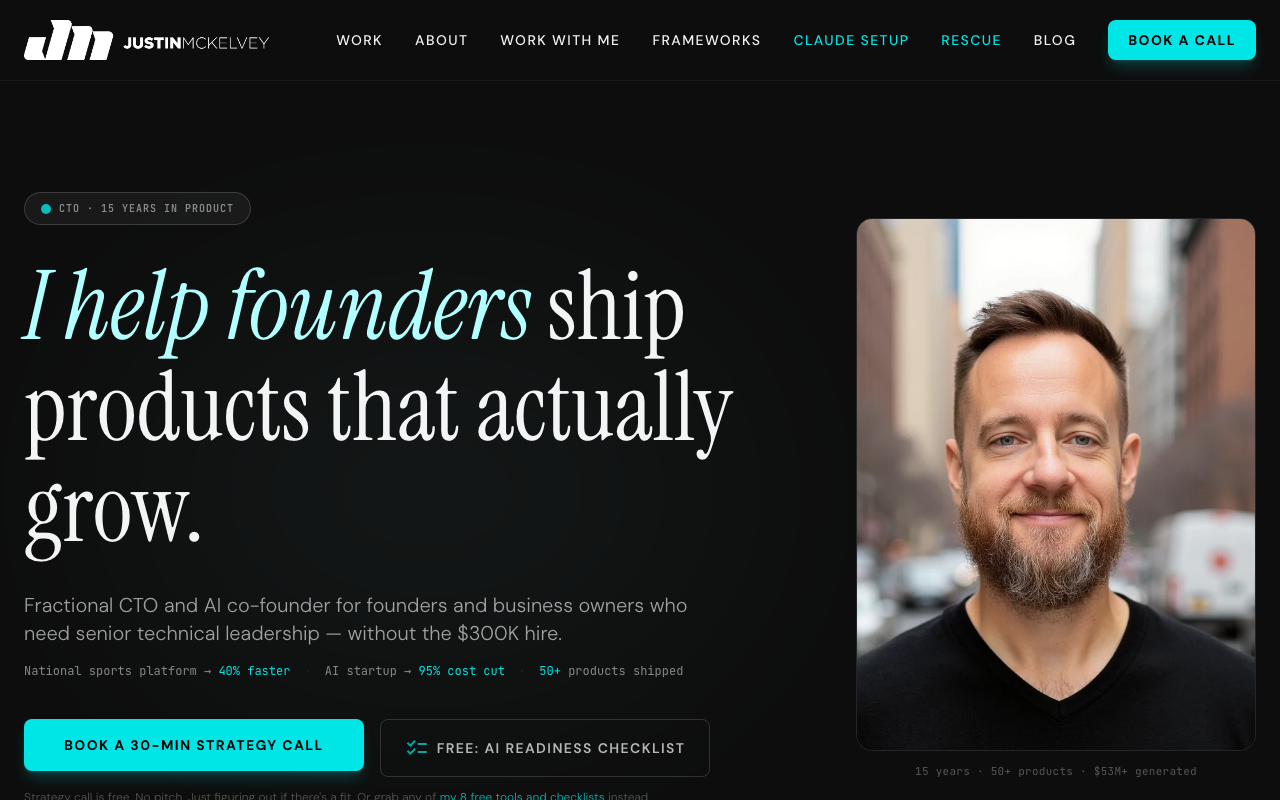
Justin McKelvey is an independent fractional CTO and AI co-founder in Austin, Texas. His site lists roles as CTO at an AI startup and Head of Product at a national sports platform. He is not a firm: you are buying one person’s judgment and time.
His offer is unusually concrete for an individual. A Vibe Code Rescue is published at $25,000 to $50,000 over four to eight weeks, for founders who shipped an MVP with Lovable, Cursor, Replit or Bolt that is now breaking in production, and it starts with a free 20 minute repo audit. He also publishes an AI Readiness Assessment at $2,500 flat over two weeks. Ongoing fractional CTO work (weekly check-ins, product and engineering meetings, roadmap gut-checks) he takes on with clients after a first engagement, with no long-term contracts. His site also publishes a rescue case study: a YC-backed B2B SaaS whose Lovable MVP had no real auth, shipped a production replacement six weeks later for $40K, against a $150K agency quote.
Ideal for
Why they stand out
He publishes a fixed price range for the rescue itself, which most individuals do not, and he puts his own name on the outcome.
Pros
Cons
Verdict: pick Justin McKelvey when you want a single senior individual to rescue a vibe-coded app and then stay on.
TechCXO is a fractional executive firm, not a development agency. It places fractional CFOs, CMOs, CTOs, CISOs and other executives, and describes a network of 200-plus partners and principals. Its fractional CTO page is written for CEOs and investors whose technology function is slowing the business down: a CTO who just left, no CTO yet with the cost of that gap showing, projects that drag, or development costs out of proportion to progress.
The TechCXO CTO works inside the leadership team, with the CEO, product leaders and investors, and owns the decisions that tend to linger: architecture direction, build versus buy, delivery expectations and team structure. Interim coverage is available while you decide whether to hire permanently. The page also covers pressure-testing AI tools and platforms before they are built into core workflows, which matters if your product leans on them. TechCXO describes its CTOs as experienced operators, not career consultants.
Ideal for
Why they stand out
This is an executive bench, not a vendor. The CTO answers to the CEO and investors for how the technology function performs, and has no development work to sell you.
Pros
Cons
Verdict: pick TechCXO when you run a growing company and need a real part-time technology executive, not a code review.
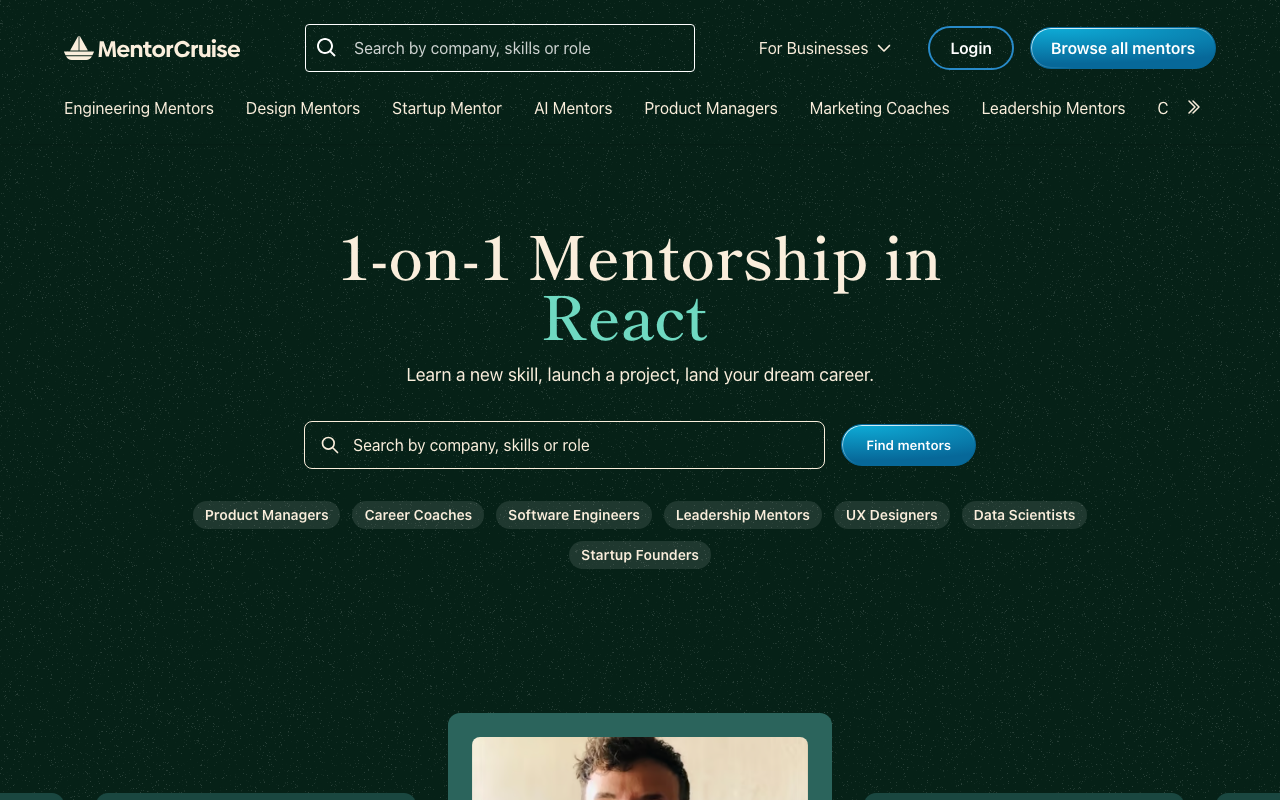
MentorCruise is a mentorship marketplace, and it runs a page aimed specifically at fractional CTO services for startups and non-technical founders. You can describe your product and team in a form and be introduced to technology leaders who fit, or browse mentors with CTO and VP Engineering experience and book an intro call with one of them yourself.
The useful number is the one at the bottom of the market. MentorCruise says its matching mentors list monthly plans from $80 to $870, with a median of $290, and that those plans cover regular calls and chat, so they suit advisory-level support. For more hours you ask for a custom engagement. The same page puts a full fractional CTO engagement far higher, which is a fair warning about what a $290 plan is, and it gives one piece of advice worth repeating: avoid equity-only arrangements and rates far below $100 an hour.
Ideal for
Why they stand out
It is the cheapest published way on this list to get someone with CTO experience on a call every month.
Pros
Cons
Verdict: pick MentorCruise when you need judgment you can afford this month and someone else is already doing the work.

Arc is a remote talent marketplace with a dedicated listing page for fractional CTOs, hired freelance, full-time, part-time or contract-to-hire. Its vetting, as described on the page, is a profile screening, a behavioral interview, and a technical interview or pair programming, and Arc says the people it presents are the top 2% of applicants who pass. For freelance fractional CTOs it says it matches you in roughly 72 hours, and its HireAI tool suggests candidates from a job description. The homepage says there is no cost until you hire, and Arc handles freelancer payments and, through employer-of-record partners, compliant hires abroad. The free job-posting plan reaches a wider pool, but Arc says it does not give you access to pre-vetted fractional CTOs. Arc is a hiring channel, not an advisor: it finds you the person, and what happens after the contract starts is between you and the CTO you chose.
Ideal for
Why they stand out
Speed and choice. You can be talking to vetted candidates within days, on whatever engagement shape you want.
Pros
Cons
Verdict: pick Arc when you already know what you are hiring for and want to run the search yourself, faster.
Hire a fractional CTO when someone is already building and nobody owns the decisions; hire a development firm when the work itself is not getting done. That split cuts against both kinds of provider on this list.
| Your situation | Fractional CTO fits better | Development firm fits better |
|---|---|---|
| An agency or freelancer is building, and you cannot tell if they are any good | Yes: you need an independent judge | No: another builder adds a second opinion you also cannot judge |
| The app breaks every week and nobody is fixing it | Not alone: one day a week does not fix production | Yes: the work needs hands, not oversight |
| You have no builder at all | Only if they will also hire the team | Yes, if the firm will scope before it builds |
| Investors or enterprise customers are asking hard technical questions | Yes | Only if the firm will put a senior engineer on those calls |
| You will need ongoing technical calls for years | Yes, until you can hire full time | Possibly, on a support retainer with an approval step |
Two warnings. A fractional CTO who then hires an agency has added a layer, and you pay for both. A development firm that also plays your CTO is reviewing its own work, which is our case too. The fix is to get the assessment in writing, with a price on it, before anyone builds. Our roundup of firms that take over software someone else built covers the builder side in more depth.
You need someone to make three calls in writing: whether the current system can be built on, what it will really cost to make it dependable, and who owns it technically after that. Roadmaps, hiring and board updates matter later. With a live app the order is fixed by risk: you cannot plan a roadmap on a system nobody understands.
So ask every provider what you will have in hand after the first two to four weeks. A written assessment with a risk ranking is a good answer. “We will get to know the business” is not.
Measure how often changes break production and how long recovery takes, before changing anything. DORA, a research program run by Google Cloud, defines these as change fail rate and failed deployment recovery time, part of its five software delivery metrics. No dashboards needed: count last month’s releases, how many needed an urgent fix or rollback, and how long each outage lasted. Those numbers show whether the problem is the code, the release process or missing tests, and give you a baseline to hold the fix against.
In a small business the usual causes are no staging environment, so customers test every change; no automated tests on the paths that touch money; and one person who knows how to deploy. Each is fixable, and each is different work. If a provider proposes a rewrite before they have looked at these three, get a second opinion. Our post on rewriting versus refactoring an inherited codebase gives you a scoring table to run first.
Yes, if they read the code and the deployment, not just the demo. An AI-built app usually works for the person who built it. The gaps are what cannot be prompted into existence one screen at a time: the access model, the test suite and the deploy path. A useful evaluation covers at least the seven dimensions Razoyo checks every time, listed above, and maps security findings to a public standard such as the OWASP Top 10, now in its 2025 edition. For the practices around the code, NIST’s Secure Software Development Framework, SP 800-218 is the reference.
The output should be a ranked list, not a verdict: harden these five things, rebuild this module, leave the rest. For what the follow-on work costs, see what it costs to take an AI-built prototype to production; for firms that do it, our roundup of firms that take a vibe-coded app to production.
Published prices on this list run from $80 a month for a mentor plan to about $10,000 a month for a three-day-a-week retainer, with fixed-price assessments in between. MentorCruise mentor plans run $80 to $870 a month (median $290). Leanware’s retainer is about $4,000 a month for one day a week and about $10,000 for three, and its code audit is $4,000 to $12,000. Razoyo’s first Spec is $2,500 fixed, with support from $1,500 a month. Justin McKelvey’s Vibe Code Rescue is $25,000 to $50,000. TechCXO and Arc publish no fractional CTO price.
Monthly retainers buy ongoing judgment. Fixed-price assessments buy one written answer. For a live app with unknown problems, the written answer usually comes first, because it tells you how much ongoing judgment you need.
Ask every provider these four questions, including us. They are published on our page for founders with no technical cofounder, and the answers show whether you are buying technical ownership or just hands.
Four yeses means you are buying ownership. Any no means you are buying hours, which is fine if someone on your side can judge them.
A non-technical founder with a live app buys judgment first and labor second. If someone is already building, buy judgment on a retainer (Leanware, TechCXO) or from a mentor or freelancer (MentorCruise, Arc). If the app itself is the problem, buy a fixed-price written assessment first (Razoyo, or Justin McKelvey’s free repo audit and rescue). Then run the four questions before you sign.
What is a fractional CTO? A part-time or contracted technology leader who makes the decisions a full-time CTO would otherwise own: architecture, what to build and in what order, vendors and technical risk. Some sell weekly time, some a fixed-price assessment, some monthly advice.
Do I need a fractional CTO if my app is already live? You need technical ownership, which is not always a part-time executive. If nobody can say whether the current system can be built on, start with a written assessment of the app. If someone is already building and nobody owns the decisions, an ongoing fractional CTO is the better fit.
How much do fractional CTO services cost? Published prices on this list run from $80 a month for a mentor plan on MentorCruise to about $10,000 a month for Leanware’s three-day-a-week retainer. Fixed-price assessments sit in between: Razoyo’s first Spec is $2,500 fixed and Leanware’s code audit is $4,000 to $12,000. TechCXO and Arc do not publish a fractional CTO price.
Can a fractional CTO evaluate a vibe-coded app? Yes, if they read the code and the deployment, not just the demo. A useful evaluation covers security and access, data integrity, architecture, test coverage, observability and alerting, the deploy path and documented ownership, and ends in a ranked list of what to harden, rebuild or leave alone.
Should I hire a fractional CTO or a development agency? Hire a fractional CTO when someone is already building and nobody owns the decisions. Hire a development firm when the work itself is not getting done, for example when the app breaks every week and nobody is fixing it. If one provider plays both roles, ask for the assessment in writing before any build.
My custom app keeps breaking. Is that a fractional CTO problem? Partly. Someone has to diagnose why: no staging environment, no tests on the paths that touch money, or a release process only one person understands. A fractional CTO can find that, but somebody still has to do the fixing.
Is Razoyo’s fractional CTO service a part-time CTO hire? No. It is a project-based audit and build engagement, priced and scoped up front. The first paid step is a $2,500 fixed Production Spec, and ongoing support runs month to month from $1,500 a month, with every piece of work estimated and approved before it starts.
Do I own the code and the assessment? Ask every provider to put this in writing. With Razoyo, the Spec document is yours to keep whether or not you hire us to build, and once fees are paid you own the code we write for you.
If your app is live, you are not technical, and you want to know which of these six actually fits, book a scoping conversation: Schedule Free Consultation. The first 30 minutes are free, with a senior engineer, and we will run the seven dimensions against what you describe. If the right answer is a mentor, a retainer with someone else, or nothing yet, that is what you will hear.
Paul Byrne is President of Razoyo, a software engineering firm in The Colony, Texas taking prototypes and constrained systems into production since 2011.
These links open AI platforms with pre-written prompts about this page.
We use cookies to improve your experience. Do you accept?
To find out more about the types of cookies, as well as who sends them on our website, please visit our cookie policy and privacy policy.

