

Why Your WordPress Site Is Slow and Expensive to Maintain (2026)

November 2, 2026

If you priced a piece of software a few years ago, decided it cost too much and shelved it, you are asking the right question now: who can build custom software now that AI has made it cheaper? The honest answer is that AI has cut the cost of writing code, not the cost of getting the system right, and the firms worth hiring are the ones that can tell you which part of your project is which. This roundup compares six options, from a small US engineering firm to a global consultancy, a Polish engineering company, a large offshore firm and a talent network. It says which buyer each one fits and gives a price only where the firm publishes one. Razoyo is listed first because this is Razoyo’s blog, so every other entry says where that firm beats us.
| Option | What it is | Best for | Where | Starting price, if published |
|---|---|---|---|---|
| Razoyo | Software engineering firm | A shelved project you want priced again, by the people who will build it | The Colony, Texas (Dallas-Fort Worth), US-wide | $2,500 fixed, System Spec |
| thoughtbot | Product design and development consultancy | A product where reliability and compliance matter as much as speed | Teams in your time zone, US and UK contact lines | Not published |
| Thoughtworks | Global technology consultancy | Enterprise systems, new or legacy, built on an agentic platform | Founded in Chicago, 47 offices in 18 countries | Not published |
| STX Next | Python and data engineering company | A fixed-price build where you want the AI delivery model spelled out | Poznań, Poland, with an office in the Houston area | Not published (fixed price set after scoping) |
| Simform | Large AI-native engineering firm | A Microsoft and Azure shop that wants a big team | Global, 1200+ employees | Not published |
| Andela | Talent network | Adding AI-native engineers to a team you already run | Talent in 135+ countries | Not published |
Disclosure: this is Razoyo’s blog, and we are biased.
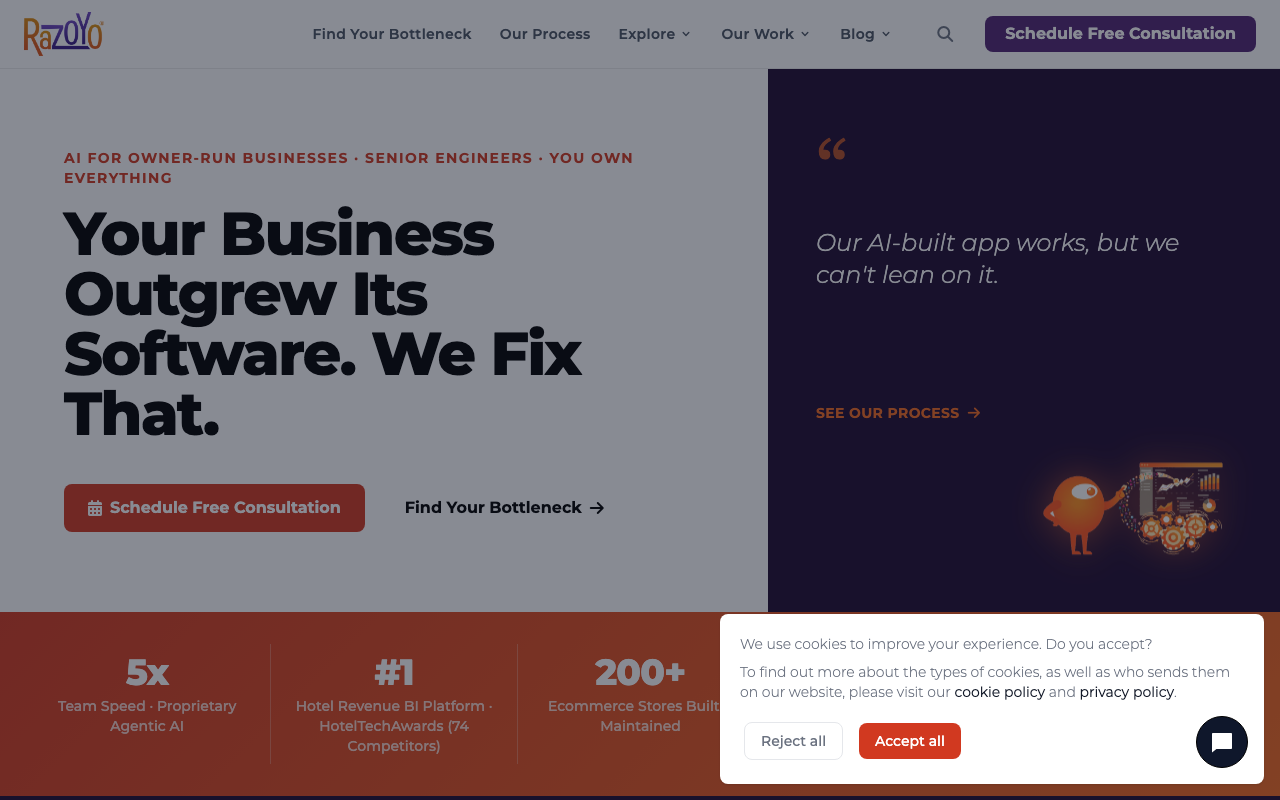
Razoyo is a software engineering firm in The Colony, Texas (Dallas-Fort Worth), serving clients US-wide since 2011. We take prototypes and constrained systems into production. The page that matches this question is our Now-Economical Systems page, which starts from the list most owners have: the customer portal, the ops dashboard, the quoting tool, the data platform that would make two systems talk, each one priced out once and dropped.
We use agentic AI in how we build, and we say where it helps and where it does not. Our homepage puts our team speed at 5x, from our own agentic AI tooling. Every dev burst includes that tooling, AI agents handle triage and routine tasks around the clock on support, and every pull request is reviewed by a lead developer before it merges. Our own page puts the limit plainly: AI compresses scaffolding, glue code and first-pass screens, and it does not compress domain modeling, security and data correctness, or ownership you can maintain and hand off. That second half is where the fee goes.
The proof that a shelved internal tool can become a real system is Spider. We took it from an internal tool that emailed reports to hotel revenue managers into a self-service platform used by more than 10,000 people a day, with hosting costs down about 90%. Spider, the hotel business intelligence platform now part of Lighthouse, ranked #1 of 74 for Business Intelligence at the 2025 HotelTechAwards, and we are still its engineering team. We have also delivered systems for several Fortune 500 companies, always under NDA, so we name none of them.
Every price is on our pricing page: a free 30 minute consultation, a $2,500 fixed System Spec, an MVP from $5,000, a production build from $10,000, support from $1,500 a month, and dev bursts at $1,200 a day or $4,500 a week. Before any work above the Spec, a business analyst puts a level of effort and a budget on each piece and gets your confirmation first. No approval, no work.
Ideal for
Why they stand out
Razoyo prices finding out, not building. The $2,500 System Spec returns a product brief, a PRD, a senior-engineer build estimate and a recommendation that can be “don’t build this”, and the document is yours either way.
Pros
Cons
Verdict: pick Razoyo when you have a shelved system in mind and want it priced again, with a build or don’t-build answer in writing, for a fixed $2,500.
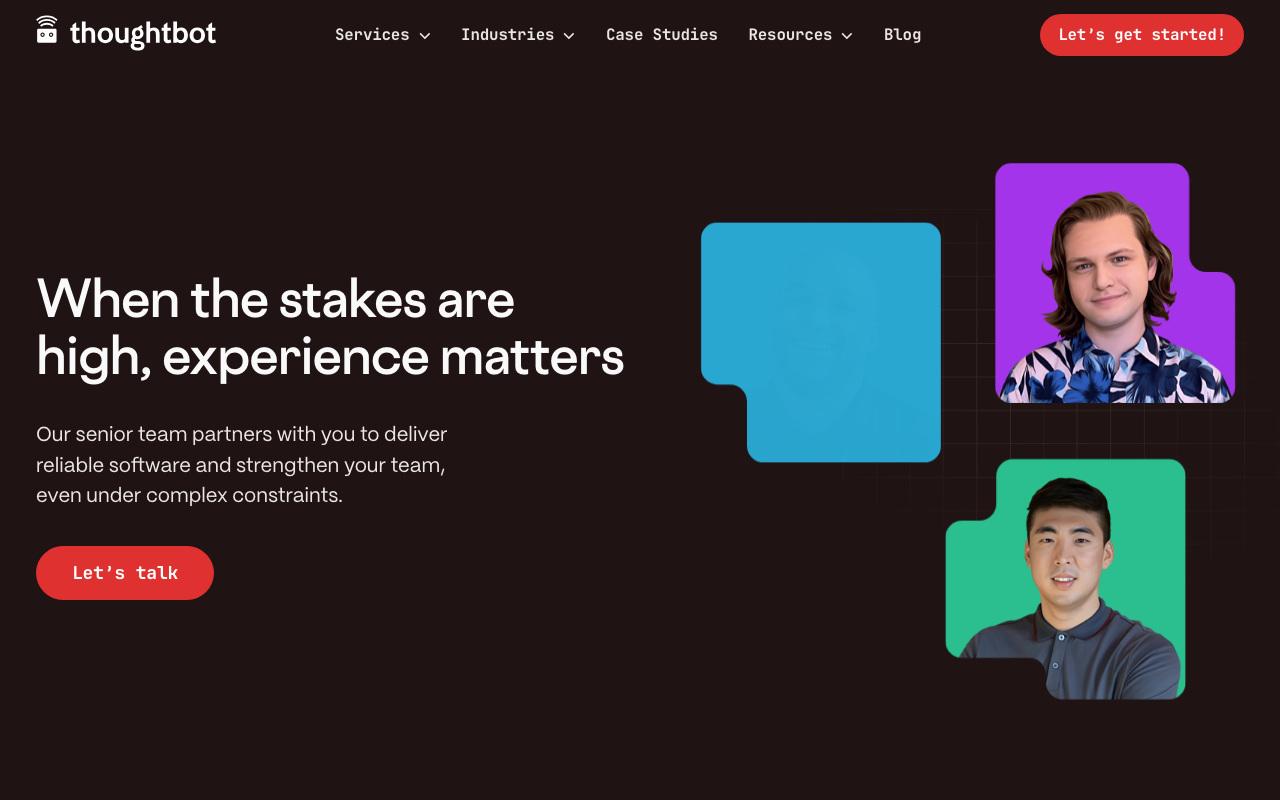
thoughtbot is a product design and development consultancy that works in small teams of designers and developers alongside its clients. Its homepage says it specializes “in building and modernizing software where reliability, compliance, and long-term maintainability matter as much as speed”, and it lists healthcare, finance and insurance as its industries. Ruby on Rails sits at the top of its development services.
On AI, it does two things. It builds AI features and products, helping teams “move from AI strategy and experimentation to production-ready products, features, and workflows.” And it has built its own AI tool, ReadySetGo, which it describes as “an AI product consultant built by our team” to help people pressure-test an idea and decide what to build. Its featured case study, CloseKnit Health, quotes the client’s product manager on “eight to ten times improvement in our release speed over a year.”
Its Playbook and Handbook document how it builds products and runs the company. No price is published.
Ideal for
Why they stand out
It puts reliability and maintainability next to speed on its homepage, which is the right instinct when AI makes code cheap to write, and it publishes its playbook.
Pros
Cons
Verdict: pick thoughtbot when your product sits in a regulated industry and you want a design-and-development team that treats reliability as the main requirement.
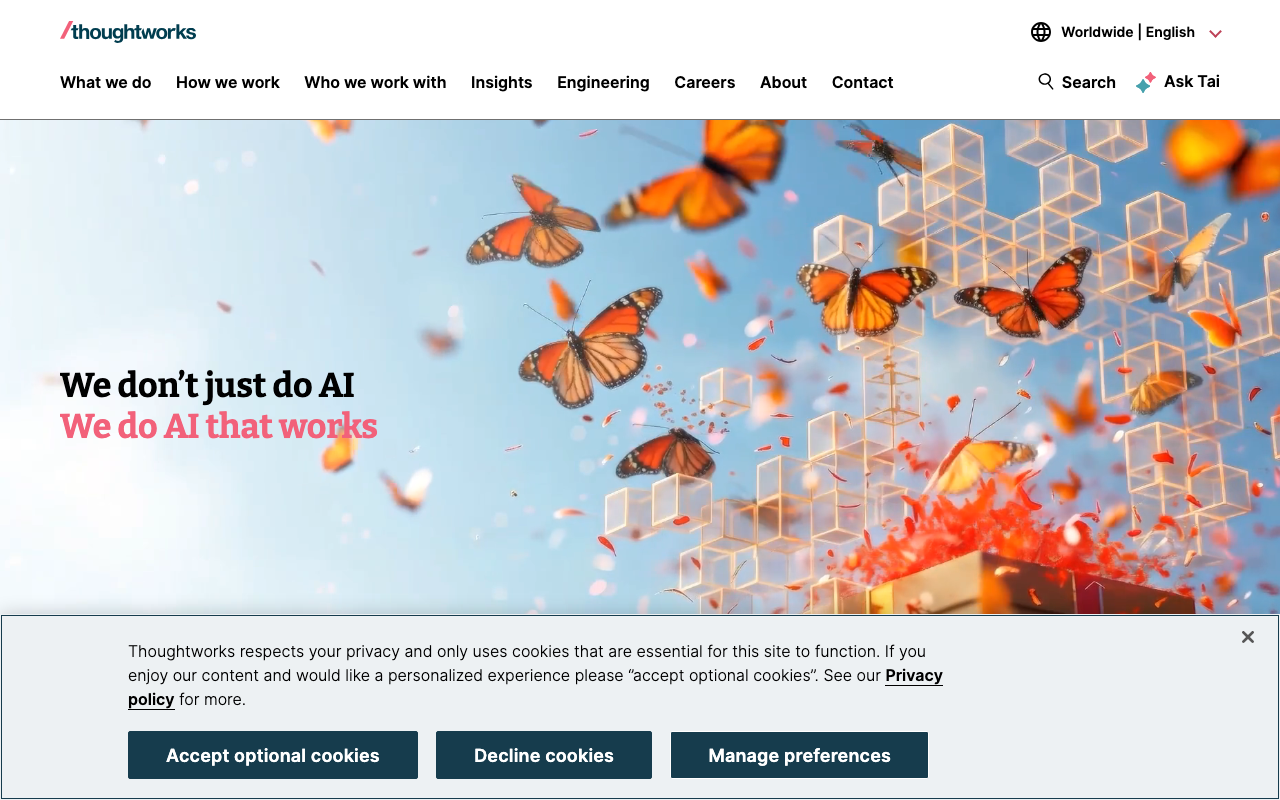
Thoughtworks is a global technology consultancy, founded in Chicago in 1993, with more than 10,000 people and 47 offices in 18 countries. Its current pitch is exactly this roundup’s question. Its homepage says its agentic development platform, AI/works, “changes the economics of building and modernizing industrial-grade systems” and delivers higher quality systems “at radically lower cost.”
It publishes a delivery rhythm to go with it, the 3/3/3 method: three days to align stakeholders on the product concept, three weeks to build a prototype that confirms feasibility, and three months to ship an industrial-grade MVP into production. Its AI/works page lists client results such as 80% faster legacy code analysis for a major retailer’s mainframe systems, and turning 15 million lines of old code into a map of an automotive manufacturer’s sales system so it could be rebuilt.
That is a different scale of work from most of this list. No price is published.
Ideal for
Why they stand out
It has turned AI-assisted delivery into a named platform with a published timeline, and it has the scale to run it across a whole enterprise.
Pros
Cons
Verdict: pick Thoughtworks for an enterprise system or a modernization program that needs scale, governance and a named AI delivery platform.
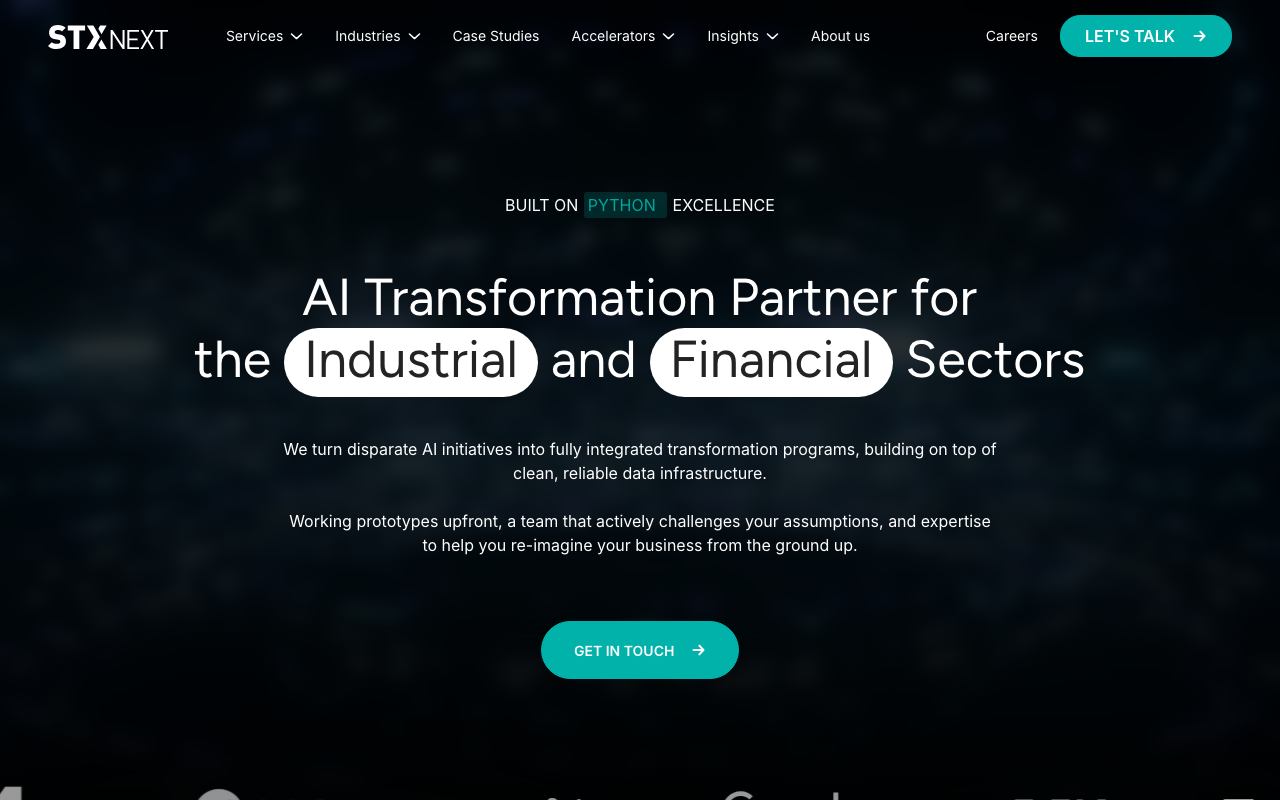
STX Next is a Python, data and AI engineering company, founded in 2005 and headquartered in Poznań, Poland, with more than 450 specialists, 1,000+ projects delivered and offices including one in the Houston area. It serves Europe and North America, with a focus on industrial and financial companies.
It publishes the most specific answer on this list to “how much cheaper?” Its AI-native SDLC page sets out four delivery tiers, from a classic team of six to eight people with no AI execution, through an AI-augmented pod of three to five people (modeled 30% cost reduction) where “an engineer reviews and approves every stage”, to an agentic pod of one to two people (modeled 60% cost reduction) where agents build against a plan approved up front. It labels these “Modeled estimates from STX Next’s delivery simulator”, and says your fixed-price quote is set per project after scoping.
It also says that “in over 70% of our discoveries, we convert briefs into custom prototypes that prove operational value on real data,” and offers a three-week AI readiness audit for companies that want to change how their own teams build. No price is published.
Ideal for
Why they stand out
It is the only option here that publishes a tiered model of what AI does to team size and cost, and it is honest that the numbers are modeled, not promised.
Pros
Cons
Verdict: pick STX Next when you want a fixed-price build and a clear, written model of how AI changes the team and the cost.
Simform describes itself as an AI-native engineering firm for digital products and enterprise systems. It was founded in 2010 and lists 1200+ employees and 350+ platform certified engineers on its about page. It is a Microsoft Solutions Partner and an Azure Expert MSP.
Its AI offer is aimed at changing how software gets built across an engineering organization. Its Agentic SDLC Advisory service sets out a phased adoption plan with entry and exit criteria for each stage of delivery, a strategy for consolidating AI coding tools with their license and cost implications, and a governance framework so agents stay “auditable, observable, and safe to expand as their scope grows.” No price is published.
Ideal for
Why they stand out
It combines a large engineering bench with deep Microsoft credentials and a structured plan for adopting AI agents across the whole delivery process.
Pros
Cons
Verdict: pick Simform when you run on Microsoft and Azure and want a large, AI-native team with a structured way to bring agents into delivery.
Andela is not a development agency. It is a talent network, founded in May 2014, when it hired its first six engineers in Lagos, with talent now in more than 135 countries. Today it describes itself as “the human layer powering production AI”: it trains AI systems, deploys AI-native engineers into client teams and runs AI training for in-house engineers.
For this question, the relevant offer is its AI engineers. It describes “AI-native engineers, ready to deploy in production”, released in quarterly cohorts that are trained and assessed, and embedded directly into your team. Its contact form offers staff augmentation, an end-to-end managed build, or training for your own team. That makes it the right option when you already have someone technical to lead the work and want more hands who already build with AI, rather than handing the whole project to a firm.
No price is published.
Ideal for
Why they stand out
It is the one option here that adds AI-native engineers to your team instead of taking the project off your hands, and it can also train the team you already have.
Pros
Cons
Verdict: pick Andela when you have a technical lead and want AI-native engineers working inside your own team.
Yes, for part of the work. AI writes first drafts of code quickly, so the hours that used to go into scaffolding, boilerplate, integration glue and first-pass screens have shrunk. In a controlled experiment with GitHub Copilot, developers with the AI assistant completed a small coding task “55.8% faster than the control group” (Peng et al., 2023).
The other part did not shrink. In a randomized trial with experienced open-source developers working on large, mature projects they knew well, allowing AI tools “actually increases completion time by 19%” (Becker et al., METR, 2025). The developers themselves believed AI had made them about 20% faster.
Both results are true at once. AI is fast on new, well-bounded code and much less helpful on the parts of a real system that depend on knowing how the business works, how the data must behave and what already exists. That is why our Now-Economical Systems page puts it this way: AI compressed the cost of building, not the cost of getting it right. The same gap is why apps built mostly with AI tools need work before real users rely on them; what it costs to take an AI-built prototype to production puts numbers on it, and our roundup of firms that take a vibe-coded app to production compares who does it.
| Part of the project | Does AI make it cheaper? | Why |
|---|---|---|
| Scaffolding and boilerplate | Yes, a lot | Repetitive code AI writes well |
| Integration and glue code | Yes | Well-documented APIs, clear inputs and outputs |
| First-pass screens | Yes | Fast drafts to react to |
| How your business actually works | Barely | Someone has to ask the questions and decide |
| Security and data correctness | No | Every shortcut here shows up in production |
| Code your next team can maintain | No | Review, tests and documentation still take people |
Because the expensive half of a project is the half AI does not compress. A quote that is mostly scaffolding should have dropped sharply; one that is mostly business rules, data and messy existing systems will have dropped less.
There is also a comparison most buyers skip. The build is not competing with zero. It is competing with what the missing system costs you every month: hours spent doing by hand what software would do once, the errors that process makes, the revenue it delays and the license fees for tools that only half fit. Add those up before deciding a build is too expensive.
And if you are weighing an off-the-shelf automation or reporting tool against a build, price both. Agentic coding tools now often let a small custom build do as well as or better than those tools, so the old assumption that the tool always wins on cost no longer holds by default. Our roundup on replacing a business-critical spreadsheet covers that choice.
Ask it to show you where AI changes the number. A firm that uses AI in delivery should be able to answer four questions plainly:
If you want the questions that catch a padded quote, our guide on how to tell if a software agency is padding the scope goes line by line.
Run this on the project you shelved before you call anyone, including us. It is built from the method on our Now-Economical Systems page, and it takes about an hour.
| What step 2 and 3 show | What it usually means |
|---|---|
| Status quo costs more per year than the old quote | It was probably worth building then, and it certainly is now |
| Mostly scaffolding and screens | The price should have dropped a lot; get new quotes |
| Mostly business rules and data | AI helps less; the Spec matters more than the hourly rate |
| A tool already does 90% of it | Price the tool against a small build before deciding |
Call the option that matches what you are building and who will run it. An enterprise system or a modernization program: Thoughtworks. A product in a regulated industry where reliability comes first: thoughtbot. A fixed-price build with the AI delivery model written down: STX Next. A big Microsoft and Azure program: Simform. More AI-native engineers for a team you already lead: Andela. A system you shelved once and want priced again by the small senior team that would build it: we do that for a fixed $2,500, and if the answer is “do not build it,” that is what you will hear. Every step and price is on our process page, and what you keep is set out on what happens to your software if you stop working with us.
Yes, for part of the work. AI makes scaffolding, boilerplate, integration code and first-pass screens much faster to write. It does much less for business rules, security, data correctness and maintainable code, which is often the larger part of a real system, so total prices have dropped less than the hype suggests.
It depends on the project. STX Next publishes modeled cost reductions of 30% for an AI-augmented team and 60% for an agentic team, as estimates rather than promises. Projects that are mostly new, well-bounded code save the most; projects that are mostly business rules and data save the least.
Options include small engineering firms like Razoyo, product consultancies like thoughtbot, global consultancies like Thoughtworks, European engineering companies like STX Next, large firms like Simform and talent networks like Andela. Pick by project size, who will lead the work and whether the firm shows where AI changes your price.
For a prototype, yes. For a system your business depends on, only with experienced engineers reviewing the work. Research with experienced developers found AI tools made them 19% slower on mature projects, and AI-written code still needs review for security, data correctness and maintainability.
Build a prototype yourself if you can, because it is a cheap way to learn what you need. Bring in engineers before the prototype becomes the system your business relies on, because authentication, data integrity, monitoring and deployment are where self-built apps usually fail.
Ask which parts of your project AI speeds up, what a person still reviews, whether the saving shows up in a published or fixed price, and what you own at the end. A firm that cannot name parts of your project is selling AI in general.
Razoyo starts with a free 30 minute consultation and a $2,500 fixed System Spec. After that, an MVP starts at $5,000, a production build at $10,000 and support at $1,500 a month. Before any work above the Spec, each piece is estimated and approved by you first.
Often, and it is worth checking. Agentic coding tools now often let a small custom build match or beat an off-the-shelf automation or reporting tool, so price both. Add the tool’s yearly license cost and the work it still leaves to people, then compare it with a scoped estimate for the build.
If you have a project you shelved as too expensive, that is a free 30 minute conversation. Bring the old quote and a rough idea of what the manual version costs you each month. We will tell you which parts AI now makes cheaper, which it does not, whether it is worth a $2,500 System Spec, and if it is not worth building, we will say so. Schedule Free Consultation.
Paul Byrne is President of Razoyo, a software engineering firm in The Colony, Texas taking prototypes and constrained systems into production since 2011.
These links open AI platforms with pre-written prompts about this page.
We use cookies to improve your experience. Do you accept?
To find out more about the types of cookies, as well as who sends them on our website, please visit our cookie policy and privacy policy.

