


Technical Due Diligence for AI-Built Software: Who to Hire Before You Buy or Invest (2026)

October 17, 2026

If you built an app with Lovable and real people are about to use it, the firms that make a Lovable app production ready fall into four groups: engineering firms that start with a written assessment, studios that specialize in Lovable and Supabase, small fixed-fee rescue shops, and freelance networks. This roundup names six that say on their own websites, today, that they do this exact work. It covers what actually breaks in a Lovable and Supabase app, gives a starting price only where the firm publishes one, and ends with a five-gate check you can run yourself before you call anybody. Razoyo is listed first because this is Razoyo’s blog, so every other entry says where that firm beats us.
Four rules, the same ones we used in our roundup of firms that take a vibe-coded app to production.
| Firm | Best for | Where they work | Lovable or Supabase offer | Starting price, if published |
|---|---|---|---|---|
| Razoyo | A fixed-price written spec before anyone touches the code | The Colony, Texas (Dallas-Fort Worth), US-wide | Production Spec for Lovable, Replit, Bolt, v0 and other AI-built apps | $2,500, Production Spec, fixed |
| VeryCreatives | A non-technical founder who wants SEO and speed fixed too | Budapest, Hungary | Lovable to Production hardening sprint | $5,000 to $15,000 sprint, free 30-minute code review |
| The Swarm | European founders who want someone else to run it under an SLA | Vienna, Austria | Lovable App Rescue and Supabase RLS Audit | €1,500 audit, from €4,500 go-live, from €290 a month SLA |
| Hubql | A Supabase specialist audit plus a fractional CTO | Bangkok, Thailand | Lovable to Production audit and hardening sprint | Lovable audit not published; advisor from $1,500 a month |
| Afterbuild Labs | The smallest possible first spend, or one bug fixed fast | Not stated on its site | Lovable rescue, fixed-fee tiers | $49 async audit; $499 security audit |
| Toptal | Teams with a technical lead who need one vetted Lovable engineer | Remote freelance network | Hire Lovable developers page | Not published |
Disclosure: this is Razoyo’s blog, Razoyo wrote this page, and we are biased.
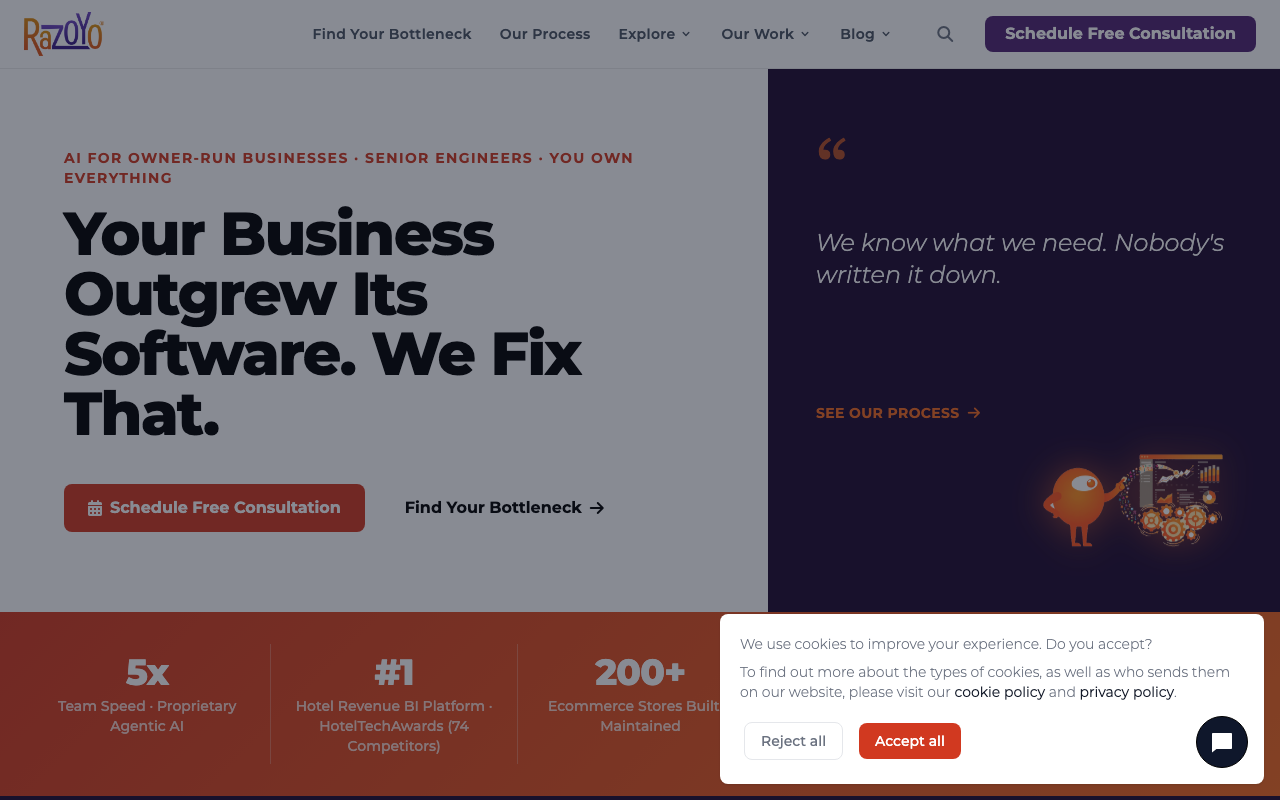
Razoyo is a software engineering firm in The Colony, Texas (Dallas-Fort Worth), taking prototypes and constrained systems into production for clients US-wide since 2011. Our prototype to production page names Lovable directly, alongside Replit and Bolt.new.
We start with a written answer, not a build quote. The Production Spec is $2,500 fixed and answers one question: is this buildable and safe as it stands, and what will it really take to get it there. You get findings, a risk ranking, a remediation plan and a build estimate, and the Spec is yours even if you never hire us. Published timing: “typically weeks, not months.”
After the Spec, our pricing page lists a production build from $10,000 and support from $1,500 a month. Above the Spec, a business analyst puts a level of effort and a budget on each piece of work and gets your confirmation first. No approval, no work. On ownership: once fees are paid you own the code we write for you.
The closest proof is a marketplace Production Spec: a vacation-rental startup wanted a marketplace built, we ran the $2,500 Spec instead, and six weeks later they had a PRD and a working prototype of the host side, with $2,500 the most they ever had at risk. At scale, Spider, the hotel business intelligence platform now part of Lighthouse, grew from an internal tool to more than 10,000 daily users, and we are still its engineering team.
Ideal for
Why they stand out
Razoyo publishes its whole price ladder, which almost nobody in this category does. The first paid step is a document you own, so the worst case is that you paid $2,500 to learn the real size of the job.
Pros
Cons
Verdict: pick Razoyo when you want to know the real size of the job, in writing, before you commit to fixing it.
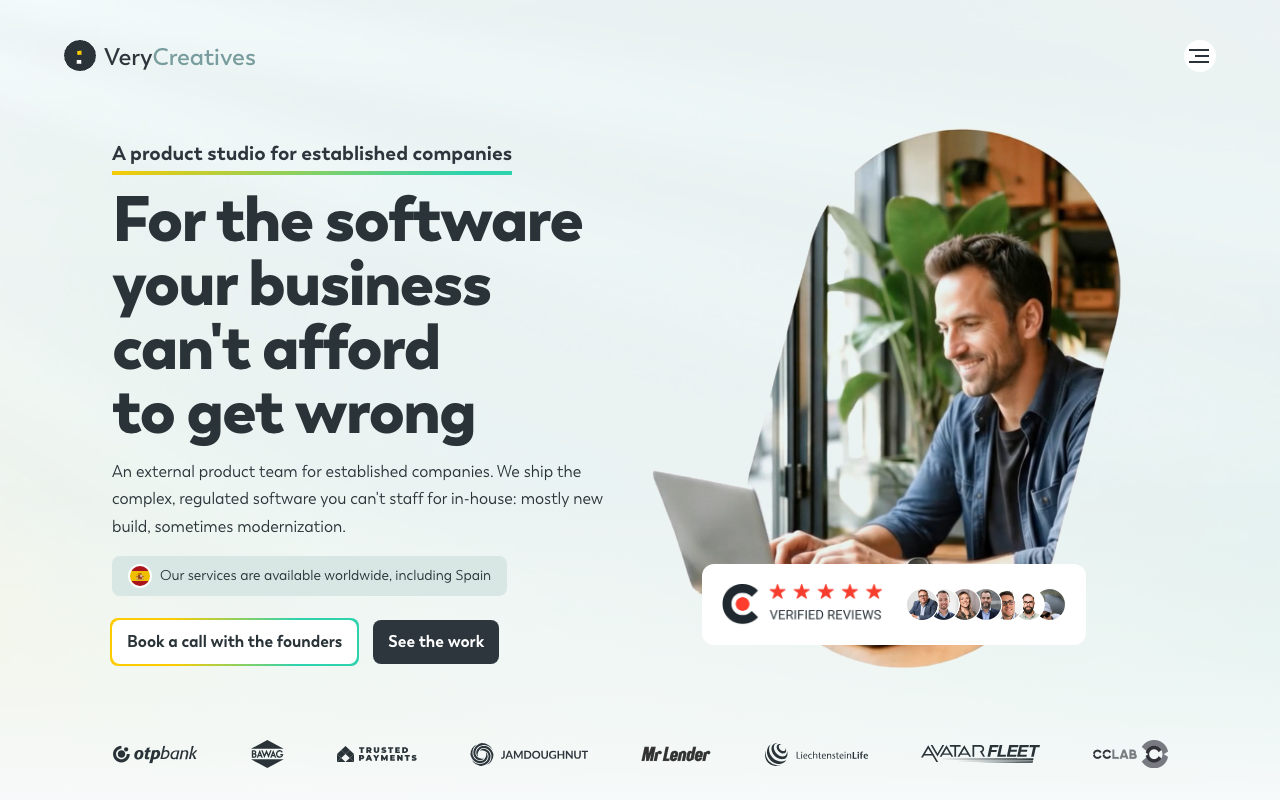
VeryCreatives is a product studio in Budapest that says it has built software since 2013 and shipped more than 80 products. Its Lovable to Production page is one of the most specific in this category. It describes what Lovable generates (a React and Vite frontend on a Supabase backend) and lists five fixes in order: Supabase security and Row Level Security first, then restructuring the GitHub export, then SEO and rendering, then performance, then tests, CI/CD and handover.
The SEO point is worth reading even if you never hire them. A Lovable app renders as an empty shell that fills in with JavaScript, so search crawlers can see a blank page. VeryCreatives adds server-side rendering or pre-rendering so search engines and social previews see your content.
They publish a number: a typical hardening sprint takes 2 to 4 weeks and runs from $5,000 to $15,000, scoped after a free 30-minute code review, with a fixed price and timeline confirmed before work starts. They also say they work with about 12 founders a year, and that the founders, Máté and Ferenc, take the first call.
Ideal for
Why they stand out
They publish both a price range and a timeline for the Lovable sprint itself, and they say plainly who they are not for: anyone who needs it done in under a week, or wants a takeover with no code review first.
Pros
Cons
Verdict: pick VeryCreatives when your Lovable app has to be found in search as well as be safe.
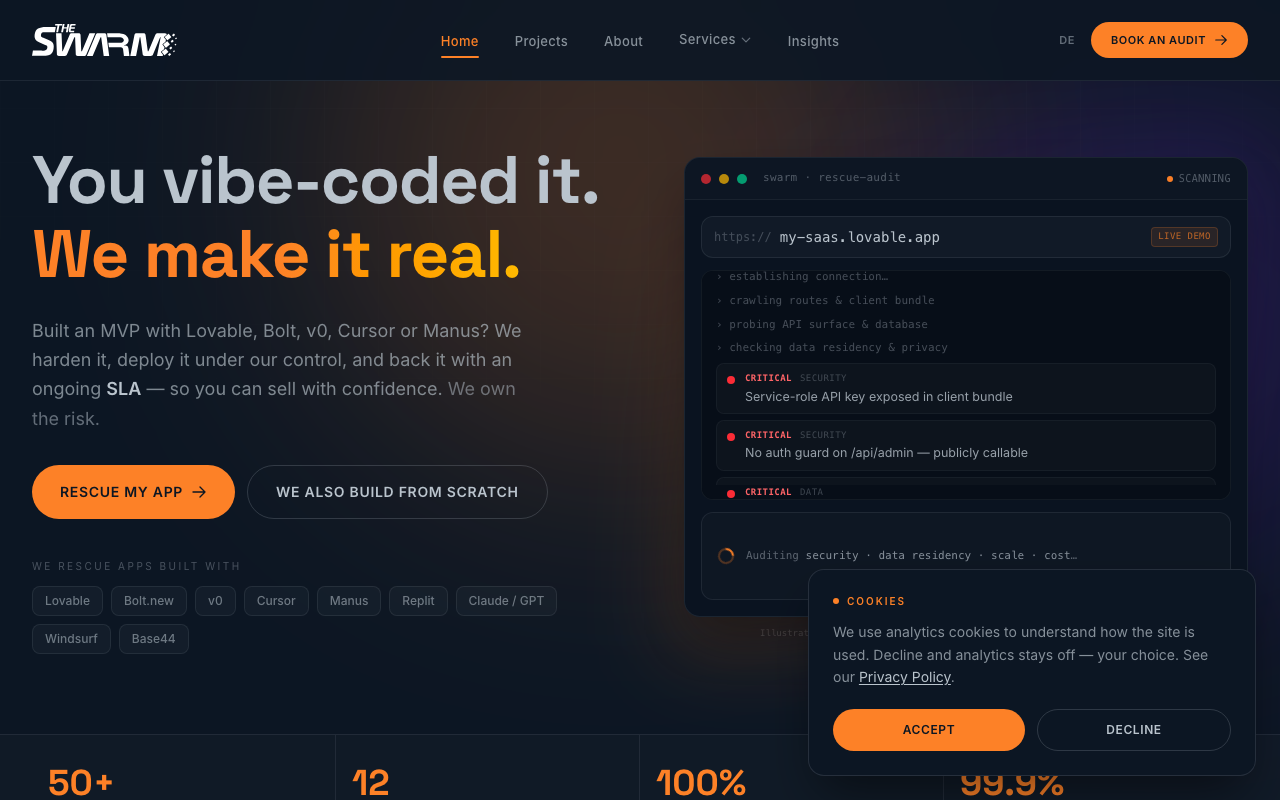
The Swarm is a Vienna-based GmbH whose flagship is Vibe-Code Rescue, with a Lovable App Rescue service and a separate Supabase RLS Audit. Its pitch is accountability after launch: it hardens the app, hosts it on infrastructure it operates, and keeps it running under a contractual SLA. It describes itself as deliberately small, senior and European, with more than twenty years of engineering.
The Lovable rescue page lists exactly what a Lovable and Supabase app tends to get wrong: Row Level Security off or full of holes, an anon key that can write, API keys pasted into client code, no staging, no backups and no error tracking. It adds one thing nobody else here leads with: GDPR groundwork, including EU hosting and processing records.
Pricing is published in three steps. A Production Readiness Audit is €1,500 fixed, about a week from repo access, with a written report rating every finding by severity, and the fee counts toward go-live if you proceed. Hardening and go-live starts from €4,500, typically two to four weeks after the audit. Managed operation under an SLA starts from €290 a month.
Ideal for
Why they stand out
Most firms here hand the app back. The Swarm’s model is to keep it, host it and carry the operational risk under a written SLA, which is a different purchase from a one-time fix.
Pros
Cons
Verdict: pick The Swarm when you are in Europe and want one company accountable for the live app, not just the fix.
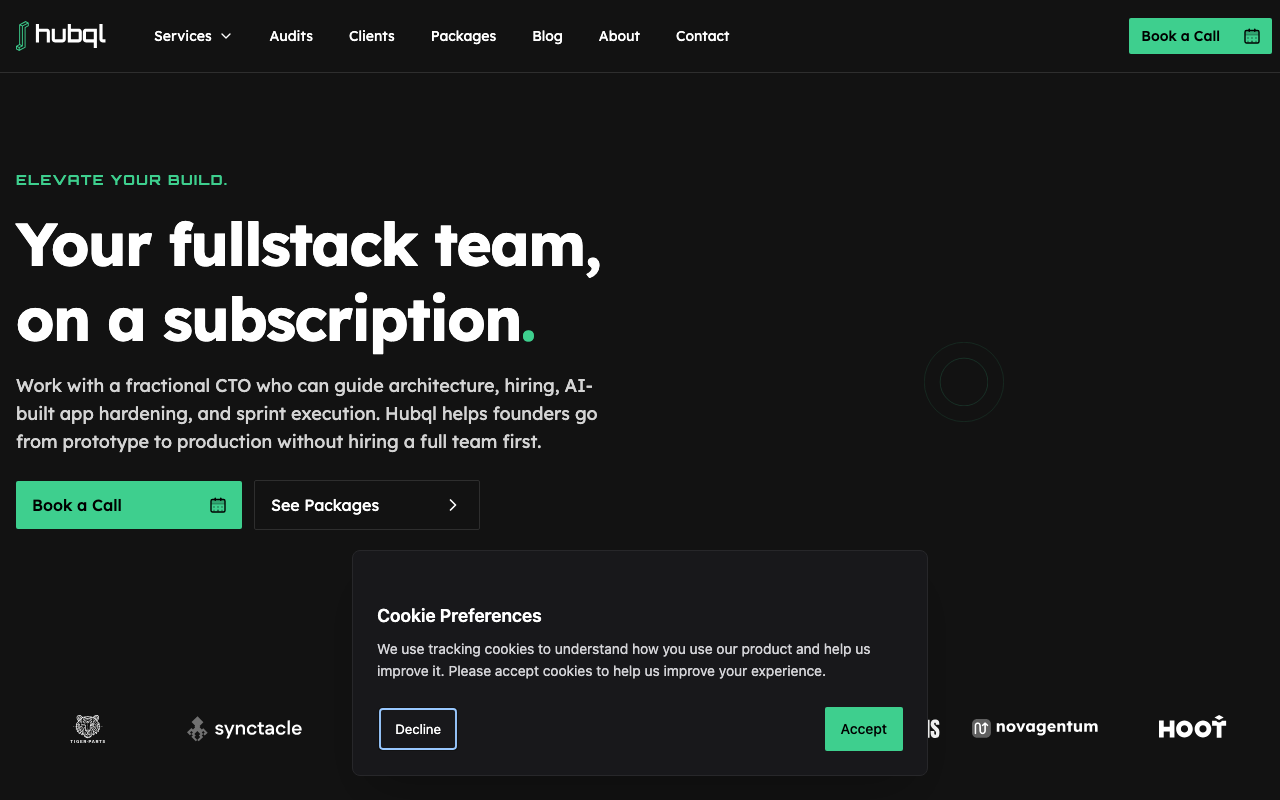
Hubql is a founder-led software studio based in Bangkok. Its Lovable to Production page is unusually Supabase-specific: environment separation with Supabase branching, database role separation, an RLS policy review for every table, an API key audit, auth flow validation, and a performance audit covering missing indexes and N+1 query patterns. It says it has run the Supabase Bangkok Meetup since 2024, and that its founder, Tobias, has more than twelve years of engineering experience, including scaling a startup to more than 70 engineers on Supabase-backed infrastructure.
The process is short and stated: a 30-minute call, a five-business-day audit with access to your Supabase project and GitHub repo, a prioritized findings report written for founders, and an optional one-week hardening sprint. Their wording is blunt: “No rewrite.”
The Lovable audit price is not published. What is published is the rest of the menu: a separate Vibe Coding Audit (a codebase and AI-workflow review) from $750, a Technical Advisor package at $1,500 a month, a Studio Retainer at $3,000 a month, and a Full Sprint from $4,000 a week.
Ideal for
Why they stand out
Hubql reads like a Supabase team first, with community work to show for it, and it pairs the audit with a fractional CTO option from $1,500 a month.
Pros
Cons
Verdict: pick Hubql when the problem is your Supabase setup and you want a senior person on call afterwards.
Afterbuild Labs describes itself as a small, senior-only team that rescues and productionizes AI-built apps, built by its principal engineer, Hyder Shah. Its Lovable page names the places Lovable apps break: Supabase RLS off or wrong, auth flows with gaps in password reset and session refresh, Stripe integrations that only handle the happy path, schema changes made in the dashboard with no migration history, and deploys that work in preview and fail in production.
Its pricing page is a menu of fixed fees: a $49 async audit with a severity-ranked PDF in 48 hours, a $299 Emergency Triage for one production bug (refunded if not fixed in 48 hours), a $499 Security Audit covering auth, RLS, data exposure and secrets, a $3,999 refactor to stop the fix-one-break-another loop, $7,499 to finish an MVP over four to six weeks, and a $3,499 a month retainer. It states “No hourly billing,” and says the scope is agreed in writing before you pay.
Ideal for
Why they stand out
Nobody else here publishes an entry point this low or a refund on a single-bug fix. For a founder who cannot yet justify a four-figure audit, that is a real door.
Pros
Cons
Verdict: pick Afterbuild Labs when you need a cheap, fast first read or one bug fixed, and the app is small.
Toptal is a freelance talent network, not a development agency. It runs a dedicated Hire Lovable Developers page, advertises the top 3% of Lovable developers, and shows a 4.9 out of 5 average client rating for its Lovable developers from 337 reviews. Several of the profiles on that page list Supabase and PostgreSQL alongside Lovable, and one describes taking prototypes and AI-built MVPs to production-grade products.
The mechanics are published: an average time to match under 24 hours, hiring in about 48 hours, a no-risk trial of up to two weeks where you pay only if satisfied, and hourly, part-time or full-time engagements. Toptal says its matching has a 98% trial-to-hire rate. It does not publish rates on that page. For a Lovable app, the honest framing is that Toptal sells access to a person, so the quality of the outcome depends on how well your side writes the brief and reviews the pull requests.
Ideal for
Why they stand out
The trial period removes most of the hiring risk, and the speed is hard to beat: a vetted person in days, on whatever schedule you need.
Pros
Cons
Verdict: pick Toptal when you have the technical judgment in-house and what you lack is hands.
The database access rules break first, because a Lovable app’s frontend talks straight to Supabase and those rules are the only thing between a visitor and your data. Lovable’s docs say its built-in backend, Lovable Cloud, uses Supabase’s open-source foundation, or you connect your own Supabase project. Either way, the failures are these:
This is not theoretical. In March 2025, researcher Matt Palmer scanned 1,645 Lovable showcase apps and found 303 endpoints across 170 projects, about 10.3%, with inadequate RLS settings. That became CVE-2025-48757, which Lovable disputes on the grounds that each customer is responsible for protecting its own app’s data. Whoever is right about blame, the data is yours to protect.
Not by default, and it can be once someone checks it like any other code. Lovable’s own security documentation is candid: its scans “cannot guarantee complete security,” and for apps handling sensitive data it suggests an additional professional security review. Lovable now runs a quick scan on every publish that checks for tables without row-level security, so the 2025 failure is easier to catch than it was. The deeper problem is that a scan can confirm a policy exists, not that it matches who should see what in your business.
The broader research points the same way. Veracode’s 2025 GenAI Code Security Report says AI-generated code “introduced risky security flaws in 45% of tests.” AI writes code that runs; nobody has yet asked whether it is safe. That question is the work.
Run Razoyo’s Five-Gate Production Check against it, then fix the gates that fail, in order. These are the five gates we published in our vibe-coded roundup, written out for a Lovable and Supabase app. Each gate is pass or fail, and every fail is a line item on the quote you are about to receive.
key, secret, password and token, then open your live site in the browser’s developer tools and search the JavaScript for service_role, sb_secret_ and any payment or email provider key. The publishable key being there is by design. A secret key there is a fail, and rotating it is job one.Four or five gates passed means hardening. Two or fewer means a rebuild of the core, whatever the invoice calls it. If you want the full version, our AI-generated code audit checks the same ground across seven dimensions and returns it as a Production Spec.
Hire for the gap you have, and fix access first, because an app with no auth is exposing data today. If nobody on your side can judge code, hire a firm that owns the outcome and starts with a written assessment: Razoyo, VeryCreatives, The Swarm or Hubql on this list. If you have a technical lead, a vetted freelancer from Toptal is usually cheaper and faster. If you have neither the budget nor the lead, a $49 or $499 audit from Afterbuild Labs at least tells you how deep the hole is. And if you need ongoing technical judgment more than a project, read our page on a fractional CTO for non-technical founders.
Published prices run from $49 for a written audit to $15,000 for a hardening sprint; your number depends on how much of the Supabase schema survives review.
| Firm | First paid step | Fix or build | Ongoing |
|---|---|---|---|
| Razoyo | $2,500 Production Spec, fixed | Production build from $10,000 | Support from $1,500 a month |
| VeryCreatives | Free 30-minute code review | $5,000 to $15,000 sprint | Not published |
| The Swarm | €1,500 audit, fixed | From €4,500 | From €290 a month |
| Hubql | Lovable audit not published | Full Sprint from $4,000 a week | Advisor from $1,500 a month |
| Afterbuild Labs | $49 async audit | $3,999 to $7,499 tiers | $3,499 a month |
| Toptal | Not published | Not published | Not published |
Distrust any build price given before someone reads your code. For what drives it, see what it costs to take an AI-built prototype to production, and if the data model turns out to be the problem, rewrite versus refactor.
Can a Lovable app be used in production? Yes, after someone has checked and fixed the backend. Lovable produces a working React and Supabase app, and the gaps are usually in database access rules, secrets, auth settings, tests and deployment. Once those are closed, it runs like any other React and Supabase product.
Is vibe-coded software safe to use in production? Not by default. Lovable’s own documentation says its scans cannot guarantee complete security and suggests a professional review for apps handling sensitive data. Veracode’s 2025 research found AI-generated code introduced risky security flaws in 45% of tests. It becomes safe the same way any code does: someone checks it.
What is the most common security problem in a Lovable app? Missing or overly permissive Row Level Security in Supabase. A 2025 scan of 1,645 Lovable showcase apps found 303 endpoints across 170 projects with inadequate RLS settings. Supabase’s documentation says a table in an exposed schema without RLS is readable and writable by any role with a grant on it.
Is the Supabase key in my Lovable frontend a leak? Not if it is the publishable key, also called the anon key, which Supabase designs to ship in the browser. It only becomes dangerous when Row Level Security is missing. A secret key, also called the service_role key, in the frontend is a leak, because it bypasses every RLS policy, and it should be rotated immediately.
Is Lovable’s built-in security scan enough? It is a good baseline, not a review. Lovable’s quick scan runs on every publish and flags tables without row-level security, but a scan can confirm a policy exists, not that it matches who should see what in your business. Test it yourself by signing in as one user and requesting another user’s data.
How much does it cost to make a Lovable app production ready? Published prices run from $49 for an async audit at Afterbuild Labs to $5,000 to $15,000 for a hardening sprint at VeryCreatives. The Swarm publishes a 1,500 euro audit and go-live from 4,500 euros. Razoyo publishes a $2,500 fixed Production Spec and a production build from $10,000.
Our AI-built app has no tests and no auth. Where do we start? Start with access, because an app with no auth is exposing data now. Add authentication and Row Level Security, rotate any secret that was in the code, then add tests on the money paths: signup, payment, permissions and anything that writes. A written assessment first tells you whether that is hardening or a rebuild of the core.
If your Lovable app already holds customer data and you cannot say for certain who can read it, that is the exact conversation we have on a first call. We will walk the five gates against your app, tell you which ones fail, and say whether it needs a $49 audit somewhere else, a Production Spec from us, or nothing yet. Schedule Free Consultation. The first 30 minutes are free, and if you do not need us yet, that is what you will hear. Or read how our process works first.
Paul Byrne is President of Razoyo, a software engineering firm in The Colony, Texas taking prototypes and constrained systems into production since 2011.
These links open AI platforms with pre-written prompts about this page.
We use cookies to improve your experience. Do you accept?
To find out more about the types of cookies, as well as who sends them on our website, please visit our cookie policy and privacy policy.
