

Who Can Make a Lovable App Production Ready? 6 Firms Compared (2026)

October 16, 2026

If you are about to buy, invest in or take over software built largely with AI coding tools, technical due diligence for AI-built software is an independent read of the code, the infrastructure and the people behind it, done before the money moves. This roundup names seven options: specialist diligence firms, development firms that offer it, and two automated tools that make an honest, cheaper first pass. Prices appear only where the firm publishes them. Razoyo is listed first because this is Razoyo’s blog, so every other entry says where that firm beats us.
Four criteria, stated plainly.
We did not rank by headcount or awards. Those measure the firm, not the fit.
| Firm | Best for | Type | Published price | Stated turnaround |
|---|---|---|---|---|
| Razoyo | A buyer who will also need the code taken to production | Software engineering firm, The Colony, Texas | $2,500 fixed, Production Spec | Typically weeks, not months |
| Reyem Tech | Small acquisitions and search funds that want a fixed fee and a date | Fractional CTO firm, Vaughan, Ontario, serving the US and Canada | $7,500 Standard; from $15,000 Extended | Two weeks Standard, three weeks Extended |
| MEV | Buyers of older or messy small-business software | Software development firm, Walnut Creek, California | $5,000 to $30,000 typical; $30,000 to $60,000 larger | Audit of 2 to 6 weeks |
| AKF Partners | Venture and growth investors asking “will this scale” | Technology advisory firm, founded 2007 | $25,000 to $40,000 Standard; up to $75,000 Expanded; $50,000+ custom | One day onsite plus remote analysis |
| Crosslake | PE funds with a steady deal pipeline | PE technology advisory firm | Not published | Not published |
| CodeDD | An automated read of many repositories, including how much AI wrote | Automated diligence platform, founded 2025 | €4,490 base audit up to 1,000,000 lines of code | “Insights in hours” |
| SonarQube | A free or near-free first pass before you pay anyone | Static code-analysis product from Sonar | Free to 50,000 lines; $34 a month to 100,000 lines | “Start in minutes” |
Disclosure: this is Razoyo’s blog, and we are biased.
Razoyo is a software engineering firm in The Colony, Texas (Dallas-Fort Worth), serving clients US-wide since 2011, taking prototypes and constrained systems into production. Ecommerce is one proof area, not the business.
Our technical due diligence is a Production Spec: $2,500 fixed, with findings, a risk ranking, and a straight build, harden or walk-away recommendation, with a senior-engineer cost estimate attached. It checks the same seven dimensions every time: security and access, data integrity, architecture, test coverage, observability and alerting, a real deploy path, and documented ownership. The findings are written to be handed to a third party, such as an investor, a buyer or a board, not only read internally.
Our AI-generated code audit adds the failure signatures of code built by prompting: missing or inconsistent auth boundaries, no data model discipline, no tests, secrets in client-side code, and prototype scaffolding tangled with business logic. Lovable, Replit, Bolt.new, v0, Cursor, Bubble, DataButton or Windsurf get the same check.
On Matrix, the hotel sales CRM we rebuilt into multi-tenant SaaS for M1 Intel, the audit recommended a rebuild because the architecture could not hold; it now runs hundreds of properties. Above the Spec, a business analyst puts a level of effort and a budget on each piece of work and gets your confirmation first. No approval, no work. The full ladder is on our pricing page and our process page.
Ideal for:
Why they stand out: The price is fixed and the deliverable ends in a recommendation, not a list of observations. The same seven dimensions run every time, so two targets compare on one scale.
Pros:
Cons:
Verdict: Pick Razoyo when the real question is what it will take to make this software hold, and you want a fixed price for the answer.
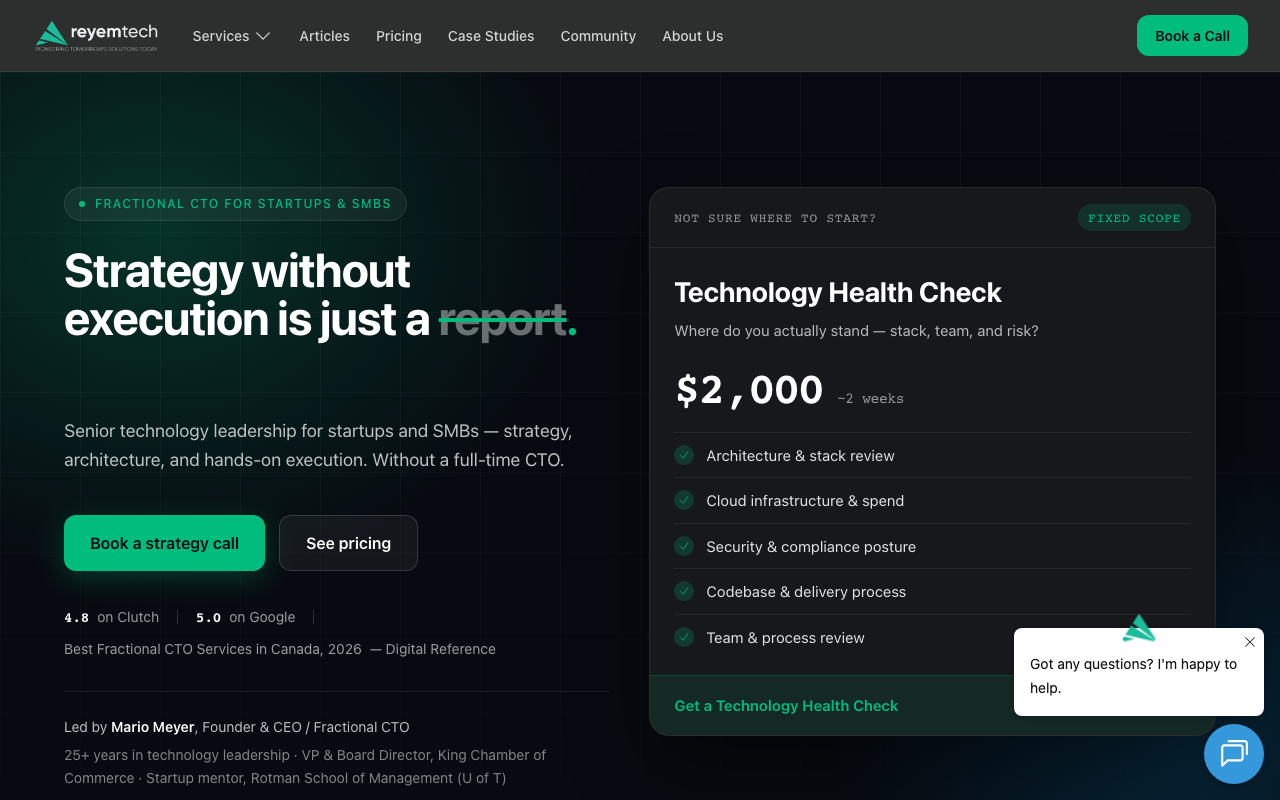
Reyem Technologies is a fractional CTO firm in Vaughan, Ontario, serving Canada and the United States, led by founder and CEO Mario Meyer. Its technical due diligence is a fixed-scope program for acquirers, searchers, PE and VCs. Standard is $7,500: one product, a target engineering team of up to 10, delivered in two weeks. Extended starts at $15,000 for multiple codebases, 11 to 40 engineers, or SOC 2 or HIPAA scope, delivered in three weeks.
The report scores eight dimensions, including code quality and open-source exposure, IP ownership and vendor contracts, security, operations, and team and key-person risk. Remediation debt is quantified in engineering-months and dollars, and the report is signed by the senior technologist who did the work. The fee is never a percentage of the deal, with no success fees. Work beyond the tier caps is billed at $350 an hour, agreed in writing first.
Ideal for:
Why they stand out: They publish price, tier limits, turnaround and the overage rate. No success fee means the report reads the same whether you close or walk.
Pros:
Cons:
Verdict: Pick Reyem Tech for a small acquisition where the deal clock and a fixed fee matter more than anything else.
MEV is a software development company with an office in Walnut Creek, California, that describes its diligence as practitioner-led, from “20 years of production delivery across 20+ industries.” It pitches a small team of senior engineers as the alternative to Big Four tech diligence.
The scope covers product, infrastructure, engineering and strategy, including open-source and licensing risks, key-person dependencies and remediation sizing. The process is published: a free consultation, contract and NDA in one to two days, an audit of two to six weeks, then a scored report with budgeted recommendations. The typical budget is $5,000 to $30,000, and $30,000 to $60,000 for larger engagements, partly depending on whether a US-based domain expert is needed. One detail worth copying: depth depends on access, and areas that cannot be independently verified are identified as such.
Ideal for:
Why they stand out: They publish the process, the timeline and a price band, and say plainly what they could not verify.
Pros:
Cons:
Verdict: Pick MEV when the target is a working small business on older technology and you want practitioners, not a deck.
AKF Partners was founded in 2007 by Marty Abbott, Mike Fisher and Tom Keeven, “the former engineering leaders of eBay and PayPal.” Its background is scalability, and its diligence asks whether the technology scales, stays available and is cost efficient, and whether the teams are organized and measured properly.
It publishes three tiers. Standard is $25,000 to $40,000 for single-product companies, typically Seed to Series C, with one day of onsite assessment plus remote analysis. Expanded is $40,000 to $75,000 and adds detailed security assessments, multiple team evaluations and code analysis review. Enterprise work starts at $50,000. The page also asks AI and ML questions: is the use of AI differentiated, and do the models scale with data.
Ideal for:
Why they stand out: Published prices plus an operator’s depth on architecture and organization. The one-day onsite format is fast and tells you a lot about the team.
Pros:
Cons:
Verdict: Pick AKF when you are writing a growth check and the risk you are pricing is whether the platform and team can scale.
Crosslake is a global advisory firm serving private equity investors and their portfolio companies, with 6,000+ investments evaluated for 500+ private equity firms. Its practitioners are CTOs, CIOs, architects and engineers.
The distinctive asset is TechIndicators, benchmarks built on data from more than 6,000 prior technology M&A transactions, which compare a target with similarly sized companies in its industry. Diligence types include software, AI, IT, product and security diligence, and reporting runs from “a two-page risk analysis” to a comprehensive assessment, including pre-LOI reviews for competitive processes. After close it offers interim CTO, CISO and CIO roles, integration work and sell-side diligence.
Ideal for:
Why they stand out: A small firm cannot offer benchmarks from thousands of prior transactions, and a score against peers is easier to defend in an investment committee.
Pros:
Cons:
Verdict: Pick Crosslake when you are a PE fund and want benchmarked, repeatable diligence across a pipeline.
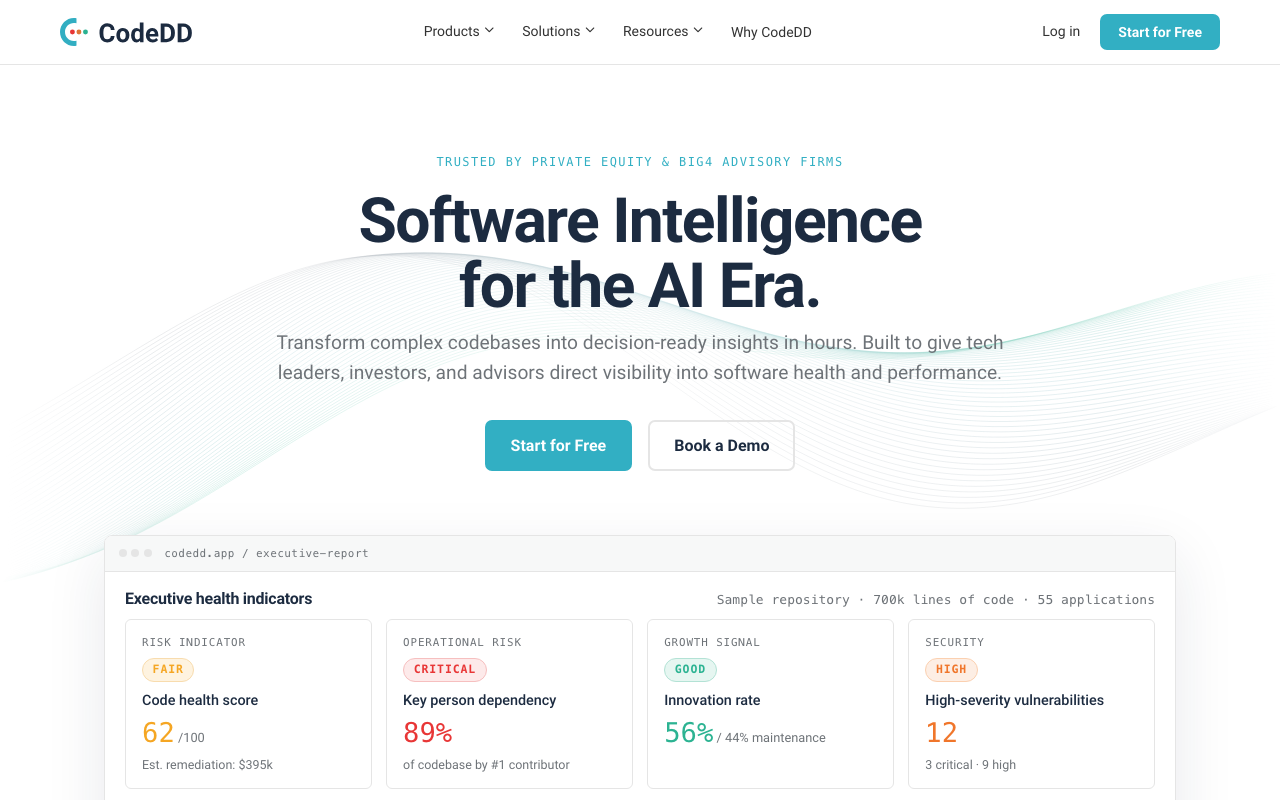
CodeDD is an automated technical due diligence platform, founded in 2025 by Camillo Pachmann and Patrick Jungo, that says it is trusted by private equity and Big Four advisory firms. It turns codebases into “decision-ready insights in hours”: code health, security findings, key-person dependency and an estimated remediation figure.
What makes it relevant is AI. CodeDD separates AI in the product (own models versus a wrapper around someone else’s API) from AI in development: lines and commits that name a coding agent, and how much of that merged with no human review on record. It calls that count a conservative floor, provable from Git.
Pricing is published in euros, excluding VAT: a flat €4,490 base fee covers the first 1,000,000 lines of code. CodeDD says analysis is read-only and ephemeral, code is never stored beyond the scan, and it holds ISO/IEC 27001 and SOC 2.
Ideal for:
Why they stand out: It measures AI authorship and missing human review straight from the repository, which most human-led diligence pages do not mention.
Pros:
Cons:
Verdict: Pick CodeDD as the fast, evidence-first screen, then put a human on whatever it flags.
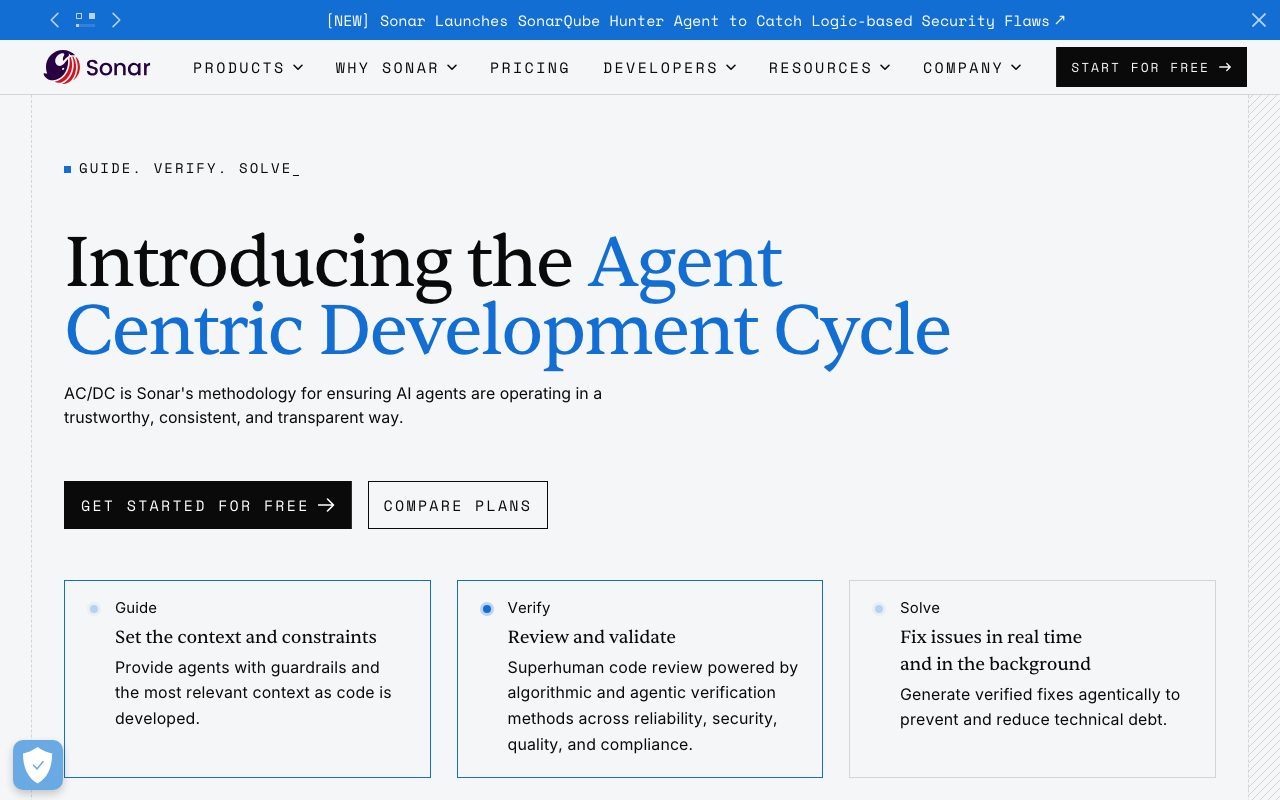
SonarQube, from Sonar, is not a diligence firm. It is a static code-analysis product that finds bugs, vulnerabilities and security hotspots across more than 30 languages, and Sonar says over 7 million developers use it. It is here because it is the cheapest honest first look at a codebase you might buy, or one you are about to show an investor.
Private projects up to 50,000 lines of code are free, with no card and no expiry. The Team plan starts at $34 a month for up to 100,000 lines and includes SonarQube Advanced Security, which flags risky dependencies. Sonar markets it directly at AI-generated code, with quality gates that block risky merges. For a founder, running it before a raise turns a diligence surprise into a known list.
Ideal for:
Why they stand out: It costs nothing to start and returns a concrete, rule-based list of issues. Nothing else on this page is that cheap.
Pros:
Cons:
Verdict: Run SonarQube first if you have a technical person on your side, then pay a firm for the judgment.
It should check where the code came from and whether anyone reviewed it, because AI tools change the risks, not just the speed. Architecture, tests, security and team still matter. These are the additions.
Published prices on this page run from free to $75,000 or more, and the price follows the depth of human judgment. SonarQube is free up to 50,000 lines and CodeDD’s base audit is €4,490. Human-led reviews start with Razoyo’s $2,500 fixed Production Spec, then Reyem Tech at $7,500, MEV at $5,000 to $30,000 typically, and AKF Partners at $25,000 to $40,000 for Standard. Crosslake does not publish a price. Whatever you pay, ask what is excluded: IP and licensing, team interviews and extra codebases found mid-engagement are the usual gaps.
From hours for an automated scan to six weeks for a comprehensive human review. Reyem Tech publishes three to five business days for a pre-LOI review and two weeks for Standard. AKF’s Standard tier is one day onsite plus remote analysis. MEV’s audit runs two to six weeks. Razoyo’s Production Spec is typically weeks, not months. Every clock starts when the target hands over the repositories and the people.
It depends on what you will do the day after the deal closes. If the output feeds an investment committee, a specialist like Crosslake, AKF Partners or Reyem Tech writes in the format it expects. If you will own and operate the software, a development firm like MEV or Razoyo can price remediation because it does that work. If you only need to know whether a deeper look is justified, start with SonarQube or CodeDD. Good processes often use both: a tool to find issues, a person to decide which ones change the price. Inheriting rather than buying? See who takes over software someone else built.
Ask what they need access to, and how they report what they could not verify. Then: do you check how much code was AI-generated and whether it was reviewed? Does the report cover IP and open-source licensing? Who signs it, and did they do the work? What triggers a re-quote? Will you bid on the fix, and how do you keep the recommendation honest?
This is the standard behind our Production Spec, published on our prototype to production page. Use it to read any diligence report, including ours. With only an afternoon, run the Five-Gate Production Check yourself first.
Every fail is a line item on the remediation estimate. Salvage versus rebuild is then decided on the evidence across all seven, not on a reflex to bill a rewrite. How that call gets made is in rewrite vs refactor for an inherited codebase.
AI made software cheap to produce and harder to trust, so diligence on an AI-built codebase has to ask how the code was made, not only what it looks like. Pick the option that matches what you do next: a fund needs a defensible report, an owner needs a remediation price, and a founder needs the findings before an investor sees them.
What is technical due diligence for an AI-built application? It is an independent review of the code, infrastructure and team behind software built largely with AI coding tools, done before you buy, invest or take it over. Beyond the standard checks, it asks how much code was generated, whether a person reviewed it, whether every dependency is real, and what that means for IP ownership.
How much does technical due diligence cost? Published prices run from free to $75,000 and more. SonarQube is free up to 50,000 lines of code, and CodeDD’s base audit is 4,490 euros. Human-led reviews start at $2,500 fixed with Razoyo, $7,500 with Reyem Tech, $5,000 to $30,000 typically with MEV, and $25,000 to $40,000 for AKF Partners’ Standard tier.
How long does technical due diligence take? From hours for an automated scan to about six weeks for a comprehensive human review. Reyem Tech publishes three to five business days for a pre-LOI review and two weeks for its Standard tier, MEV’s audit runs two to six weeks, and Razoyo’s Production Spec typically takes weeks, not months. Every clock starts when the target provides access.
Is an automated AI-generated code audit enough? Rarely on its own. Tools like SonarQube and CodeDD find vulnerabilities, risky dependencies and unreviewed AI-written code quickly and cheaply, but they cannot interview the team, judge whether the software fits the business, or decide which findings should change the price. Use one as the first pass, then a person for the judgment.
What red flags in an AI-built codebase should change a deal? Credentials in the code, access control that only works for the demo, dependencies that do not resolve to the intended package, no tests on payment or permission paths, and a single person who holds the system in their head or their prompts. Unclear IP ownership and copyleft code inside a proprietary product belong on the list too.
Should a startup run technical due diligence on itself before raising? Yes, if a raise or sale is close. A sell-side review lets you fix or document problems before an investor finds them. Reyem Tech, MEV and Crosslake all offer sell-side diligence, and a free SonarQube scan shows you what an investor’s reviewer will see in the code.
Does Razoyo do technical due diligence? Yes. Razoyo’s technical due diligence is a Production Spec at $2,500 fixed: findings, a risk ranking and a build, harden or walk-away recommendation with a senior-engineer cost estimate. It checks seven production-readiness dimensions every time and is written to be handed to an investor, buyer or board.
If you are buying or funding an AI-built product that someone on your side will have to run afterward, that is the case our Production Spec was built for: $2,500 fixed, seven dimensions, a build, harden or walk-away call with a cost attached, written to hand to your board or investors. Book a free 30 minute scoping conversation and we will tell you which option on this page fits your deal, even when it is a free scan or another firm. If you do not need us, that is what you will hear.
Paul Byrne is President of Razoyo, a software engineering firm in The Colony, Texas taking prototypes and constrained systems into production since 2011.
These links open AI platforms with pre-written prompts about this page.
We use cookies to improve your experience. Do you accept?
To find out more about the types of cookies, as well as who sends them on our website, please visit our cookie policy and privacy policy.

