


Upwork Alternatives When You Need a Team That Owns the Result (2026)

October 29, 2026

If you have an idea for a B2B software product and no intention of building it yourself, the firms that will build a B2B SaaS product from scratch for you fall into four groups: engineering firms that define the product in writing before they build, product studios, no-code agencies, and freelance networks you direct yourself. This roundup names six, says who each one fits, and gives a price only where the firm publishes one. Razoyo is listed first because this is Razoyo’s blog, so every other entry says where that firm beats us.
Every version of this search comes down to one question: who makes the technical decisions you cannot make yourself, and do you see them in writing before you pay for a build?
| Firm | Best for | Who defines the product | Where they work | Price, if published |
|---|---|---|---|---|
| Razoyo | A fixed-price written spec before any build | Razoyo, in a $2,500 System Spec you keep | The Colony, Texas (Dallas-Fort Worth), US-wide | Spec $2,500 fixed; MVP from $5,000; production from $10,000 |
| thoughtbot | A documented product studio, especially in regulated markets | thoughtbot, in a Shaping Sprint | Distributed: Americas, Europe, West Asia, Africa | Not published |
| Designli | A guaranteed live V1 and a refund window | Designli’s dedicated pod, inside TractionLab | Greenville, South Carolina, plus Dallas and San Francisco | Impact Week $1,700; TractionLab not published |
| Altar.io | European founders who want a scoped MVP | Altar.io, in a 15 to 20 day Product Scope | Lisbon, Portugal | Example projects from €18k |
| LowCode Agency | Validating fast on no-code, on a published budget | LowCode Agency, in a hypothesis and feature spec | Not stated on the pages we read | MVPs from $15K to $120K |
| Lemon.io | Founders who can direct developers | You, unless you buy its MVP service | Remote network | Rates of $55 to $140; MVP benchmark around $16K |
Disclosure: this is Razoyo’s blog, and we are biased.
Razoyo is a software engineering firm in The Colony, Texas, in the Dallas-Fort Worth area, serving clients US-wide since 2011. The work is taking prototypes and constrained systems into production. For a founder who is starting from an idea, that work begins with writing the product down.
We do not quote a build on the first call. The first paid step is a System Spec: $2,500 fixed and time-boxed, two or three working sessions that produce a product brief, a PRD, a senior-engineer build estimate and a plain build-or-don’t-build recommendation. It is yours whether or not you build with us. Next, a $2,500 Requirements Package locks user flows, edge cases, integrations and acceptance criteria. A working MVP starts from $5,000, and taking it to production starts from $10,000. Every step is on our pricing page and our process page. Above the Spec, a business analyst puts a level of effort and a budget on each piece of work and gets your confirmation first. No approval, no work.
The same senior people who scope the product build it, launch it and support it. Once fees are paid you own the code we write for you.
The closest published example is a marketplace Production Spec. A vacation-rental startup wanted a two-sided marketplace built, and we ran a $2,500 fixed-fee Production Spec instead of quoting the build: product brief ten days after kickoff, PRD two weeks later, a working prototype of the host side six weeks after the first email. The most they had at risk was $2,500. For shipped SaaS, Matrix was an internal hotel sales CRM that was not multi-tenant, rebuilt into multi-tenant SaaS for M1 Intel, and Spider, the hotel business intelligence platform now part of Lighthouse, grew from an internal tool into a self-service platform used by more than 10,000 people a day. We have also delivered systems for several Fortune 500 companies, always under NDA, so we name none of them.
Ideal for
Why they stand out
Razoyo publishes its whole price ladder and puts a fixed-price written definition in front of any build. The Spec is allowed to end with someone else building. On our scoping page, a franchising pickleball league got a number larger than it had in mind, we did not shave it, and the league took its finished Spec to a development partner that could fund the build.
Pros
Cons
Verdict: pick Razoyo if you want the product defined in writing, at a fixed price, by the people who will build it, before you commit a build budget.
thoughtbot is a design and development consultancy whose MVP page puts the problem well: building software has never been easier, but “building the right product still requires the right team,” whether you start “from a prototype, a pitch deck, or a product vision.” Its front door for new products is the Shaping Sprint, a time-boxed engagement in five stages (understand, diverge, converge, prototype, test) that ends in a testable artifact: a clickable prototype, a working proof of concept, a roadmap document or an ad experiment.
It builds web apps in React, Ruby on Rails and Python, and mobile apps for iOS, Android and React Native. It says it has deep experience in healthcare, finance and insurance, building “with HIPAA, SOC 2, and your industry’s specific requirements as part of the foundation.” It also offers a Fractional CTO and a Fractional Product Manager, and helps you hire and upskill the team that will own the product. Its Playbook and open source work are public. It does not publish prices.
Ideal for
Why they stand out
thoughtbot documents how it works in public, from its Playbook to its sprint method, so you can judge the process before you call.
Pros
Cons
Verdict: pick thoughtbot if you want a product studio with a documented method, especially in a regulated market, and you plan to build your own team.
Designli is headquartered in Greenville, South Carolina, with offices in Dallas and San Francisco, and it is built for exactly the founder this page is about. Its own FAQ says it directly: “The non-technical founder is our primary client.”
For a founder starting from scratch, the offer is TractionLab, a 90-day engagement that puts a live app with a real user in the market by Day 30 and aims at a first paying customer by Day 90. If V1 is not in real users’ hands by Day 30, the next month is free. The first two weeks are fully refundable, the 90-day price is fixed up front, you can cancel on 30 days’ notice, and in Designli’s words “everything we build is yours to keep.” One dedicated pod runs it, from product owner and engineering lead to designer and architect, in two-week sprints with biweekly demos. Every feature starts as a hypothesis measured against real user behavior. For an existing product, Impact Week is a $1,700 one-week audit; TractionLab itself is priced on the call.
Ideal for
Why they stand out
Designli publishes its guarantees: a refundable first 14 days, and a real user by Day 30 or the next month free.
Pros
Cons
Verdict: pick Designli if a fast, guaranteed V1 and a team accountable for traction matter more to you than a long written spec.
Altar.io is a product and software development firm headquartered in Lisbon, Portugal, run by people who describe themselves as ex-startup founders. Its first step is the Product Scope, an intensive 15 to 20 day process that opens with a two-day session and produces a revised value proposition, the main assumptions to prove, and a complete set of user stories for the MVP. Optional extras include a tech spike, a tiny build that proves a risky technology approach is viable.
After the Scope comes its MVP Builder or full custom development, handled by a dedicated in-house team. Its pricing page carries an estimator and recent real examples: an arts marketplace in two months for €18k, a community platform MVP in three months for €40k, and larger AI and data systems from €90k to €350k. Projects can start on its Seed, a base covering common functions such as signup and password recovery, so “the project starts with ~50% of the code already done.”
Ideal for
Why they stand out
Few studios publish what past projects cost. Altar.io lists recent examples by duration and price, and the Product Scope is a bounded way to test the relationship.
Pros
Cons
Verdict: pick Altar.io if you are in or near Europe and want a structured scope plus real price examples before you sign.
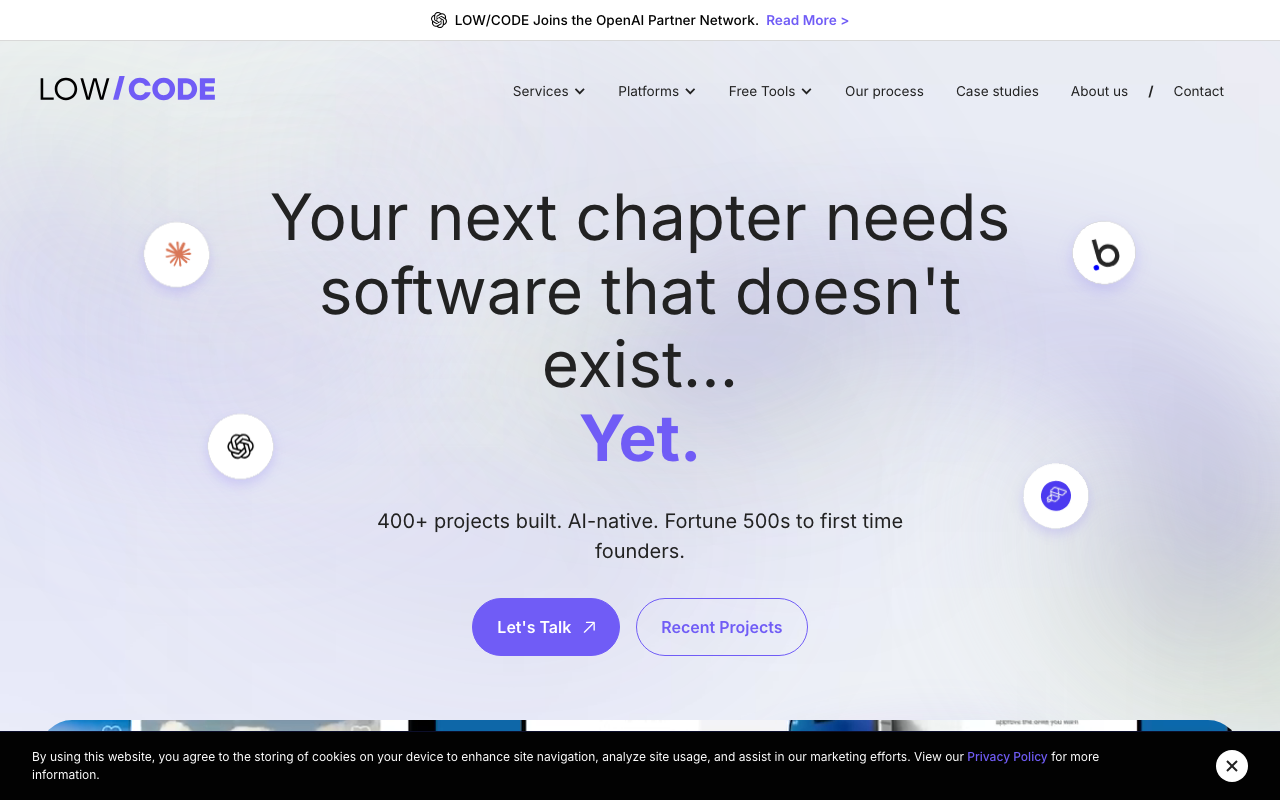
LowCode Agency was founded by Jesus Vargas in 2019 as a low-code and no-code practice and has grown into a team of more than 40 that says it has shipped over 400 products. It builds on Bubble, FlutterFlow, Glide and Webflow, and it now writes custom code too: “Low-code when it fits, custom code when it does not.”
Its MVP page names non-technical founders as an ideal fit (“We become your product development capability”) and is candid about who is not: anyone who wants “a proof-of-concept demo with no intention to ship.” The process starts with a hypothesis document and a minimum feature spec (one to two weeks each) before design and four to twelve weeks of sprints. It publishes MVP ranges: $15K to $30K over 6 to 10 weeks, $30K to $60K over 8 to 14 weeks, and $60K to $120K over 12 to 18 weeks.
Ideal for
Why they stand out
It publishes price bands and timelines, says plainly who it is not for, and picks the platform per project, custom code included.
Pros
Cons
Verdict: pick LowCode Agency if getting a testable product in front of buyers matters more than owning a codebase from day one.
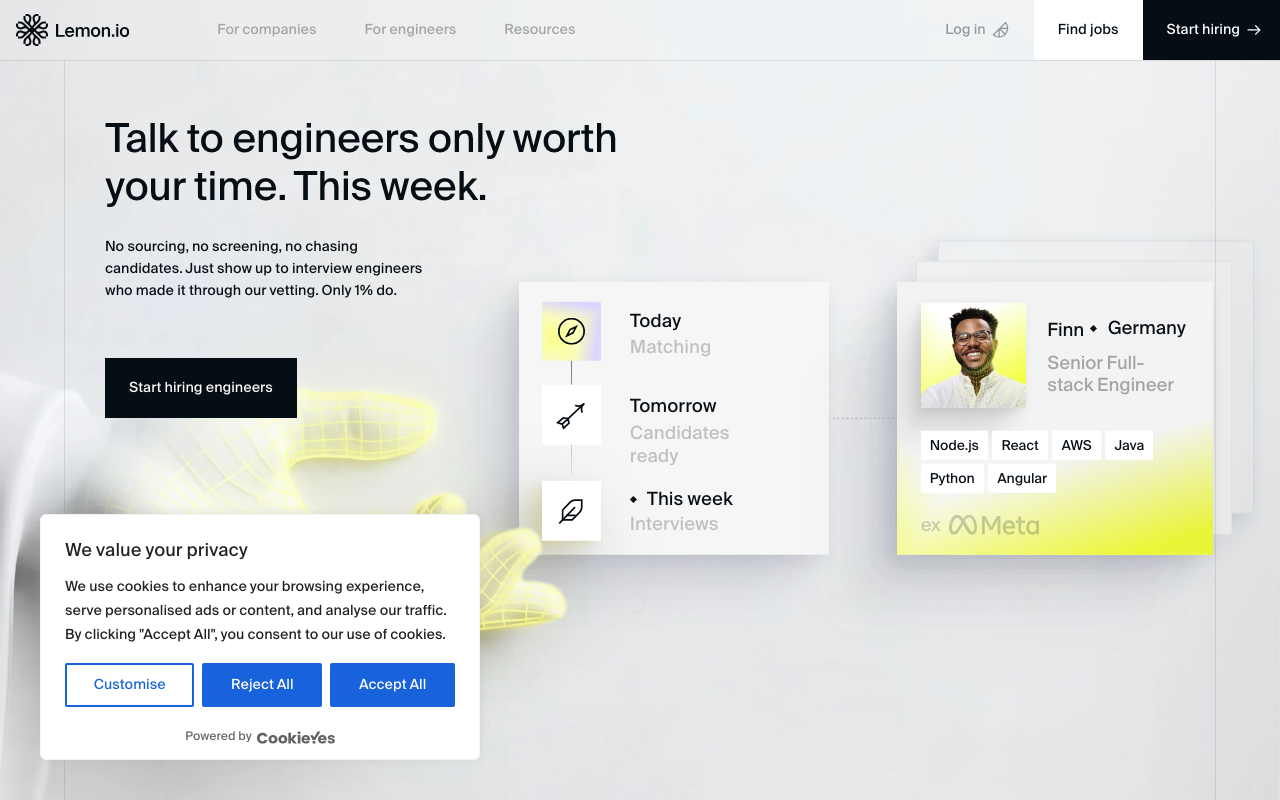
Lemon.io describes itself as “a platform that connects businesses with top freelance developers.” Started in 2015, it pre-vets engineers from Europe, Latin America, the US and Canada, says its acceptance rate is 1.2%, and has a senior engineer interview every candidate before you meet them.
It has added an MVP development service: a scoping window of one to two weeks, about two to three months from idea to MVP release, and a dedicated lead in charge of quality and delivery. It lists software engineers’ rates of $55 to $140, and it benchmarks a 320-hour MVP at around $16K in development, or roughly $20K to $25K once product design, QA and backend infrastructure are included. There are no upfront fees and no minimum duration, and its FAQ says you own all intellectual property produced for your project.
Ideal for
Why they stand out
Published rates, a concrete MVP cost benchmark and pre-vetting make the freelance route usable for a founder who already knows what to build.
Pros
Cons
Verdict: pick Lemon.io if you already know what to build and have someone who can review the work.
Firms that take on the product decisions as well as the code. Of the six here, Designli calls non-technical founders its primary client and LowCode Agency lists them as an ideal fit, Razoyo and Altar.io start with a bounded scoping step, and thoughtbot adds fractional technical leadership. Lemon.io is the exception: it supplies engineers, and unless you buy its MVP service the product decisions stay with you. Ask each one who writes the spec, and whether you could hand that document to another team. If not, you are buying a dependency, not a definition.
Yes, and for a non-technical founder it is usually the safer setup, as long as the definition is a document you own. A handoff between a strategy firm and a build firm is where intent gets lost. At Razoyo the same senior people who scope the product build and support it, and Altar.io and Designli run definition and build inside one team too.
The Agile Manifesto’s principles include this one: “Business people and developers must work together daily throughout the project.” Your job shifts from writing code to answering questions fast, and a firm that never asks you any is guessing.
The business rules, not the screens. When the vacation-rental startup in our marketplace case arrived, four questions were open on day one, and in our own words then, “None of those are engineering questions. All of them change what gets built.” For a B2B SaaS product, they become:
A good definition also says what is deliberately left out. That marketplace Spec contained no guest-side booking at all, because the business only works if hosts show up first.
Published starting points only, because most firms here quote after a call. Razoyo: a $2,500 fixed System Spec, a $2,500 fixed Requirements Package, an MVP from $5,000 and production from $10,000. LowCode Agency: MVP bands from $15K to $120K. Altar.io: example projects from €18k to €350k. Lemon.io: a 320-hour MVP benchmark around $16K in development, $20K to $25K with design, QA and infrastructure. Designli publishes only Impact Week ($1,700), and thoughtbot publishes no prices.
A “from” price is a floor. Several user roles, billing and per-customer data separation push a B2B product above it, which is why the definition comes first: it turns a range into your number.
Start on no-code when the main question is whether anyone will pay, and start in code when you already know the product depends on heavy data, deep integrations or many customer organizations on one platform. The cost arrives later: Bubble’s support center says it does not support code exports, so moving off it is a rebuild. Our guide to replacing a business-critical spreadsheet walks through the same decision for internal systems.
Whoever the contract says, so get it in writing before work starts. Under US copyright law, commissioned work is not automatically yours: the Copyright Office’s Circular 30 on works made for hire limits commissioned works made for hire to nine listed categories under a signed written agreement, and software is not named among them. Razoyo’s wording is that once fees are paid you own the code we write for you. Designli says everything it builds is yours to keep, and Lemon.io’s FAQ says you own all IP produced for your project.
Our published process, written as a test you can apply to any firm. The rule behind it, from the marketplace engagement: buy the smallest piece that tells you whether to buy the next piece. Each rung has a price, a deliverable you keep, and a question that decides whether you climb.
Above the Spec, a business analyst prices each piece of work and you approve it before it starts. A firm that cannot show you its stopping points is selling one rung: the whole budget.
What is the best firm to build a B2B SaaS product from scratch? The one whose model removes the risk you most fear. Razoyo defines the product in a $2,500 fixed System Spec before any build, Designli guarantees a live V1 with a real user by Day 30, Altar.io runs a 15 to 20 day Product Scope, LowCode Agency builds fast on no-code, and Lemon.io supplies vetted engineers you direct.
Who builds custom SaaS platforms for non-technical founders? Firms that take on the product decisions as well as the code. Designli calls non-technical founders its primary client, LowCode Agency lists them as an ideal fit, Razoyo and Altar.io start with a bounded scoping step, and thoughtbot offers fractional technical leadership.
I have an idea for an app and want a firm to build it end to end. Where do I start? Start with a written definition of the product before anyone prices the build. Ask each firm for its first step, what it costs, and whether you keep the document if you stop there. At Razoyo that step is a $2,500 fixed System Spec producing a product brief, a PRD and a senior-engineer estimate.
I want to build a software product but do not want to build it myself. Who do I hire? Hire a firm that owns the technical decisions, not just the typing. Product studios and engineering firms such as Razoyo, thoughtbot, Designli and Altar.io take responsibility for definition, design and build. Hire freelancers only if someone on your side can specify and review the work.
Is there a company that handles both product definition and software development? Yes. Razoyo, Altar.io, Designli and thoughtbot all run product definition and development inside one firm, and at Razoyo the same senior people scope, build and support the product. Make sure the definition is a document you own.
How much does it cost to build a B2B SaaS MVP? Published numbers vary widely. Razoyo lists an MVP from $5,000 after a $2,500 Spec, LowCode Agency publishes MVP bands from $15K to $120K, Altar.io shows example projects from €18k, and Lemon.io benchmarks a 320-hour MVP at around $16K in development. Any build price given before the product is defined is a guess.
Do I own the code a software firm writes for me? Only if the contract says so, so get it in writing. The US Copyright Office’s Circular 30 limits commissioned works made for hire to nine listed categories, and software is not named among them, so ownership is normally set by an assignment clause. Razoyo’s wording is that once fees are paid you own the code we write for you.
Should a non-technical founder start on a no-code platform? Start on no-code when the main question is whether anyone will pay. Start in code when the product depends on heavy data, deep integrations or many customer organizations on one platform. Bubble’s support center says it does not support code exports, so moving off it later is a rebuild.
If nobody on your side can make the technical calls, the expensive mistake is buying a build before anyone has written the product down. A free 30 minute call with a senior engineer tells you whether a System Spec is the right next step and what it would cost. If the honest answer is “hire a freelancer” or “do not build this yet,” that is what you will hear. Schedule Free Consultation.
Related reading: product development from Spec to MVP, you have no technical cofounder: what to hire instead, firms that take a vibe-coded app to production, what it costs to take an AI-built prototype to production, who takes over software someone else built, and prototype to production.
Paul Byrne is President of Razoyo, a software engineering firm in The Colony, Texas taking prototypes and constrained systems into production since 2011.
These links open AI platforms with pre-written prompts about this page.
We use cookies to improve your experience. Do you accept?
To find out more about the types of cookies, as well as who sends them on our website, please visit our cookie policy and privacy policy.

