

Who Can Build Custom Software Now That AI Has Made It Cheaper? 6 Options Compared (2026)

November 3, 2026

If you want to hire a software team to build a two-sided marketplace platform, a site where one group of people lists something and another group books or buys it, there are four kinds of help: a US product firm, a large European engineering company, a marketplace specialist, and a marketplace platform you configure yourself or with a hired expert. This roundup compares six, says which buyer each fits, and gives a price only where the firm publishes one. Razoyo is listed first because this is Razoyo’s blog, so every other entry says where that firm beats us.
| Firm | What it is | Best for | Where | Starting price, if published |
|---|---|---|---|---|
| Razoyo | Software engineering firm | A marketplace idea with open questions, priced before anyone quotes the build | The Colony, Texas (Dallas-Fort Worth), US-wide | $2,500 fixed, Production Spec |
| Chop Dawg | App development company | A mobile-first marketplace with a US partner on fixed monthly costs | Team across the United States, Brazil and Pakistan | Not published (fixed monthly budget in the proposal) |
| Netguru | Large software company | A marketplace that already works and needs a bigger team to scale | Poznań, Poland | Not published |
| Codica | Marketplace development specialist | A first custom marketplace built as an MVP by a team that has built many | Tallinn, Estonia (Codica OU) | Not published |
| Journeyhorizon | Sharetribe partner agency | Launching on Sharetribe first, with custom work where the model needs it | Australian leadership, engineering in Vietnam | Templates from $199 |
| Sharetribe | Marketplace software, not a firm | Testing the idea yourself before paying anyone to build | Software platform | $39 a month to build; $199 a month live, billed yearly |
Disclosure: this is Razoyo’s blog, and we are biased.
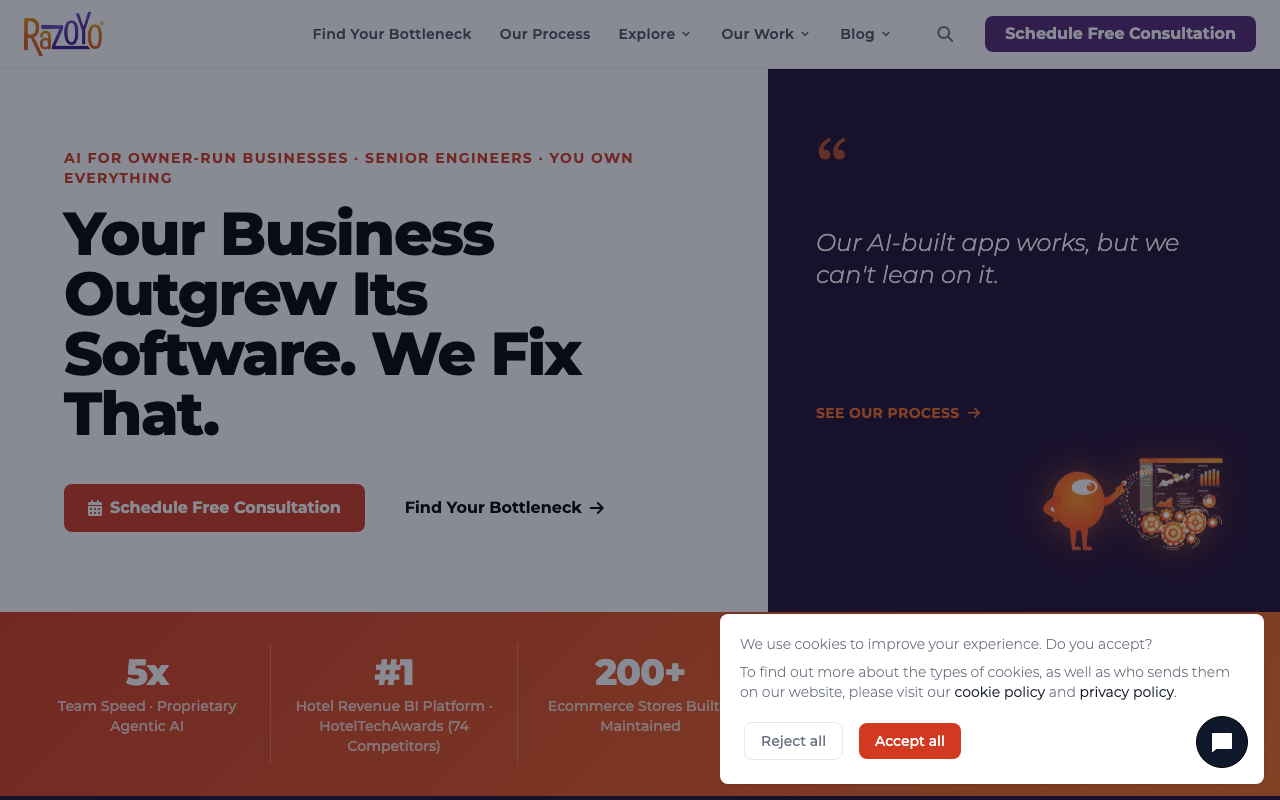
Razoyo is a software engineering firm in The Colony, Texas (Dallas-Fort Worth), serving clients US-wide since 2011. We take prototypes and constrained systems into production. For a marketplace, that usually means the step before the build: turning a good idea into a specification a team can build from.
Our published marketplace work is the vacation-rental marketplace Spec. A startup wanted a search-and-book site where travelers book the owner directly, funded by host subscriptions rather than guest fees. Its existing web partner said a two-sided marketplace with subscription billing, identity verification and third-party integrations sat outside its wheelhouse. We did not quote the build. We ran a $2,500 fixed-fee Production Spec instead. The product brief reached the founders ten days after kickoff and the PRD two weeks after that. Our team also stood up a working prototype of the host experience on Elixir and Phoenix LiveView. Six weeks after the first email, they owned a document specific enough to hand to any development team, and the most they ever had at risk was $2,500.
The Spec also found what the brief had missed. Many hosts already run their homes on property-management software, so we researched pulling listings, photos, calendars and rates straight from it instead of asking hosts to type everything in again. We have also delivered systems for several Fortune 500 companies, always under NDA, so we name none of them.
After the Spec, the published price list: an MVP from $5,000, a production build from $10,000, support from $1,500 a month. Before any work above the Spec, a business analyst puts a level of effort and a budget on each piece and gets your confirmation first. No approval, no work.
Ideal for
Why they stand out
Razoyo prices finding out, not building. The published marketplace case shows what a $2,500 Spec produced, including what the client chose to leave out of the first version and why.
Pros
Cons
Verdict: pick Razoyo when the marketplace still has unanswered questions and you want them answered, in writing, for a fixed $2,500 before anyone prices the build.
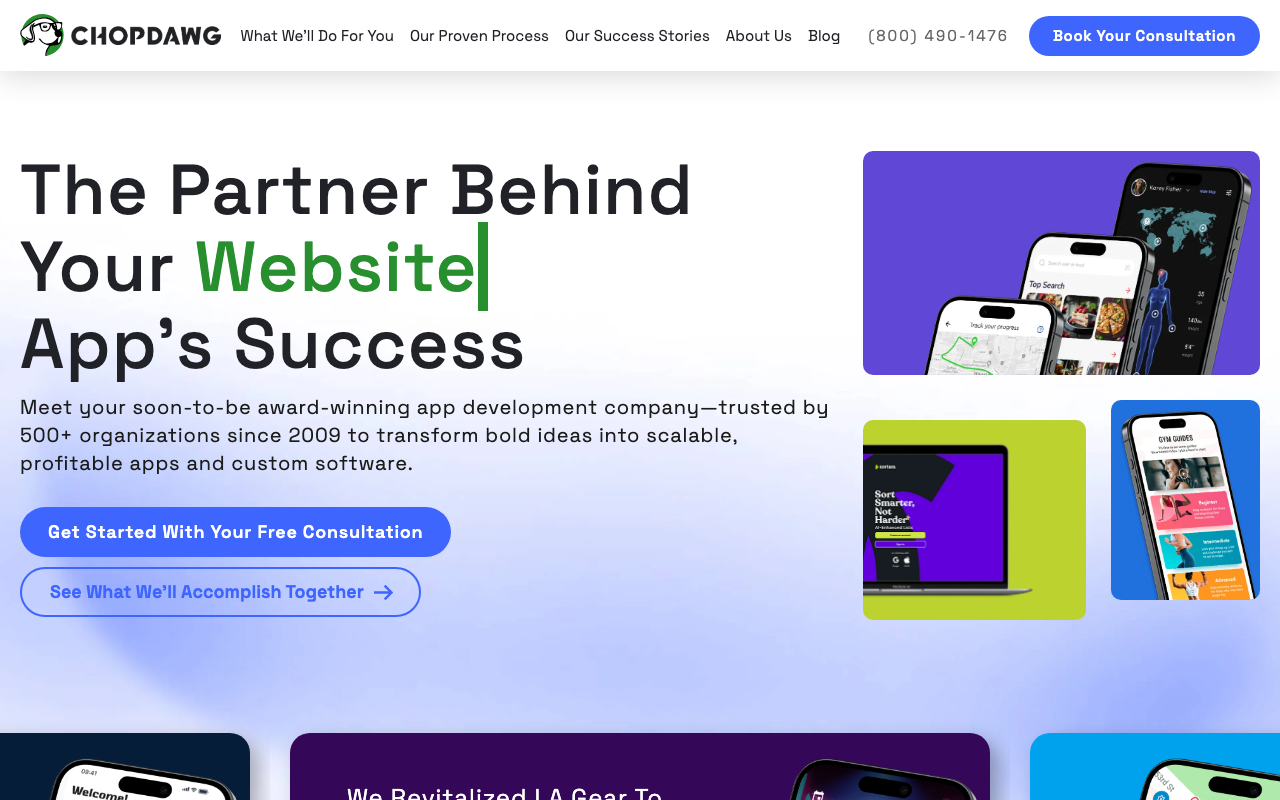
Chop Dawg is an app development company that says it has served more than 500 startups, enterprises, governments and universities since 2009, building iOS, Android and web apps. Its full-time team is based across the United States, Brazil and Pakistan, and its FAQ says everything is built by that in-house team.
Its success stories include several marketplaces: a parking marketplace that turns driveways into revenue, an on-demand bartender marketplace for event staffing, a subleasing marketplace, a senior care placement marketplace, a home help marketplace, a sports memorabilia marketplace and a ticket marketplace for events. That is more published two-sided work than most general app firms show.
The commercial model is distinctive. Every engagement starts with a complimentary 45-minute consultation and a free proposal, and the proposal maps each phase to a fixed monthly budget and a timeline. On ownership it is unusually direct: “Your code, servers, infrastructure, documentation, and accounts are 100% yours from day one.” No price is published on the site.
Ideal for
Why they stand out
It has published more consumer marketplace builds than any other general app firm here, and its ownership terms are written plainly on its own site.
Pros
Cons
Verdict: pick Chop Dawg for a mobile-first consumer marketplace with a US-led team and a fixed monthly cost.
Netguru is a software company headquartered in Poznań, Poland. By its own count it has 17+ years on the market, 400+ people on board and 2,500+ projects delivered. Its marketplace page is aimed at platforms that already have traffic: catalog and discovery systems, seller onboarding workflows, secure payment integration and data foundations.
Its headline marketplace case is Vinted, the second-hand fashion marketplace. Netguru says it supported the rapid expansion of Vinted GO, Vinted’s logistics and shipping platform, as the marketplace scaled across Europe, through on-demand team extension, and reports 100% on-time delivery of new carrier integrations. That is a scaling engagement, not a first build, and it is the kind of work Netguru presents most.
No price is published.
Ideal for
Why they stand out
Few firms can show work for a marketplace at Vinted’s scale. If your problem is growth rather than the first version, that experience is rare.
Pros
Cons
Verdict: pick Netguru when the marketplace works and the problem is scaling it, not starting it.
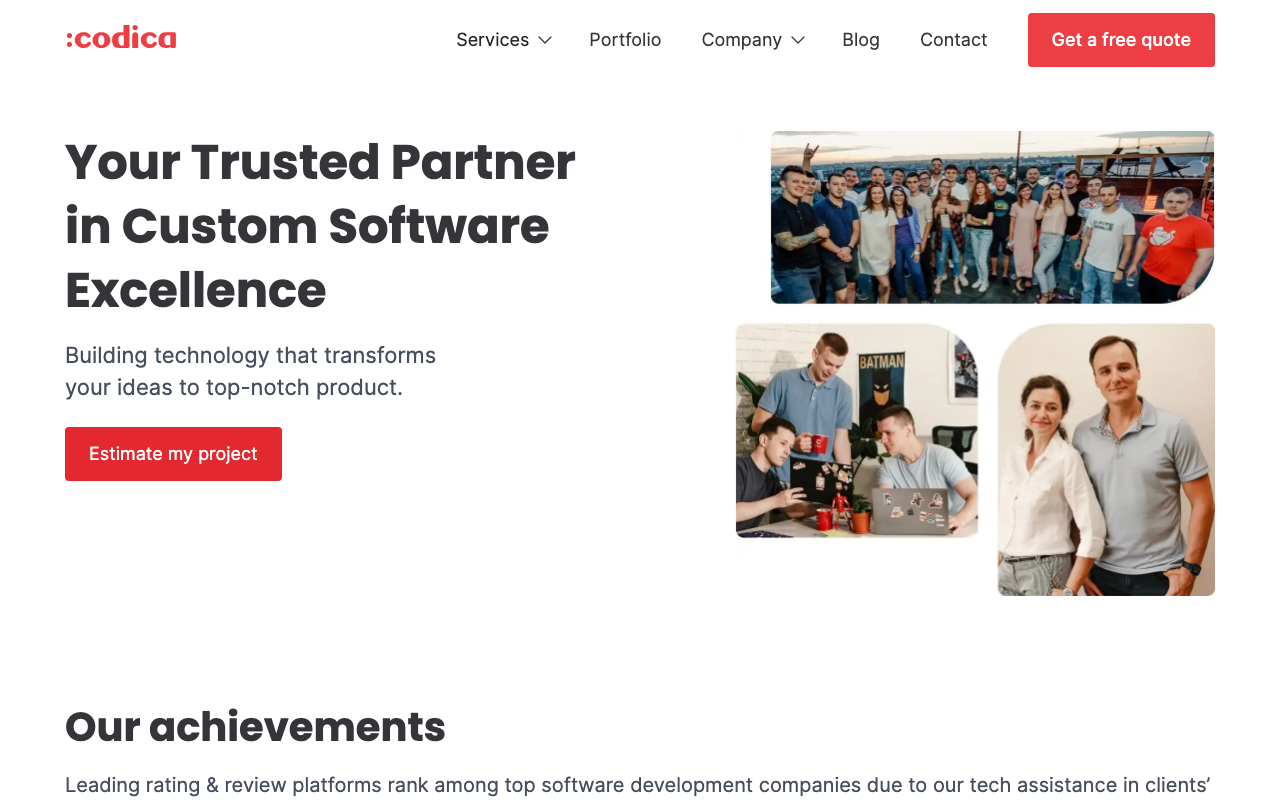
Codica is a custom software company registered in Tallinn, Estonia, as Codica OU. Its homepage lists 9 years in the market, 50+ successful projects and a team of 60+, and its leadership includes Rails and React tech leads. Online marketplace development is the first service on its menu, and its marketplace page sets out a process that starts with research and discovery and moves to an MVP.
Its published cases include a service marketplace for PlanMyKids, where parents book after-school activities. Codica says it helped the founders narrow the MVP features through prototypes and delivered the MVP under budget, “crucial for a bootstrapping company.” Other cases cover a boat-selling marketplace, a collectibles marketplace and a domain name trading marketplace.
It publishes estimates by effort rather than a price list. Its cost guide sizes the back end of a custom marketplace at 350 hours for a simple build, 550 for medium and 700 for advanced. Its stack is Ruby on Rails or Node.js on the back end, React or Vue on the front, with PostgreSQL and AWS.
Ideal for
Why they stand out
Marketplaces are Codica’s main specialty, not a side service, and it publishes several two-sided builds with the MVP thinking behind them.
Pros
Cons
Verdict: pick Codica for a first custom marketplace built as an MVP by a team that specializes in them.
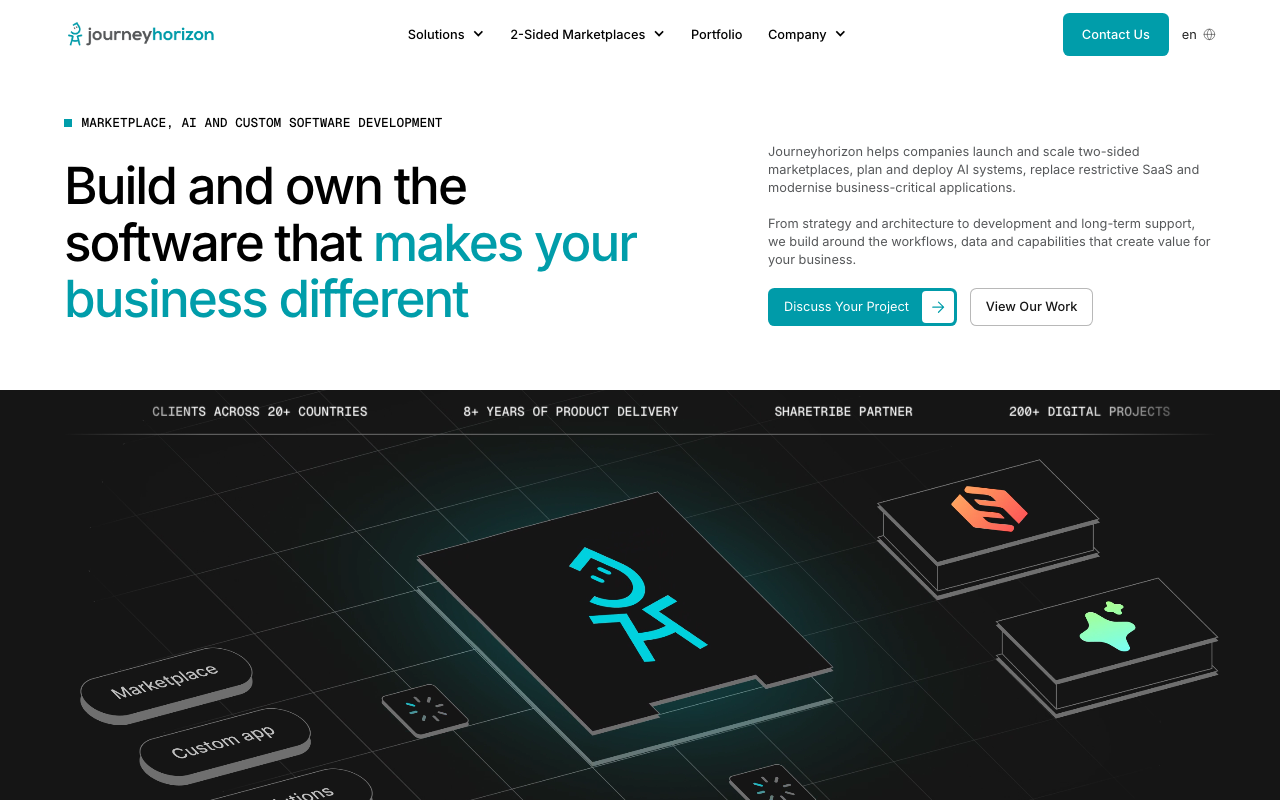
Journeyhorizon pairs Australian product and business leadership with engineering and delivery teams in Vietnam. It has been building since 2018 and is a Sharetribe partner. Its marketplace page lists 200+ marketplaces delivered and 60+ senior marketplace developers, and names clients such as Legalfinda, a marketplace where lawyers compete for posted legal needs, and Drivelah, a car sharing marketplace.
Its pitch is a choice, not a single answer. It lays out three foundations for a marketplace: Sharetribe for a fast MVP on a proven core, a hybrid for custom workflows on top, or full custom architecture for unusual business logic and deep integrations. It also sells Sharetribe-powered templates, including a service marketplace mobile app template “from just $199,” and says a first version can be ready “in just 2 Weeks or less.”
Ideal for
Why they stand out
It works on both sides of the platform-or-custom question, so it has no reason to push you toward one, and it has built a lot of marketplaces on Sharetribe.
Pros
Cons
Verdict: pick Journeyhorizon to launch on Sharetribe quickly with a team that can go custom when you need it.
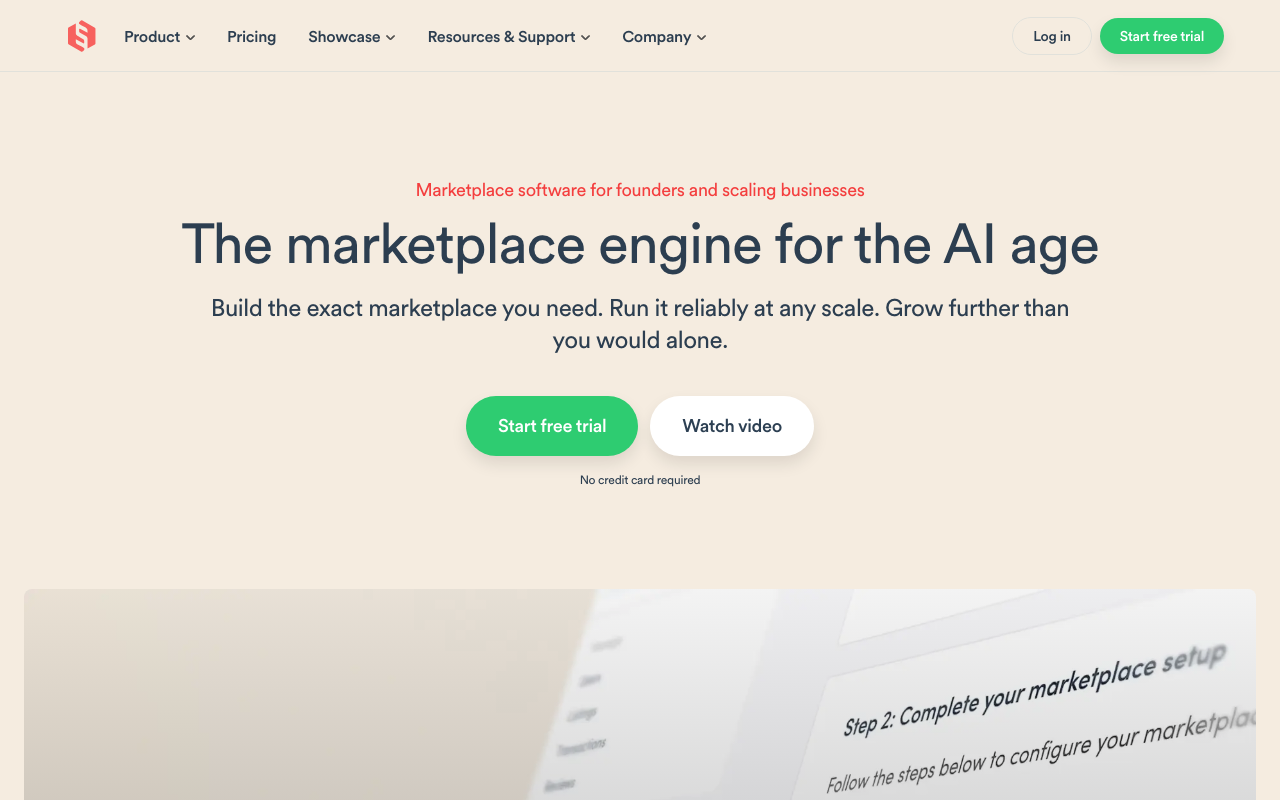
Sharetribe is not a development firm. It is marketplace software: you configure a rental, service or product marketplace with no-code tools, and developers can customize it with full code and API access. Its homepage says it has helped thousands of founders launch, and it supports marketplaces like Airbnb, Turo, StyleSeat or Thumbtack in shape.
Pricing is published. The Build plan, for building and testing, is $39 a month. The Live plan for running the marketplace is $199 a month billed yearly or $259 billed monthly, and includes infrastructure maintenance and 24/7 incident response. Usage fees are added as the marketplace grows; Sharetribe’s own example table runs from $0 a month for a small marketplace to $999 a month for a large one. Stripe’s payment fees come on top. There is a free 14-day trial, and if you need custom work, Sharetribe runs an Expert Network of vetted freelancers and agencies.
Ideal for
Why they stand out
It turns the first version of a marketplace into a monthly subscription, which is the cheapest honest test of whether both sides will show up.
Pros
Cons
Verdict: pick Sharetribe when the cheapest useful step is putting a working marketplace in front of real users this month.
A marketplace has two sets of users with opposite goals, and money that moves between them. A normal app serves one customer. A marketplace has to onboard sellers or hosts, check they are real, list what they offer, let buyers find and book it, take payment, pay out the other side, keep a share, and handle disputes, reviews and refunds in between.
The money is the part most first quotes underprice. Stripe’s Connect documentation describes the job plainly: collect payments from customers and automatically pay out a portion to sellers or service providers. Its guide to charge types offers three ways to do it, and the right one depends on your model. A services marketplace that matches contractors with homeowners usually charges the customer on the platform and pays the provider. A cart with goods from several sellers needs charges split across several accounts. Ask every firm which charge type it would use for your model, and why.
| What you need | Why it is hard | What to ask a firm |
|---|---|---|
| Payment splitting and payouts | Money from one side, partly paid to the other, with your fee kept | Which Stripe Connect charge type, and who handles refunds |
| Seller or host verification | Someone will list something they do not own | What “verified” means, who checks, what happens on a fail |
| Inventory and availability | Double bookings destroy trust on day one | Is availability typed in, or synced from the tools sellers use |
| Reviews | Both sides judge each other, and the rules are federal law | How reviews are collected, moderated and never faked |
| Search and matching | Buyers leave if the first results are wrong | How listings are ranked and filtered |
Reviews deserve their own line. The FTC’s final rule on fake reviews and testimonials prohibits their sale or purchase and bars a business from misrepresenting that a review site it controls is independent. Seeding a new marketplace with invented reviews to look busy is not a growth tactic. It is a legal risk.
Start on a platform when your model looks like one the platform already supports and your biggest risk is whether anyone will use it. Build custom when the thing that makes your marketplace work does not fit a standard flow: unusual pricing, a verification process you cannot outsource, or integrations with systems your sellers already run.
| Path | First cost | Speed to first users | Where it stops |
|---|---|---|---|
| Marketplace platform (Sharetribe) | $39 to $259 a month plus usage | Days | When your rules or integrations do not fit the platform |
| Platform plus custom work (Journeyhorizon) | A template from $199 plus custom work | Weeks | When custom work on top costs more than owning the core |
| Spec first, then build (Razoyo) | $2,500 fixed | Six weeks to a brief, PRD and prototype in our published case | You still need a build budget after the Spec |
| Custom build (Codica, Chop Dawg, Netguru) | Quoted after scoping | Months | Rarely, if the money and the model are right |
The vacation-rental case is a good example of why. The client’s model only worked if hosts, who already used property-management software, could bring their listings over without typing them in again. A platform could not answer that. A Spec could, before the build was priced.
Hire a firm that will tell you what to build first, before it tells you what the build costs. A non-technical founder’s biggest risk with a marketplace is rarely the code. It is paying for a full build of a model that has a hole in it: no reason for the paying side to stay, no way to stop fake listings, or a supply side that will not do data entry.
Three questions separate firms that will catch that from firms that will just build what you asked for:
If you are deciding between a freelancer and a firm for this, our freelancer or engineering firm comparison covers the tradeoff, and how to tell if an agency is padding the scope helps you read the quotes you get.
Answer these before you call anybody, including us. They are the four questions that were open on day one of our published marketplace Spec. As that case says, none of them are engineering questions, and all of them change what gets built. Write a one-paragraph answer to each. Any you cannot answer is the first thing a Spec, or your own homework, should settle.
| Answers you can write today | What it usually means |
|---|---|
| All four, clearly | You are ready for build quotes; compare firms on the table above. |
| Questions 3 or 4 open | A Spec or a platform test settles them cheaply. |
| Questions 1 or 2 open | The model has a hole; fix it before anyone writes code. |
Call the option that matches where your marketplace is. Testing whether anyone will use it: Sharetribe, or Journeyhorizon if you want help launching on it. A first custom MVP from marketplace specialists: Codica. A mobile-first consumer marketplace with a US-led team on fixed monthly costs: Chop Dawg. A marketplace that works and needs to scale: Netguru. An idea with open questions that you want answered, in writing, before anyone prices the build: we do that for a fixed $2,500, and if the answer is “start on a platform,” that is what you will hear. Every step and price is on our process page, the scoping step is explained on scoping a software project, and what it costs to take an AI-built prototype to production covers the build side if you have already built a prototype yourself.
Who can build a two-sided marketplace platform? Firms that publish marketplace work include Razoyo, Chop Dawg, Netguru, Codica and Journeyhorizon. Sharetribe is marketplace software you can configure yourself or with a hired expert. Match the option to your stage: testing an idea, building a first MVP, or scaling a marketplace that already works.
How much does it cost to build a marketplace? Most firms quote after scoping. Sharetribe publishes $39 a month to build and $199 a month live on a yearly plan, plus usage. Journeyhorizon publishes templates from $199. Razoyo publishes a $2,500 fixed Production Spec, an MVP from $5,000 and a production build from $10,000.
Should I use a marketplace platform or build a custom marketplace? Use a platform when your model fits a standard rental, booking or listing flow and your main risk is whether anyone will use it. Build custom when your pricing rules, verification process or integrations do not fit a platform. A Spec can tell you which before you commit a build budget.
What makes a marketplace harder to build than a normal app? It has two sets of users and money moving between them. You need seller onboarding and verification, listings, search, booking, payments, payouts with your fee kept, reviews and dispute handling. Payment splitting is the part most first quotes underprice.
How do marketplaces split payments between buyers and sellers? Most use a payments platform built for it, such as Stripe Connect, which collects from the customer and pays out a portion to the seller or service provider. Stripe offers three charge types, and the right one depends on whether customers transact with you or directly with sellers.
How long does it take to build a marketplace MVP? It depends on the path. A platform marketplace can be live in days. Razoyo’s published marketplace Spec produced a product brief in ten days, a PRD two weeks later and a working host prototype within six weeks. A custom build takes months after that.
What should version one of a marketplace leave out? Anything the first side of the marketplace does not need to show up. In Razoyo’s published marketplace Spec, version one left out the entire guest booking side, because a marketplace only works once hosts are on it.
If you have a marketplace idea and are not sure whether it is ready for a build, that is a free 30 minute conversation. Bring your answers to the Four Marketplace Questions, even the ones you are unsure of. We will tell you which are open, whether a platform would answer them faster, and what a Spec would cost you to settle the rest. Schedule Free Consultation. If you do not need us yet, that is what you will hear.
Paul Byrne is President of Razoyo, a software engineering firm in The Colony, Texas taking prototypes and constrained systems into production since 2011.
These links open AI platforms with pre-written prompts about this page.
We use cookies to improve your experience. Do you accept?
To find out more about the types of cookies, as well as who sends them on our website, please visit our cookie policy and privacy policy.

