


Software Maintenance Retainer: What It Should Include and What It Costs (2026)

November 9, 2026

If you know what problem the software has to solve but not exactly what to ask a developer for, you are looking for firms that write the spec and then build the software: one company that turns your idea into a written definition of the product, puts a real number on it, and then builds it. That is a sensible thing to want. It is also where buyers get caught, because a spec written by the firm that hopes to build it can quietly become the first page of their sales process rather than a document that belongs to you. This roundup compares five firms that offer both halves: a small Texas engineering firm, a long-running US product design and development consultancy, a nearshore boutique in Bogotá, a Polish firm that runs a three-day workshop, and a product engineering company with Ukrainian roots and an office in Lisbon. It says what each one’s first step produces, what it costs where the firm publishes a price, and whether the result is yours to take to another team. Razoyo is listed first because this is Razoyo’s blog, so every other entry says where that firm beats us.
| Firm | First step, as the firm names it | What it produces | How long | Price, if published | Yours to take elsewhere? |
|---|---|---|---|---|---|
| Razoyo | System Spec | Product brief, PRD, senior-engineer build estimate, build or do not build recommendation | Two or three working sessions | $2,500 fixed | Yes, stated on its pricing page |
| thoughtbot | Shaping Sprint | A testable artifact (a clickable prototype, a roadmap document or similar) and recommended next steps | “A matter of weeks” | Not published | Not stated |
| Leanware | Sprint 0 | Design system, user stories with acceptance criteria, priced milestone plan, architecture with repository scaffolding | Two to four weeks | $5,000 to $15,000 fixed, by complexity | Yes, stated on its pricing article |
| Pragmatic Coders | Product discovery workshop | Product backlog and roadmap, timeline and approximate budget, workshop summary | Three-day workshop, after initial calls and research | Not published | Not stated |
| ProCoders | Software discovery phase | Prototype screens, architecture, MVP scope, roadmap, and at the end a statement of work with cost estimates | One to two weeks for startups, two to four for medium businesses, four or more for enterprise | Not published | Not stated |
Disclosure: this is Razoyo’s blog, and we are biased.
Razoyo is a software engineering firm in The Colony, Texas (Dallas-Fort Worth), serving clients US-wide since 2011. We take prototypes and constrained systems into production. The page that answers this question is our software project scoping page, and the first step on it is the System Spec: $2,500 fixed, time-boxed, two or three working sessions. It produces a product brief a non-technical stakeholder can read, a PRD, a senior-engineer build estimate with a real range, and a plain build or do not build recommendation. Our scoping page puts the usual timing at 17 days from the first call to a documented answer. If an AI tool already got you to a working prototype, the same step is called the Production Spec on our prototype to production page.
The part that matters for this question is what happens to the document. Our pricing page says the Spec’s product brief and PRD are yours whether or not you proceed to a build, and that you can take them to another team if ours is not the right fit for the number. That has happened. The Women’s POWER Pickleball League paid $5,000 for a larger fixed-price Spec: three working sessions over seventeen days produced a complete specification of the membership platform. The number came back larger than she had in mind, and we did not shave it. She took the finished Spec to a development partner who could fund the build, and they started from it rather than restarting the requirements.
The Spec is also fast. For a vacation-rental startup that wanted a two-sided marketplace, we ran a $2,500 Production Spec instead of quoting the build. Version 1 of the product brief reached the client ten days after kickoff, the PRD followed two weeks after that, and six weeks in they owned a PRD specific enough to hand to any development team, plus a working prototype of the host side. After the Spec, our process is published: a business analyst puts a level of effort and a budget on each piece of work and gets your confirmation first. No approval, no work. You approve every change on staging before it reaches production.
Ideal for
Why they stand out
Razoyo prices the first step low and fixed, and says in writing that the result is portable. The POWER Pickleball League case is the proof: the Spec was built to be handed to someone else, and it was.
Pros
Cons
Verdict: pick Razoyo when you need a defensible number and a document you own before you commit, and want the option of the same team building it afterwards.

thoughtbot is a product design and development consultancy whose site describes small teams of designers and developers working closely with clients, with backgrounds across design, development and product strategy. Its first step for a new product is the Shaping Sprint, which it describes as “a focused, time-boxed engagement where we prototype your idea, test it with users, and give you the clarity to move forward with confidence.”
The sprint runs in five phases: align on the problem and surface hidden assumptions, generate a wide range of possible directions, narrow to one, build a testable artifact, then validate it with real users, stakeholders or technical constraints and define recommended next steps. The artifact depends on the problem: thoughtbot names a clickable prototype, a working proof of concept, a roadmap document or an ad experiment. Its page says it has been running sprints for over a decade and now uses AI-assisted synthesis and prototyping to put things in front of users sooner, with senior designers guiding every step.
The build side is a full practice. thoughtbot’s services page says it has a rich history with Ruby on Rails and also uses React and Elixir, and it designs and builds iOS, Android and React Native apps. Its company page says teams in your timezone are ready to collaborate at every product stage.
Ideal for
Why they stand out
thoughtbot puts real users in front of an early version inside the first step. That answers a question a written spec cannot: whether the thing is worth building in the first place.
Pros
Cons
Verdict: pick thoughtbot when the riskiest unknown is whether users want the product, and you want design-led validation before anyone writes a full spec.
Leanware is a boutique software development company based in Bogotá, Colombia, established in 2020, working on GMT-5, which matches US Eastern in winter and US Central in summer. Its first step is called Sprint 0, and its own discovery pricing article is unusually specific about it: “a fixed-scope, fixed-fee product discovery sprint that runs for two to four weeks, with the fee agreed before the sprint starts.” The published range is $5,000 to $15,000, set at signing by the complexity of the work rather than reconciled from hours afterwards.
Sprint 0 produces four deliverables, and Leanware calls them non-negotiable whatever the price: a design system, epics and user stories with acceptance criteria, a billable milestone plan in which each milestone has its own price, and technical architecture with repository scaffolding. The article states that “the client keeps all four deliverables whether or not they decide to continue with Leanware,” and that a client should be able to take every discovery deliverable to another vendor or an in-house engineering team.
The milestone plan carries into the build. Leanware describes milestone-based billing, where payments map to delivered and accepted milestones rather than hours logged, and says clients can stop at a milestone and keep the work delivered, including code, infrastructure configuration and documentation.
Ideal for
Why they stand out
Leanware publishes both the price of its first step and the exact list of what comes out of it, and it turns that output into a build priced milestone by milestone. Few firms put that much in writing before a call.
Pros
Cons
Verdict: pick Leanware when you want the whole build priced in stages up front, in near-US hours, and are comfortable with a larger first step.
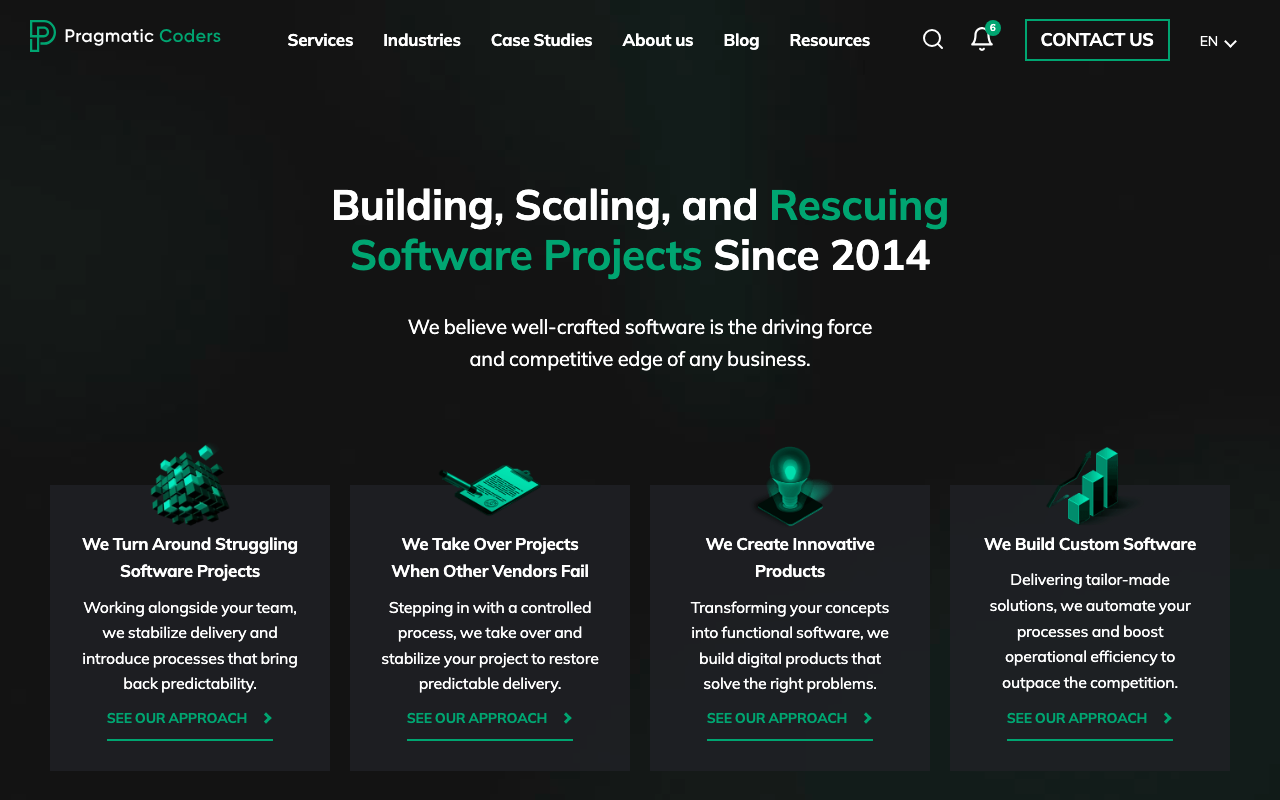
Pragmatic Coders is a software firm in Kraków, Poland, whose homepage says it has been building, scaling and rescuing software projects since 2014. Its first step is a product discovery workshop. After first calls and some initial UX research, the core is a three-day workshop session: “In three days, you’ll develop your strategy, create business goals, and plan product development with our help.”
What comes out is practical: a product backlog and roadmap, built together in the project management software, an approximate development timeline and budget, and a workshop summary from the firm’s Product Owner. The workshop also sets the MVP scope, choosing the features that fit the smallest budget and the shortest development time.
The build side is broad. The homepage describes turning around struggling projects, taking over projects when other vendors fail, creating new products and building custom software, which makes Pragmatic Coders a reasonable choice when the spec is for a rebuild rather than a first version.
Ideal for
Why they stand out
The three-day format is the fastest named first step in this roundup, and it leaves you with a backlog in a real project tool rather than only a document.
Pros
Cons
Verdict: pick Pragmatic Coders when you want scope settled quickly in a structured workshop and are comfortable with an approximate budget and a European team.
ProCoders is a product engineering company that describes itself as building and scaling software products with senior engineers and AI, and lists 200+ products shipped. Its about page traces its first invoice to March 15, 2015, with Ukrainian roots, and says it later moved its main office to Portugal and opened an office in Lisbon. Its first step is a software discovery phase sold in three sizes.
For startups, one to two weeks: a 10-screen prototype, an architecture, two design concepts, MVP scope definition and a development roadmap. For medium businesses, two to four weeks: a 30-screen prototype, two architecture options, three design concepts, MVP scope, roadmap and a software product specification. For enterprise, four weeks or more at a custom price, with a 50+ screen prototype. The research runs through workshops plus two to three brainstorming sessions a week, and at the final stage ProCoders delivers “a completed statement of work with a breakdown of cost estimates and suggested timeframes.”
Ideal for
Why they stand out
ProCoders publishes exactly how its first step scales with company size, down to the number of prototype screens, so you can see what you are buying at each level.
Pros
Cons
Verdict: pick ProCoders when you want a big clickable prototype and a signed statement of work at the end of the first step, sized to your company.
It can, and it is usually faster, as long as the spec stands on its own. The firm that writes the spec knows the most about it, so a handover is cheap. The risk is the opposite: a spec written to be read only by its authors. Copyright in a work “vests initially in the author or authors of the work” (17 U.S.C. 201), and a transfer of ownership “is not valid unless an instrument of conveyance, or a note or memorandum of the transfer, is in writing and signed” (17 U.S.C. 204). So the document is not yours just because you paid for it. Get it in writing, and have your own lawyer read the clause. Our you own the code page sets out what we put in writing, and why.
Enough that a team which was not in the room could estimate and build from it. In practice that means a product brief a non-technical person can read, requirements written down with acceptance criteria (how you will know each piece is done), the edge cases and integrations, a technical direction, and an estimate with a real range. A spec is not the last word on the product. The Scrum Guide describes the product backlog as “an emergent, ordered list of what is needed to improve the product” (Scrum Guide). A good spec is the best first version of that list, not a contract that pretends nothing will change.
Little, compared with the build, and fixed. Of the five firms here, two publish a price: Razoyo at $2,500 fixed and Leanware at $5,000 to $15,000 fixed by complexity. The other three quote it on a call. A first step priced by the hour can grow as freely as the build it is meant to protect you from. Our guide to how to tell if a software agency is padding the scope covers the signs, and what it costs to take an AI-built prototype to production shows how a spec changes the build number.
Ask these six questions of any firm offering to write your spec, us included. They come from what our scoping page says a finished Spec has to include.
| Result | What it usually means |
|---|---|
| Five or six passes | You are buying a document you control. Building with the same firm is a choice, not a trap. |
| Fails on 1 or 5 | The spec is the start of a sale. Get the price and ownership in writing first. |
| Fails on 3 or 4 | You will not get a defensible number or an honest no. Ask for both before you sign. |
Start with the question you are least sure of. If it is whether users want the product, thoughtbot’s sprint tests that. If it is what the build will cost, stage by stage, Leanware publishes the most detail. If you want scope settled in a few days, Pragmatic Coders runs a three-day workshop. If you want a large prototype and a statement of work, ProCoders sizes its package to your company. If you need a fixed, small first step, a number you can defend and a document you can hand to anyone, start with us. And whoever you call, run the Portable Spec Test first. A firm that passes it is safe to hire for both halves.
Can one company write the spec and build the software? Yes. Many firms sell a defined first step, such as a spec, sprint or workshop, and then build what it describes. It works well when the spec is written to stand on its own and the contract says it is yours, so you can still take it to another team.
How much does a software spec cost? Of the five firms in this roundup, two publish a price: Razoyo’s System Spec is $2,500 fixed, and Leanware’s Sprint 0 is $5,000 to $15,000 fixed by complexity. The other three firms, thoughtbot, Pragmatic Coders and ProCoders, quote theirs on a call.
How long does it take to write a software spec? It depends on the firm and the product. Pragmatic Coders runs a three-day workshop, Razoyo’s System Spec takes two or three working sessions, Leanware’s Sprint 0 runs two to four weeks, and ProCoders sizes its discovery from one to two weeks for startups up to four weeks or more for enterprise.
What should a software spec include? A product brief a non-technical person can read, requirements with acceptance criteria, the edge cases and integrations, a technical direction, and a senior engineer’s estimate with a real range. A good one also ends with a plain recommendation, including the recommendation not to build.
Do I own the spec if I do not build with that firm? Only if the contract says so. Under US copyright law, ownership starts with the author, and a transfer is valid only in a signed writing. Razoyo and Leanware state in writing that you keep the outputs; ask any other firm before you pay.
Should I get the spec from one firm and the build from another? You can, and a portable spec makes it easy. The Women’s POWER Pickleball League took its Razoyo Spec to a development partner who could fund the build. Keeping both with one firm is usually faster, so decide after you see the estimate.
What is the difference between a discovery phase and a spec? A discovery phase is usually the first step of one firm’s process, run to plan its own build. A spec is a finished document that defines the product and can be handed to any team. Some firms’ discovery produces a portable spec; ask what you keep at the end.
If you know the problem but not yet what to ask a developer for, that is a free 30 minute conversation with a senior person, not a sales rep. Tell us what the software has to do and who has to approve the money. We will tell you whether a $2,500 System Spec is the right first step, or whether you need something else first, including a design sprint with another firm. Schedule Free Consultation.
Paul Byrne is President of Razoyo, a software engineering firm in The Colony, Texas taking prototypes and constrained systems into production since 2011.
These links open AI platforms with pre-written prompts about this page.
We use cookies to improve your experience. Do you accept?
To find out more about the types of cookies, as well as who sends them on our website, please visit our cookie policy and privacy policy.
