

Our Offshore Team Built It and Now It Keeps Breaking. Who Can Take Over the Codebase? 6 Options Compared (2026)

November 6, 2026

If your business needs custom software and nobody on your payroll writes code, you are asking who can build custom software for a company with no engineering team, and the question hides a second one that matters more: who runs it after launch. Building the first version is the part every firm will quote. The part that decides whether you are happy in two years is everything after it: who fixes it when it breaks, who keeps it patched, who tells you honestly what a change will cost, and whether you can walk away with the code if the relationship ends. A company with engineers can check those things for itself. A company without them is relying on the firm to be straight. This roundup compares five options: a small Texas engineering firm, a Tampa consultancy built around service businesses, a Baltimore firm that acts as a technical team for clients without one, a nearshore company that prices by piece of working software, and a vetted network of remote developers. It says which buyer each one fits and gives a price only where the firm publishes one. Razoyo is listed first because this is Razoyo’s blog, so every other entry says where that firm beats us.
| Option | What it is | Best for | Where | Starting price, if published |
|---|---|---|---|---|
| Razoyo | Software engineering firm | Owner-run businesses that want a fixed-price answer before a build and the same team after it | The Colony, Texas (Dallas-Fort Worth), US working hours | $2,500 fixed System Spec; support from $1,500 a month |
| Sourcetoad | Software consultancy for service businesses | Service firms of 50 to 300 people that want build, maintenance and a help desk from one firm | Tampa, Florida, with locations also listed in Australia and the Philippines | Not published |
| SmartLogic | Custom web and mobile application consultancy | Organizations that want a firm to act as their technical team | Baltimore, Maryland | Not published |
| Azumo | Nearshore software development company | A bounded build with a fixed price per piece of working software | Headquartered in San Francisco, engineers in Latin America | $499 to $899 per Delivery Unit |
| Scalable Path | Vetted network of remote developers | Hiring developers directly, with someone to lead them | San Francisco, developers mostly in Latin America | Minimum engagement 150 hours or $7,500 |
Disclosure: this is Razoyo’s blog, and we are biased.
Razoyo is a software engineering firm in The Colony, Texas (Dallas-Fort Worth), serving clients US-wide since 2011. We take prototypes and constrained systems into production, and our homepage says who we build for: owner-run businesses. The pages that match this question are custom systems and manual operations, and the comparison that matters most is our own in-house developer or engineering firm page, because hiring a first developer is the option most owners weigh against us.
How we work with a company that has no engineers is published, and it follows our process. A free 30 minute consultation with a senior person comes first, and you leave with an honest recommendation, including the recommendation not to build. Then a $2,500 fixed System Spec: a product brief, a senior engineer’s build estimate and a build or do not build recommendation, yours to keep whichever team you choose. MVPs start from $5,000 and production builds from $10,000. After launch, ongoing support from $1,500 a month keeps the same senior team on the product: unlimited bug fixes through our automated systems, AI agents around the clock for triage with every pull request reviewed by a lead developer before it merges, and a bi-weekly check-in with your project manager. You approve every change on staging. Retainers run month to month, with thirty days’ notice to stop.
The proof closest to this situation is a warranty portal rebuild for a company that supplies warranties to automotive dealerships. Its portal needed advanced developer help every month just to load its outside data. We rebuilt it so the client’s own administrators run the monthly import and the reports, and five years on it has needed only moderate maintenance. For larger systems, Spider, the hotel business intelligence platform now part of Lighthouse, grew from a few dozen daily users to more than 10,000 after we rebuilt it on Elixir and Phoenix, and ranked #1 of 74 for Business Intelligence at the 2025 HotelTechAwards. We have delivered systems for several Fortune 500 companies, always under NDA, so we name none of them.
Ideal for
Why they stand out
Razoyo publishes the mechanism that protects a buyer who cannot read code: a business analyst puts a level of effort and a budget on every piece of work and gets your confirmation first. No approval, no work. And our own comparison page says plainly when you should hire in-house instead of us.
Pros
Cons
Verdict: pick Razoyo when you have no engineers, are not yet sure what to build, and want a fixed $2,500 answer before anyone quotes a build, then the same team running it afterwards.
Sourcetoad is a software consultancy founded in 2008 by three friends from the University of South Florida, headquartered in Tampa, Florida, and it also lists Perth, Australia and Bacolod, the Philippines among its locations. It is part of Thompson Holdings, a 100% employee-owned family of companies, and it cites 50+ employees and 300+ apps taken to market. Its focus is unusually specific: mid-sized service businesses of 50 to 300 employees in professional services, AEC, healthcare, hospitality, financial consulting and education, helping them, in its words, unlock 10x efficiency without adding headcount.
What makes it fit a company with no engineers is the support side. Its application maintenance service covers package and library updates, monitoring and performance tuning, database maintenance, backups and disaster recovery planning, and regulatory compliance audits, for Laravel, PHP, Java, React, React Native, Vue, Node and Drupal applications. Its application help desk logs and tracks support tickets under response-time guarantees, Monday to Friday, 8 am to 6 pm Eastern, with 24/7/365 options. It also offers fractional CTO services, including vendor management, infrastructure oversight and documentation, and says it has achieved SOC 2 Type II and HIPAA compliance.
Ideal for
Why they stand out
Sourcetoad sells the whole operating picture, not only the build. A help desk with a published service window and a 24/7 option is the closest thing in this list to having your own IT department for one piece of software.
Pros
Cons
Verdict: pick Sourcetoad when you run a service business of 50 to 300 people and want one firm to build the software, maintain it and answer the support tickets.
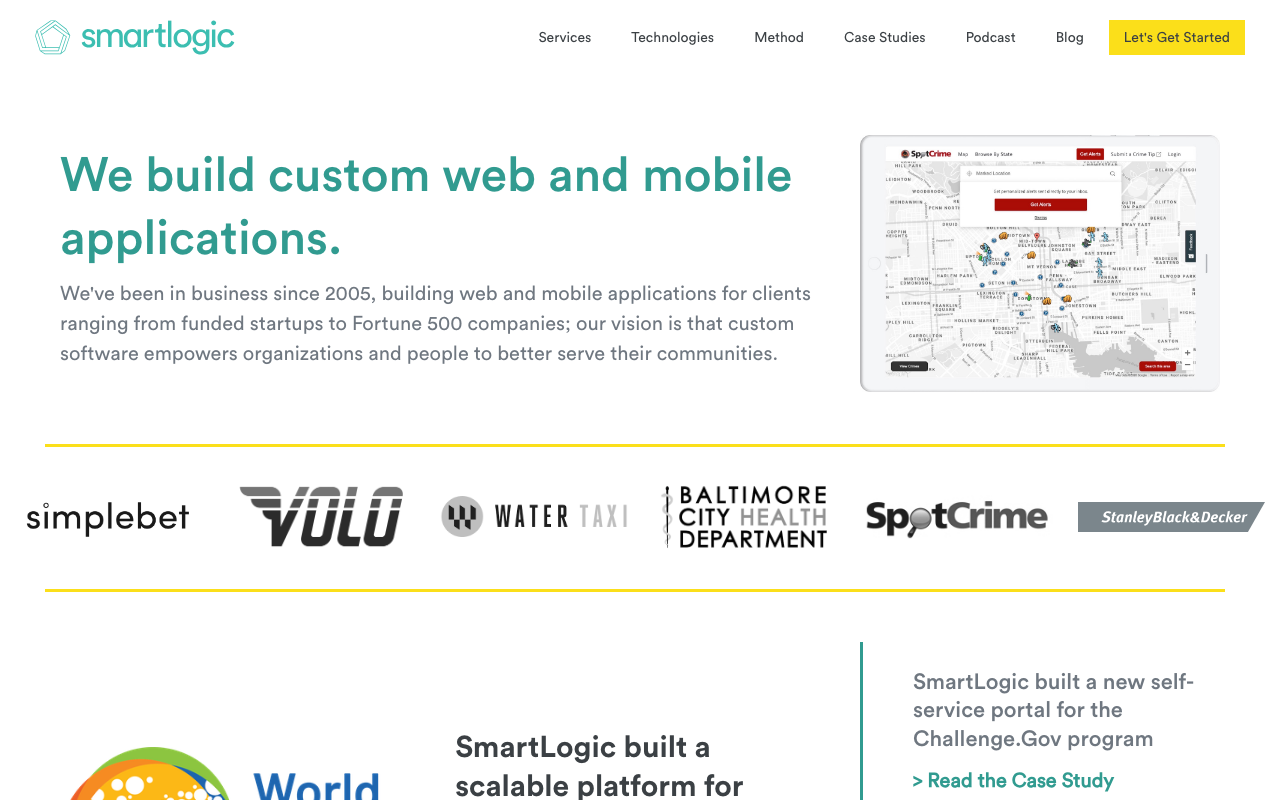
SmartLogic is a custom web and mobile application consultancy based in Baltimore, Maryland, building custom software since 2005. It says it has built over 150 custom applications for enterprises and startups, including startups later acquired by Groupon, Network for Good and Raytheon, and that over 40% of its annual revenue comes from repeat customers. Its client list on the homepage runs from the Baltimore City Health Department to Stanley Black and Decker.
It is the firm in this list that describes the no-engineering-team client most directly. In its own words: “Some of our clients have no technical staff but need an internal or external tool built, and so we function as their de-facto technical team.” It says almost everyone on its team codes, including its product designer and its director of marketing, and that it puts weight on translating between technical and business perspectives. Much of its work is new applications built from scratch on Elixir and Phoenix, Ruby on Rails, React and React Native, and its clients are concentrated in Maryland, New York, Washington DC and Virginia, though it has worked with clients on five continents.
Ideal for
Why they stand out
SmartLogic says in writing that it acts as the technical team for clients without one, and its repeat-customer share suggests clients keep it on after launch. Its civic and public health work is a strong signal for organizations in those sectors.
Pros
Cons
Verdict: pick SmartLogic when you want a firm that will openly act as your technical team, especially for a civic, health or public-sector tool.
Azumo is a nearshore software development company founded in 2016, headquartered in San Francisco, with engineers working from over a dozen countries in Latin America in US time zones. It says it is SOC 2 compliant, builds with AI coding assistants, and offers several delivery models, from one engineer inside your team to a fully managed build.
For a company without engineers, the managed option is the relevant one. Azumo describes managed project delivery as an agreed scope with written acceptance criteria and a named delivery manager accountable for hitting it, for a bounded build where you want it to own the outcome rather than staff the work. Its pricing is published and unusual. It breaks your scope into Delivery Units, each a defined, testable piece of working software with its own acceptance criteria, grades each by complexity, and gives the full price up front: $899 per Delivery Unit for MVPs and single-feature builds, $699 for full product builds, $499 for multi-phase platforms. It also says that if an engineer is not working out, it replaces them at no cost, with handover overlap so the codebase context is not lost.
Ideal for
Why they stand out
Price per testable piece of software is a sensible model for a buyer who cannot judge hours. You approve a list of things that will work, each with acceptance criteria, rather than a block of time.
Pros
Cons
Verdict: pick Azumo when you can write down the features you need and want a fixed price for each one, delivered by a nearshore team in your time zone.
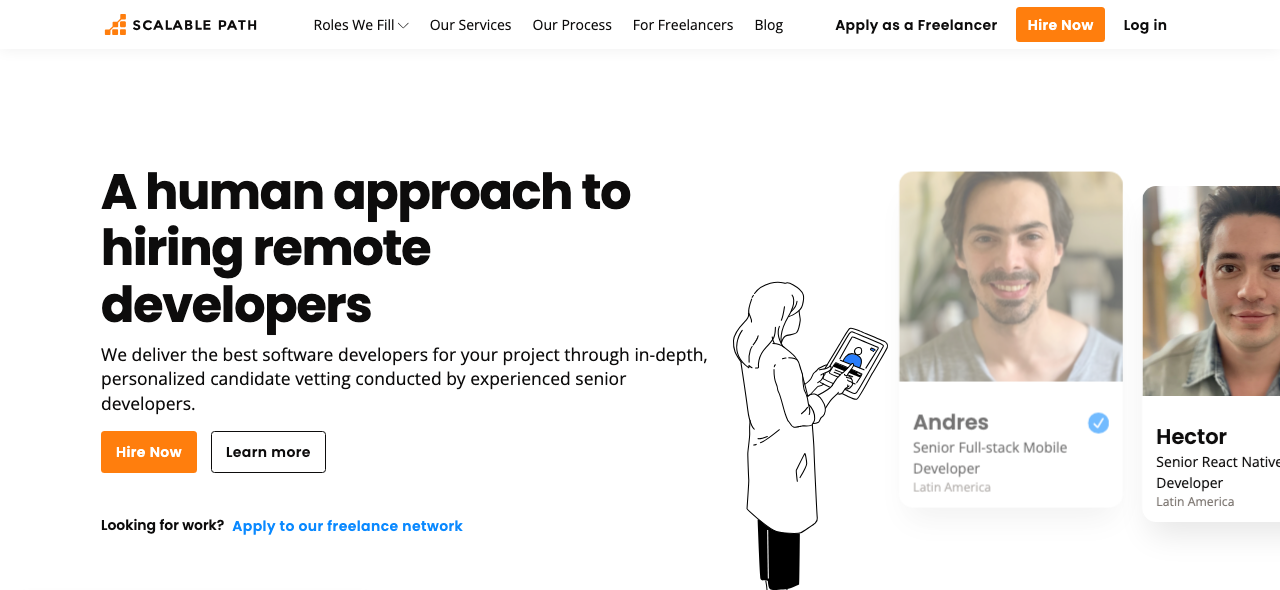
Not every company without engineers should hire a firm. Scalable Path is a remote developer marketplace and technical staffing company founded in 2010, made globally from San Francisco, which matches companies with vetted developers for contract-based work. It focuses on Latin America and says it has served over 300 clients. Its vetting is the selling point: senior engineers run a live technical challenge over video, tailored to your role, and share the recording with you, and it says about 4% of candidates make it through.
What makes it relevant here is that it places technical leaders as well as developers: fractional CTOs and project managers are both on its list of roles. A company with no engineers can hire a fractional CTO through it first, then the developers that person will direct. The terms are published: a minimum engagement of 150 hours or $7,500, roughly one developer for one month, a two-week risk-free trial, payment only for hours worked and no placement fees. A dashboard shows hours, invoices and, if you connect your repository, Git metrics.
Ideal for
Why they stand out
You interview and choose the people, with a recorded technical challenge to judge them by, and you can stop after a two-week trial. For a company that wants control of who works on its software, that is more control than any firm offers.
Pros
Cons
Verdict: pick Scalable Path when you want to build your own team over time and will hire a fractional CTO or technical lead first to direct it.
More than code. A company with engineers can review the work, judge an estimate and take over if the vendor disappears. A company without them needs those protections built into the engagement: a written definition of what is being built before the price, an approval step before each piece of work, someone accountable after launch, and ownership of the code and the accounts. The build is the easy part to buy. The relationship after it is where buyers without engineers get hurt, because they cannot tell a fair estimate from a padded one, and our guide on how to tell if an agency is padding the scope covers what to look for.
Sometimes, and it is worth saying when. A first hire wins when software is the core of your business and will be for years, when the roadmap is continuous, and when you have someone who can manage and review an engineer, because a lone developer without a technical lead is a risk. A firm wins when you do not yet know what to build, when the work comes in bursts, and when you need skills one person cannot cover. Budget the hire honestly: the US Bureau of Labor Statistics Occupational Outlook Handbook puts the median annual wage for software developers at $135,980 in May 2025, before benefits, recruiting and equipment. A common and sensible pattern is a firm first, then a hire who takes the code over. Our fractional CTO or engineering firm and freelancer or engineering firm comparisons cover the other two choices.
Decide this before you sign the build, not after. Custom software is never finished: libraries need updates, servers need patches, and the business keeps asking for changes. NIST’s Guide to Enterprise Patch Management Planning (SP 800-40 Rev. 4) calls patching “a critical component of preventive maintenance for computing technologies,” and says preventive maintenance helps prevent compromises, data breaches and operational disruptions. Without engineers, someone outside the company has to own that. Ask each firm three things: who answers when it breaks, how fast, and how a change is priced once the build is done. A firm that only talks about the build is answering half the question.
By owning the things you cannot judge. Make sure the repository, the hosting account and the domain are in your company’s name from day one, and that the contract says you own the code once fees are paid; our code ownership page sets out what that looks like with us. Then insist on a written approval step: no work starts until you have seen what it is and what it costs. And get a second opinion before any large rebuild, because a firm that only ever recommends a rebuild is not giving you an engineering opinion. If you are not sure the first build is even the right thing, scoping a software project explains the step that answers that before you commit a budget.
This turns our published process into questions you can put to any firm, us included, before you sign. A company without engineers should get a clear yes to each one in writing.
| # | Ask the firm | A good answer looks like |
|---|---|---|
| 1 | Will you define the product before you price the build? | A written brief and build estimate you own, before a build quote |
| 2 | Is every piece of work estimated and approved by me before it starts? | A level of effort and a budget per item, and no work without your yes |
| 3 | Do I see every change before it goes live? | A staging site where you approve changes first |
| 4 | Does a senior person review every change? | Every change reviewed by a lead developer before it merges |
| 5 | Who answers when it breaks, and what does that cost each month? | A named support arrangement with a predictable monthly cost |
| 6 | Do I own the code, the repository and the accounts? | Ownership in writing once fees are paid, and accounts in your name |
| 7 | How do I stop? | A notice period, and what you keep when you leave |
If a firm cannot answer question 1, you are paying it to find out what you want while the meter runs. If it cannot answer question 7, you are not hiring a partner, you are acquiring a dependency. Every answer for Razoyo is on our pricing page, including what a retainer includes and how to stop.
If you have no engineers, are not yet sure what to build, and want a fixed-price answer before any build quote, then the same team afterwards: Razoyo. If you run a service business of 50 to 300 people and want a help desk with response-time guarantees: Sourcetoad. If you want a firm that openly acts as your technical team, especially for a civic or health tool: SmartLogic. If you can list the features and want a fixed price for each: Azumo. If you want to build your own team and will hire a technical lead first: Scalable Path. If your software already exists and someone needs to take it over, see firms that take over existing codebases, and if the system you need is an internal tool or a customer portal, firms that build custom internal tools and portals. If it starts as a spreadsheet the business runs on, replacing a business-critical spreadsheet is the place to begin.
Options include small US engineering firms like Razoyo, service-business consultancies like Sourcetoad, firms that act as a client’s technical team like SmartLogic, nearshore companies with managed delivery like Azumo, and developer networks like Scalable Path. Pick by whether you need support after launch, how clear your scope is, and whether you have anyone to lead developers.
Hire a developer when software is your core business for years, the roadmap is continuous, and someone can manage and review an engineer. Use a firm when you do not yet know what to build, the work comes in bursts, or you need skills one person cannot cover. A firm first and a hire later is a common pattern.
Whoever you agree it with before the build. Ask each firm who answers when it breaks, how fast, and how changes are priced after launch. Razoyo’s ongoing support starts from $1,500 a month with the same team; Sourcetoad offers a help desk with response-time guarantees.
Ask for a written definition of the product before any build price, and an approval step where every piece of work is estimated and confirmed by you before it starts. Then get a second opinion before any large rebuild. Those two protections replace most of the judgment an in-house engineer would give you.
You should, in writing. With Razoyo, once fees are paid you own the code we write for you, and the repository. Whoever you hire, keep the repository, the hosting account and the domain in your company’s name from day one.
It depends on the scope, which is why a defined product should come before a build price. Published figures in this roundup: Razoyo’s System Spec is $2,500 fixed, MVPs start from $5,000 and support from $1,500 a month; Azumo prices $499 to $899 per Delivery Unit; Scalable Path’s minimum engagement is 150 hours or $7,500.
Yes, if someone can lead them. Networks like Scalable Path vet developers and also place fractional CTOs and project managers. Without a technical lead, you are directing work you cannot review, and nobody is accountable for the whole system.
Razoyo starts with a free 30 minute consultation and a $2,500 fixed System Spec that you own either way. MVPs start from $5,000, production builds from $10,000, and ongoing support from $1,500 a month with the same team. Before any work above the Spec, each piece is estimated and approved by you first.
If your business needs software and nobody on your team writes code, that is a free 30 minute conversation. Bring the job you want the software to do, and anything you already pay a developer to do every month. We will tell you whether it is worth building, whether it is worth a $2,500 System Spec, and if a first hire or an off-the-shelf product would serve you better, we will say so. Schedule Free Consultation.
Paul Byrne is President of Razoyo, a software engineering firm in The Colony, Texas taking prototypes and constrained systems into production since 2011.
These links open AI platforms with pre-written prompts about this page.
We use cookies to improve your experience. Do you accept?
To find out more about the types of cookies, as well as who sends them on our website, please visit our cookie policy and privacy policy.

