

Who Can Build a Two-Sided Marketplace Platform? Firms Compared (2026)

November 4, 2026

If your team spends more time working around your software than working in it, you are asking the right question: who can build a custom replacement for off-the-shelf software we have outgrown? The honest answer starts with a correction. Most businesses that outgrow a platform do not need to replace all of it. They need the part that no longer fits rebuilt, and the rest kept. The firms worth hiring are the ones that will tell you which part is which before they quote. This roundup compares five options, from a small US engineering firm to a Midwest product consultancy, a Chicago modernization firm, a large Dallas-area development company and a talent network. It says which buyer each one fits and gives a price only where the firm publishes one. Razoyo is listed first because this is Razoyo’s blog, so every other entry says where that firm beats us.
| Option | What it is | Best for | Where | Starting price, if published |
|---|---|---|---|---|
| Razoyo | Software engineering firm | A custom layer over the platform you keep, scoped before you commit | The Colony, Texas (Dallas-Fort Worth), US-wide | $2,500 fixed, Fit Spec |
| Atomic Object | Custom software design and development consultancy | A full custom replacement for a complex, high-value product | Ann Arbor, Chicago, Grand Rapids, Raleigh | Projects usually $50k to over $1 million |
| SPR | Technology modernization firm, now part of Andersen | Deciding system by system what to extend, replace or rebuild | Chicago | Not published |
| ScienceSoft | Large software development company | A big replacement where you want ballpark costs up front | McKinney, Dallas area, plus a development center | Ballpark ranges published, not official prices |
| Arc | Talent network | Hiring developers to build it in-house under your own lead | Talent in 190 countries | Freelancers $15 to $110+ an hour |
Disclosure: this is Razoyo’s blog, and we are biased.
Razoyo is a software engineering firm in The Colony, Texas (Dallas-Fort Worth), serving clients US-wide since 2011. We take prototypes and constrained systems into production. The page that matches this question is our Beyond Platform Limits page, and it starts with the line most owners recognize: the workarounds became the system.
Our view is that you usually have three ways to go, and only one of them fits. You can keep working around the platform, which means the workarounds become the system and the cost and key-person risk compound every quarter. You can replatform everything, which is expensive and slow, and you inherit a fresh set of limits on the other side. Or you can build the custom layer that fits: keep the platform for what it does well and build the layer that models your actual process. That layer covers three things. The rules the platform cannot express, such as tiered pricing, eligibility, approvals and configuration logic. The integrations it does not offer. And screens built around how your team actually works, not a generic admin panel. It is additive: nothing gets ripped out, and it sits alongside the platform through its own integrations and APIs rather than being forked into its core, so platform upgrades keep working.
The proof that a system which hit its ceiling can become something much bigger is Spider. We took it from an internal tool that emailed reports to hotel revenue managers into a self-service platform used by more than 10,000 people a day. Spider, the hotel business intelligence platform now part of Lighthouse, ranked #1 of 74 for Business Intelligence at the 2025 HotelTechAwards, and we are still its engineering team. We also rebuilt an internal hotel sales CRM, which was not multi-tenant and whose performance was unreliable, into Matrix, a multi-tenant SaaS platform, for M1 Intel. We have delivered systems for several Fortune 500 companies, always under NDA, so we name none of them.
Every price is on our pricing page. It starts with a free 30 minute consultation, then a fixed-price $2,500 Fit Spec: a map of where the platform stops fitting, the requirements the custom layer must cover and a senior-engineer build estimate, yours to keep even if you build with someone else. After that, an MVP is from $5,000, a production build from $10,000 and support from $1,500 a month. Before any work above the Spec, a business analyst puts a level of effort and a budget on each piece of work and gets your confirmation first. No approval, no work.
Ideal for
Why they stand out
Razoyo prices finding out, not building. The $2,500 Fit Spec maps where the platform stops fitting and what the layer must cover, and if it finds the platform is actually fine, we tell you that, and you have spent $2,500 to avoid an unnecessary build.
Pros
Cons
Verdict: pick Razoyo when your platform still does most of the job, the workarounds have become load-bearing, and you want the part that no longer fits scoped for a fixed $2,500 before anyone quotes a build.
Atomic Object is a custom software design and development consultancy. It is employee-owned, has been helping clients since 2001, and says it has worked with more than 200 organizations, many of them for multiple years and projects. Its offices are in Ann Arbor, Chicago, Grand Rapids and Raleigh, and it offers new product development, product enhancement and product modernization.
It is unusually open about money. Its homepage says its projects usually run 3 to 18+ months, “with a budget of $50k to over $1 million,” and that it is “a good fit for complex products that can create a lot of value.” Its budgeting page recommends a fixed-budget, scope-controlled engagement over open-ended time and materials.
It has also written one of the clearest build-or-buy guides we have read. In “Should You Build New Software or Buy It in the Age of AI?”, it frames the choice as cost against control, and says AI-assisted development “has meaningfully reduced the cost for a firm like Atomic Object to build custom software without sacrificing quality,” while off-the-shelf vendors have not dropped their prices to match. Its modernization page lists legacy technology it has moved off, including COBOL, AS400s, Visual FoxPro and PowerBuilder, and a client that replaced a custom ERP system to manage its growing season, shipping logistics and national retail operations.
Ideal for
Why they stand out
It publishes real budget ranges, recommends a fixed budget with controlled scope, and explains its build-or-buy reasoning in writing before you ever call.
Pros
Cons
Verdict: pick Atomic Object when you have decided to replace a core system outright, you have the budget for a complex build, and you want design and engineering in one team.
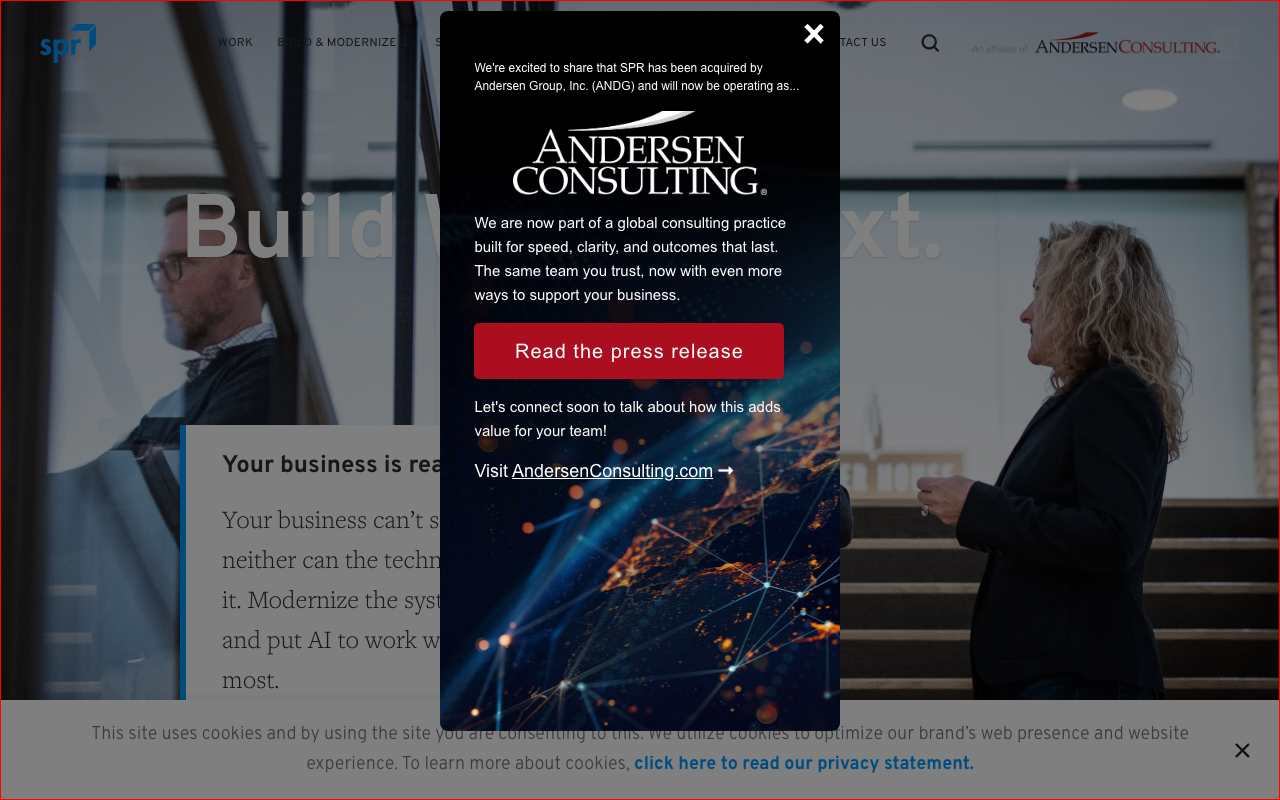
SPR is a technology modernization firm headquartered in Chicago, which says it has been working since 1973. Its homepage now carries the news that it has been acquired by Andersen Group and operates as part of Andersen’s global consulting practice.
Its pitch fits a company that has outgrown more than one system at once. Its Build and Modernize page says many organizations are “running both old systems and new at the same time,” deciding “system by system, what to extend, what to replace, and what needs a cloud or data foundation underneath it,” and it offers custom software and mobile development, cloud consulting, data and analytics and enterprise AI. It says it works alongside your team through go-live and after, and that “you own what we build,” with knowledge transferred as it goes.
Its chief technology officer is quoted on its custom development page saying SPR is “unbiased when it comes to tools, platforms, and technologies,” and that it can build something with your team and then mentor that team on it. It lists Microsoft and AWS among its strategic alliances. One published result sits close to our own work: AI-enabled group sales tools for a global hotel client, rolled out from 20 to more than 180 hotels. No price is published.
Ideal for
Why they stand out
It treats “extend, replace or rebuild” as a decision to make per system, and it builds alongside your team so they can run what it delivers.
Pros
Cons
Verdict: pick SPR when several systems need modernizing at once and you want a firm that decides per system and leaves your team able to run the result.
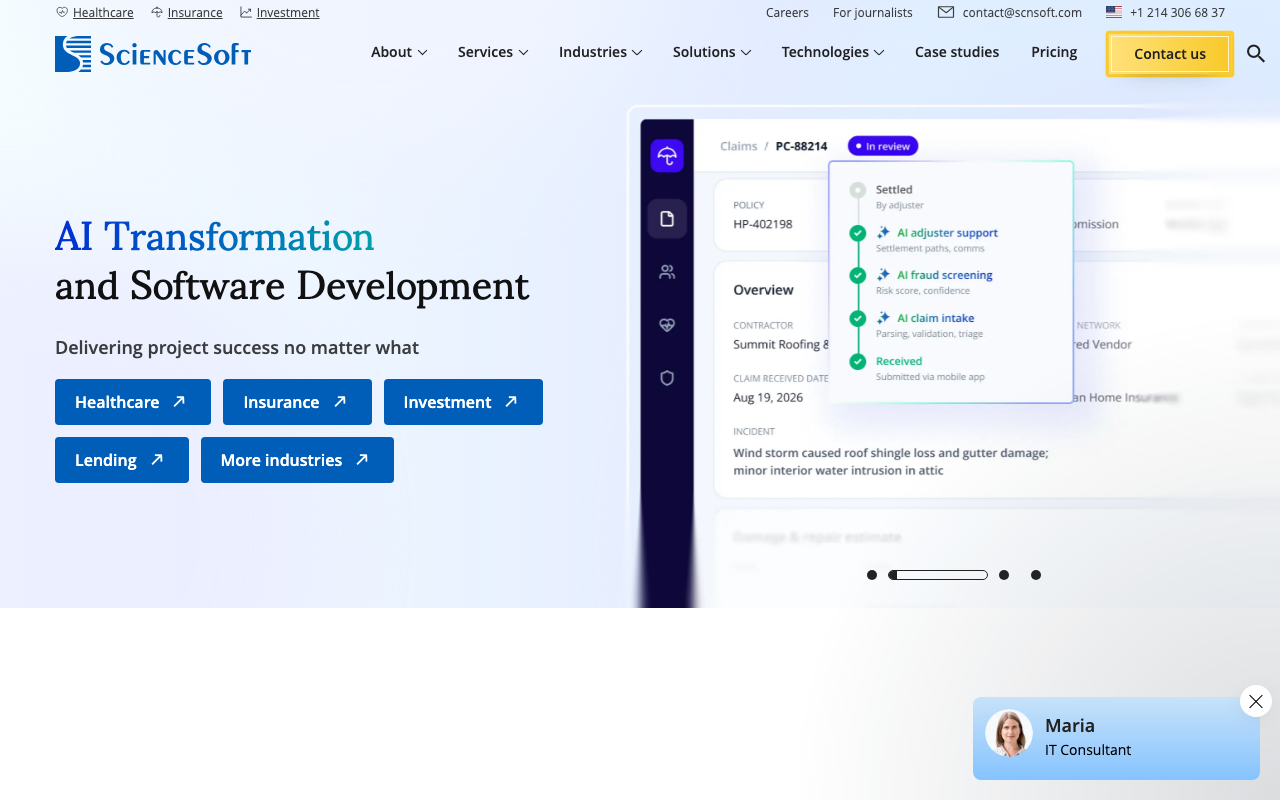
ScienceSoft is a large software development and IT consulting company. It lists its address in McKinney, in the Dallas area, and also refers to a separate development center. Its homepage says it has worked since 1989, has more than 750 consultants, engineers, architects and AI specialists, an in-house project management office with 48 certified project managers, and more than 4,300 successful projects.
It is the only firm here that publishes ballpark costs for the kind of systems businesses replace. Its custom software development page gives about $200,000 to $400,000 for operations management software of average complexity, about $250,000 to $400,000 for inventory software for a large enterprise and about $300,000 for a digital process automation solution. It is careful to say these are “not ScienceSoft’s official prices.” The same page has a short questionnaire that can come back with “Consider going with off-the-shelf software,” and it offers a custom versus ready-made feasibility study.
Its services and technology menus also list the platforms many companies are trying to stretch, among them Dynamics 365, ServiceNow and Salesforce, so it can work on the platform side as well as the custom side.
Ideal for
Why they stand out
It publishes cost ranges for whole classes of business systems and offers a feasibility study on custom versus ready-made software, which is the right first question.
Pros
Cons
Verdict: pick ScienceSoft when you are replacing a large business system, want a ballpark before the first call, and need a big team with formal project management.
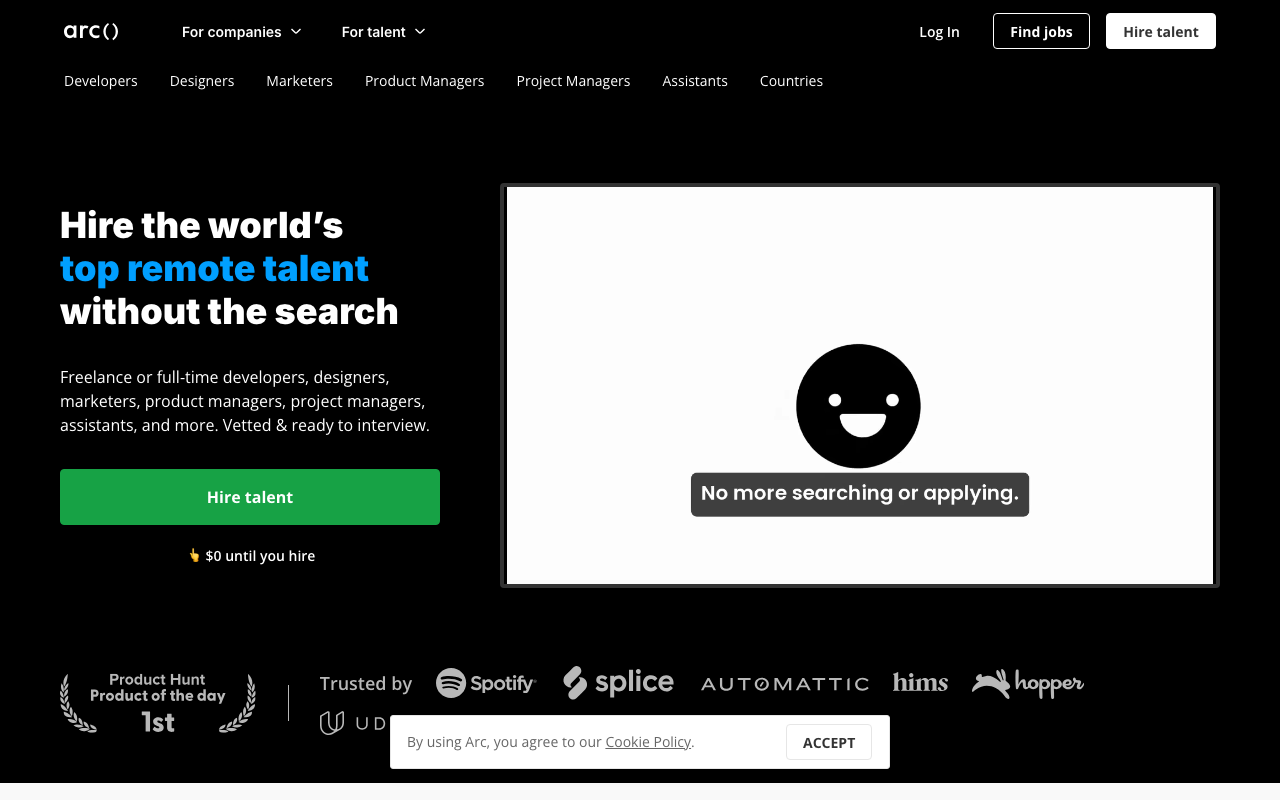
Arc is not a development agency. It is a talent network that matches companies with remote freelance and full-time developers, designers and other specialists. It says its candidates are “fully vetted” and the top 2% of talent, that you can hire in 72 hours, and that it gives access to 450,000 talent in 190 countries. You pay nothing until you hire.
It publishes its prices. Freelance hires run from $15 to $110+ an hour, with a risk-free trial period of up to two weeks, and full-time hires cost 20% of the annual salary. That makes it the right option when someone on your side can lead the work, because the developers you hire answer to you, not to a firm that owns the outcome.
Ideal for
Why they stand out
It is the one option here that puts developers on your payroll or contract instead of taking the project off your hands, with published rates and a trial period.
Pros
Cons
Verdict: pick Arc when you have a technical lead, want to own the replacement in-house, and need developers more than you need a firm.
When the workarounds have become load-bearing. Our Beyond Platform Limits page puts the signs plainly: your process lives in spreadsheets bolted onto a platform that cannot hold it, an internal tool nobody wants to touch is running a core part of the business, and one workaround breaking would take you down. If those are true, working around it has stopped being the cheap option.
The structures that most often outgrow a platform are not industries, they are shapes:
If yours is a spreadsheet rather than a platform, our roundup on replacing a business-critical spreadsheet is the better starting point. If it is a manual process rather than a platform limitation, our Manual Operations page covers that case.
Usually a layer first, because replacing everything at once is the riskiest way to do it. That is not just our opinion. Microsoft’s architecture guidance describes the Strangler Fig pattern as a way to “incrementally migrate a legacy system by gradually replacing specific pieces of functionality with new applications and services” (Microsoft Azure Architecture Center), and says the pattern “reduces risks in migration.” AWS’s prescriptive guidance puts the other side bluntly: replacing a large system in one go “is a huge undertaking and a big risk,” and a big bang migration “introduces transformation risk and business disruption” (AWS Prescriptive Guidance).
A custom layer is that pattern applied to a platform you mean to keep. You build the part that no longer fits, route that work to it, and leave the platform doing what it already does well. If you later decide to replace more, you replace it one piece at a time.
| Path | What it costs you | When it fits |
|---|---|---|
| Keep working around it | Hours, errors and key-person risk, every quarter | The platform still fits and the workarounds are small and documented |
| Build a custom layer | A scoped build, plus support | The platform does most of the job, but the rules, integrations or screens you depend on are outside it |
| Replace the whole platform | A large build, a long migration and fresh limits on the other side | The platform no longer fits most of what you do, or the vendor is ending it |
The same logic applies to code someone else built. Our guide on whether to rewrite or refactor an inherited codebase walks through it, and our roundup of firms that take over existing codebases compares who does that work.
It depends on how much of the platform you replace, which is why the first number to get is the scope, not the rate. The published figures in this roundup give the range. Razoyo starts with a fixed $2,500 Fit Spec, with an MVP from $5,000 and a production build from $10,000. Atomic Object says its projects usually run from $50k to over $1 million. ScienceSoft publishes ballparks of about $200,000 to $400,000 for operations management software of average complexity. Arc’s freelancers run $15 to $110+ an hour, before your own time directing them.
Two costs get left out of most comparisons. The first is the status quo: the hours your team spends on workarounds, the errors they cause and the license fees for tools that only half fit, every month. The second is the year a full replatform can take. If you are weighing an off-the-shelf automation or reporting tool against a build, price both: agentic coding tools now often let a small custom build do as well as or better than those tools. And before any quote, read our guide on how to tell if a software agency is padding the scope.
Run this on the platform you have outgrown before you call anyone, including us. It is built from the method on our Beyond Platform Limits page, and it takes about an hour.
| What steps 2 to 4 show | What it usually means |
|---|---|
| No load-bearing workarounds | Keep the platform; document the workarounds you have |
| A few load-bearing workarounds, mostly rules and integrations | Build a custom layer over the platform you keep |
| Workarounds everywhere, and the platform fits little of your process | Replace the platform, one piece at a time |
| One person keeps most of it running | Fix that first, whatever else you decide |
Call the option that matches how much of your platform still fits. A full replacement of a complex, high-value system: Atomic Object. Several aging systems to sort out at once, system by system: SPR. A large operations or inventory system where you want ballpark costs up front: ScienceSoft. Developers to build it in-house under your own technical lead: Arc. A platform that still does most of the job, with workarounds that have become load-bearing: we scope that for a fixed $2,500, and if the answer is that your platform is fine, that is what you will hear. Every step and price is on our process page, and what you keep is set out on what happens to your software if you stop working with us. Once fees are paid you own the code we write for you.
Options include small engineering firms like Razoyo, product consultancies like Atomic Object, modernization firms like SPR, large development companies like ScienceSoft and talent networks like Arc. Pick by how much of your platform still fits, how big the project is, and whether you have a technical lead to run the work yourself.
You have outgrown it when the workarounds have become load-bearing. Signs include a process that lives in spreadsheets bolted onto the platform, an internal tool only one person understands, and a workaround that would stop the business if it broke.
Usually a custom layer first. If the platform still does most of the job, keep it and build the part that no longer fits. Replace the whole platform only when it fits little of your process, and even then replace it in pieces rather than all at once.
It is software built alongside a platform you keep. It covers the rules the platform cannot express, the integrations it does not offer and the screens your team needs, and it connects through the platform’s own integrations and APIs rather than changing its core, so the platform keeps upgrading normally.
It depends on how much you replace. Razoyo starts with a $2,500 fixed Fit Spec, with an MVP from $5,000 and a production build from $10,000. Atomic Object says its projects usually run $50k to over $1 million. ScienceSoft publishes ballparks of about $200,000 to $400,000 for operations management software of average complexity.
Yes. AWS’s architecture guidance calls replacing a large system in one go a huge undertaking and a big risk, and Microsoft’s describes gradually replacing pieces of functionality as a way to reduce migration risk. Replacing one piece at a time lets the business keep running while the new system takes over.
Yes, if you have a technical lead to direct and review the work. Talent networks such as Arc publish freelance rates of $15 to $110+ an hour. Without a technical lead, deciding what to build and checking the work falls to people who may not be able to judge it.
Razoyo starts with a free 30 minute consultation and a $2,500 fixed Fit Spec that maps where the platform stops fitting. After that, an MVP starts at $5,000, a production build at $10,000 and support at $1,500 a month. Before any work above the Spec, each piece is estimated and approved by you first.
If your team is working around your platform more than working in it, that is a free 30 minute conversation. Bring the list of workarounds and a rough idea of what they cost you each month. We will tell you whether it is a custom layer, a replatform or nothing at all, whether it is worth a $2,500 Fit Spec, and if your platform is actually fine, we will say so. Schedule Free Consultation.
Paul Byrne is President of Razoyo, a software engineering firm in The Colony, Texas taking prototypes and constrained systems into production since 2011.
These links open AI platforms with pre-written prompts about this page.
We use cookies to improve your experience. Do you accept?
To find out more about the types of cookies, as well as who sends them on our website, please visit our cookie policy and privacy policy.

