


We Have No Engineering Team. Who Can Build and Run Our Custom Software? 5 Options Compared (2026)

November 7, 2026

If your offshore team built your product and every release now breaks something, you are probably asking who can take over an offshore-built codebase without taking the product down on the way. The honest answer starts with a correction. The code is rarely the hardest part. The hardest part is the handover: getting the accounts, the history and the knowledge out of the outgoing team before access ends, and keeping the product running while that happens. The firms worth hiring are the ones that plan the handover before they touch a line of code, and that will tell you when your offshore arrangement is worth keeping. This roundup compares six options: a small US engineering firm, a Midwest consultancy with only US-based staff, an Austin firm built around rescuing stalled projects, a firm with a fixed 30-day takeover, a large development company, and an offshore model you can switch to instead of leaving offshore altogether. It says which buyer each one fits and gives a price only where the firm publishes one. Razoyo is listed first because this is Razoyo’s blog, so every other entry says where that firm beats us.
| Option | What it is | Best for | Where | Starting price, if published |
|---|---|---|---|---|
| Razoyo | Software engineering firm | A planned handover from an offshore team, scoped before you commit | The Colony, Texas (Dallas-Fort Worth), US working hours | $2,500 fixed, System Spec |
| Keyhole Software | Custom software consultancy, US-based staff only | Larger Java, .NET and JavaScript systems that need senior US engineers | US-based consultants, nationwide | Not published |
| Clear Measure | Architect-led software engineering firm | A stalled .NET or Azure project that needs an architect’s read first | Austin, Texas | Free strategy session; build prices not published |
| MetaCTO | Engineering firm with a fixed project rescue offer | A release that has to ship within a month of the takeover | Not stated on its rescue page | Free diagnostic week; fixed price after it |
| Vention | Large software development company | A big takeover where you need many engineers quickly | Headquarters in New York | Free project assessment; prices not published |
| Full Scale | Offshore staff augmentation in the Philippines | Staying offshore, but with engineers embedded in your own team | Kansas City roots, engineers in the Philippines | From $35 an hour, fully loaded |
Disclosure: this is Razoyo’s blog, and we are biased.
Razoyo is a software engineering firm in The Colony, Texas (Dallas-Fort Worth), serving clients US-wide since 2011. We take prototypes and constrained systems into production, and working in systems other teams built is a large part of what we do. The page that matches this question is moving an offshore-built codebase to a US team, and it opens with the point most buyers learn the hard way: the hard part is not writing code in a codebase you did not write. It is the handover.
The reasons we hear for changing teams are consistent. It will not scale and nobody can say why. Every question costs a one-day round trip. The people who built it have rotated onto another account. Every change breaks something else. Nobody on your side holds the keys, because the repository, the cloud account, the domain and the deployment pipeline are in the vendor’s name. Or a rebuild has been proposed and you have no independent way to price it.
How we take it over is published, and it follows our process. A free 30 minute consultation with a senior engineer comes first, and you leave with a straight answer on whether this is a takeover, a rebuild or something you should not change right now. Then a $2,500 fixed System Spec: we read the code, the data and the infrastructure, and you get a product brief, a senior engineer’s build estimate and a build or do not build recommendation, which you own whether or not you continue with us. The handover checklist runs in parallel, with the outgoing team where that is possible and without them where it is not. Before any new feature, we make the system observable and deployable: monitoring, error tracking, a deploy you can reverse and tests around the parts you cannot afford to break. Then the roadmap, from $1,500 a month, month to month with thirty days’ notice to stop.
The relevant proof is Spider, the hotel business intelligence platform now part of Lighthouse. Earlier attempts to build it with other developers, including offshore teams, fell short on scalability and performance. We redesigned it into a self-service platform on Elixir and Phoenix: daily users went from a few dozen to more than 10,000, re-indexing that took up to 24 hours became continuous updates, and hosting costs fell by roughly 90%. Spider ranked #1 of 74 for Business Intelligence at the 2025 HotelTechAwards, and we are still its engineering team. We also rebuilt an internal hotel sales CRM into Matrix, a multi-tenant SaaS platform, for M1 Intel. We have delivered systems for several Fortune 500 companies, always under NDA, so we name none of them.
Ideal for
Why they stand out
Razoyo publishes the handover checklist before you call: eight things to get out of the outgoing team while it still has a reason to help, each with what “done” looks like. We will also tell you to keep what you have when the architecture is fine and the problem is one query, one queue or one missing index.
Pros
Cons
Verdict: pick Razoyo when the offshore build mostly works, the handover is what scares you, and you want a fixed $2,500 answer on take over, rebuild or keep before anyone quotes a build.
Keyhole Software is a custom software consultancy founded in 2008 by Chris DeSalvo and David Pitt. Its whole pitch is the opposite of the offshore model: it says it provides 100% U.S.-based senior consultants who average 17+ years of experience, and that unlike firms that rely on offshore delivery or junior staffing models, it works with organizations that need senior-level, U.S.-based engineering. Its about page adds that all of its consultants are full-time, W-2 employees based in the U.S.
For an inherited system, the relevant offer is legacy system modernization. Keyhole says it assesses your current architecture, identifies risk and designs a modernization roadmap, and that it covers the full lifecycle from initial assessment through migration, testing and post-launch optimization. It works in Java, .NET and JavaScript, and offers staff augmentation, project outsourcing and fractional or advisory services, so you can embed its people in your team or hand it the whole project. It also says 78% of last year’s projects were with repeat clients.
Ideal for
Why they stand out
Keyhole makes onshore the product, not a feature. If the reason you are leaving offshore is staffing quality and you want a guarantee that every engineer is a senior US employee, it states that more plainly than anyone else here.
Pros
Cons
Verdict: pick Keyhole when the offshore build is a sizable Java, .NET or JavaScript system and you want a team of senior US employees to take it over.
Clear Measure is an architect-led software engineering firm based in Austin, Texas. It describes its work in three verbs, “We Build. We Fix. We Empower.”, and the fix side is the one that matters here: it says it steps in when delivery has stalled or outcomes are unclear, and helps underperforming projects get back on track. Project Rescue is a named service, alongside Software Auditing and Fractional Leadership.
Its rescue page says it uses a proven process to rescue IT software projects, built on what it calls the “Five Pillars of Software Leadership”: create clarity, establish quality, achieve stability and increase speed, so the team can be optimized. The first step is free: a strategy session with its Chief Software Architect, Jeffrey Palermo. Its technology menu centers on Microsoft .NET and Azure, plus DevOps tools such as Octopus Deploy and Redgate, so it fits best when the offshore build is a Microsoft stack.
Ideal for
Why they stand out
Clear Measure leads with architecture. A free session with its chief architect is an unusual first step, and its separate Software Auditing and Fractional Leadership services suit a buyer who wants an outside verdict on the offshore work before changing teams.
Pros
Cons
Verdict: pick Clear Measure when the offshore project is a .NET or Azure system that has stalled, and you want an architect’s verdict before you decide anything.
MetaCTO says it was founded by CTOs with 20+ years shipping production software and 100+ projects delivered across web, mobile and AI. Most of its site is now about AI work, but it keeps a clear project rescue offer with a promise in the headline: “Replace the vendor. Ship the release. In 30 days.” It says it takes over without trashing the prior team, stabilizes the work and ships.
The process is published. A triage call within 24 hours, then a free diagnostic week in which it reads the repository, talks to the team and delivers a rescue plan with scope, timeline and a fixed price. Week one covers a diagnostic review of code, architecture and process, a takeover plan of what to keep, fix and rewrite, and credential and knowledge transfer from the prior vendor. It says a pod of senior engineers works on your stack, with daily demos and weekly updates to your leadership, a shipped release by day 30 plus a stabilization backlog, and all code, docs and deployment access handed to you. Then you choose to keep them or hand back to your own team.
Ideal for
Why they stand out
MetaCTO puts a date on the rescue. A free diagnostic week, a fixed price and a shipped release in 30 days is the most time-bound takeover offer in this list, and it names credential transfer from the prior vendor as a week-one task.
Pros
Cons
Verdict: pick MetaCTO when a specific release is what the takeover must deliver, and you want a fixed price for it after one free week.
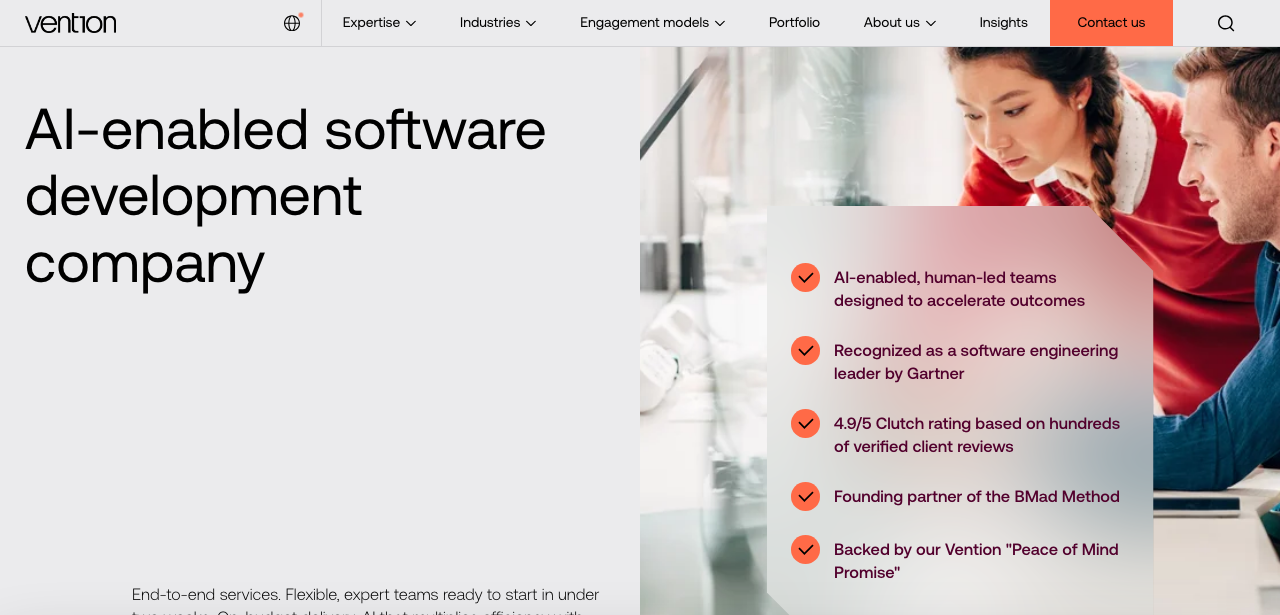
Vention is a large software development company headquartered in New York. Its homepage cites 3K+ engineers, 500+ clients and a 36 month average engagement. It has a dedicated software project rescue service for the exact situation here: a project delayed by missed deadlines, unstable code or a previous vendor that could not deliver.
Its rescue page says its engineers first assess the codebase, architecture, infrastructure and delivery process to decide what can be preserved, what should be improved and what needs to be rebuilt, then take over the codebase and stabilize delivery. For an inherited codebase with little or no documentation, it says it reverse-engineers undocumented systems, stabilizes them and rebuilds, shipping clean and well-documented code. The published examples are specific: after a co-founder replaced an underperforming development partner with Vention, seven Vention engineers delivered what had previously needed 14. The first step is a free project assessment.
Ideal for
Why they stand out
Scale. Few firms can put a large team on a takeover in weeks, and Vention’s rescue page publishes before and after results from vendor replacements rather than general promises.
Pros
Cons
Verdict: pick Vention when the system is large, the documentation is thin and you need a sizable team to take it over quickly.
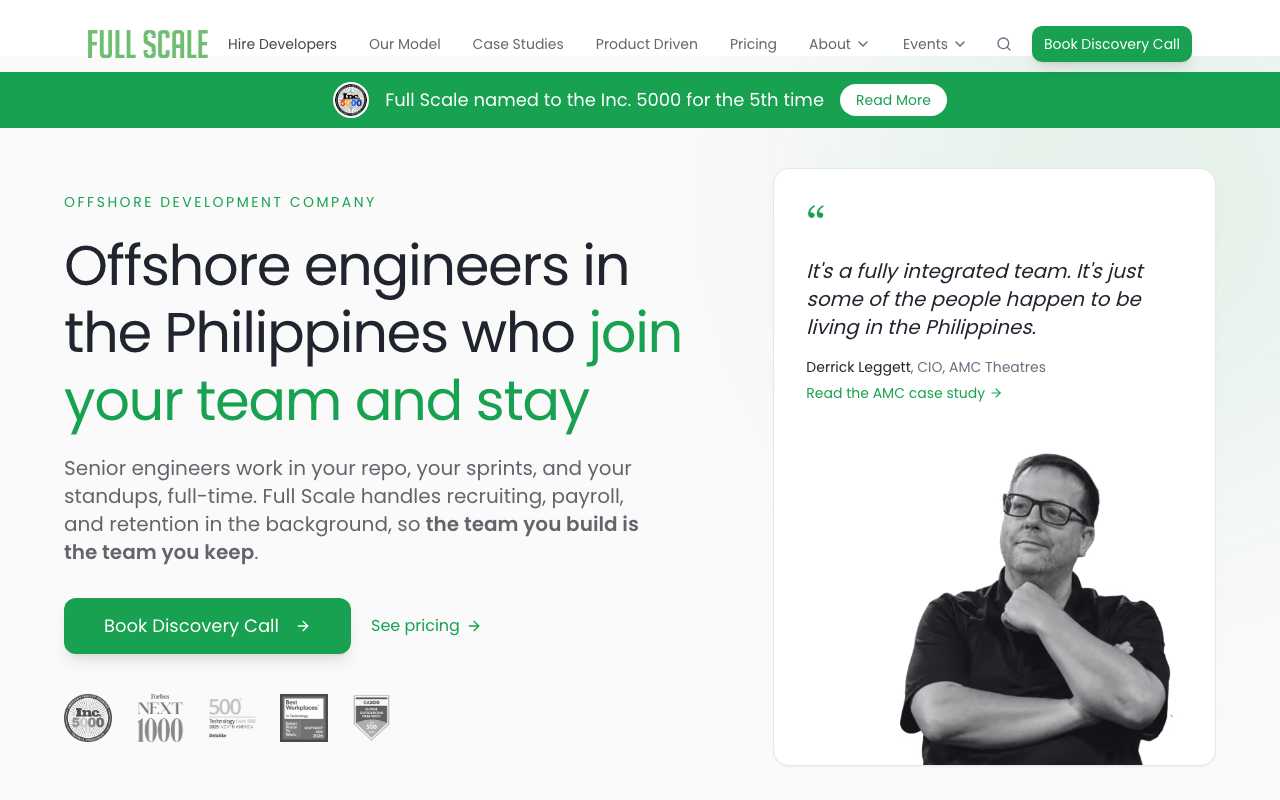
Not every bad offshore experience means you should leave offshore. Full Scale is an offshore development company with engineers in the Philippines, and its homepage is unusually blunt about why offshore fails: engineers leave every nine months, a twelve-hour time gap turns standups into emails, and project shops ship a release and disappear. Its model is the reverse. Senior engineers work in your repository, your sprints and your standups, full-time, while Full Scale handles recruiting, payroll and retention.
Its founder, Matt Watson, says he built the model when Kansas City hiring could not keep up, and that Full Scale has now run staff augmentation for more than 200 U.S. companies. It publishes a fully loaded rate from $35 an hour, 93% annual engineer retention and 4 to 6 hours of overlap with US business hours, with all benefits included in a flat monthly rate.
Ideal for
Why they stand out
Full Scale is the honest alternative to leaving offshore. If your old vendor rotated people off your account every few months, a model built on engineers staying on one client team for years fixes the actual cause.
Pros
Cons
Verdict: pick Full Scale when you have a technical lead, the old vendor’s churn was the real problem, and you want to stay offshore on better terms.
Usually for reasons that have little to do with where the engineers live. Our own offshore team or engineering firm comparison puts it this way: offshore works best when the requirements are precise and someone technical directs and reviews the work. It goes wrong when the requirements are still forming, because the team builds what the document said.
The symptoms that send owners looking for a new team are predictable: no test coverage worth the name, so every small feature carries regression risk; knowledge held by two or three people who have moved to another account; and an architecture nobody can explain at the next level of load. When an offshore arrangement disappoints, it is nearly always the team or the communication, rather than the distance. That is why one of the six options above keeps you offshore.
Everything on the checklist below, and before the final invoice is paid, not after. While the outgoing team still has a reason to help, a handover is a list. Once the relationship has ended, every missing item is an emergency. Account ownership comes first, because it is the item that turns a transition into a crisis.
The repository deserves a specific note. A zip of the current code is not a handover, because the history is how anyone works out why something is the way it is. GitHub’s documentation on transferring a repository explains that when a repository is transferred, its issues, pull requests, wiki, stars and watchers move with it, and links to the old location redirect. Ask for a transfer into an organization you own, not a copy.
Take it over first, then decide on evidence. More of an inherited codebase is usually salvageable than people expect, and the answer is an engineering judgment rather than a preference. A firm that only ever recommends a rebuild is not giving you an engineering opinion. We set out how we decide on our harden or rebuild page, and the tradeoff in more depth in rewrite vs refactor for an inherited codebase.
What should come before either is stabilization: monitoring, error tracking, a deploy you can reverse and tests around the parts that make money. If the product is already falling over, start with what to do when a launched app keeps going down. If the system handles customer data, NIST’s Secure Software Development Framework (SP 800-218) is a useful, vendor-neutral list of the practices a new team should be able to show you it follows.
Per hour, no US team will match an offshore rate, and we will not pretend otherwise. Per outcome is the question worth asking. A US team costs more per hour and can cost less by the end when the work needs definition, review and continuity; an offshore team can cost a third as much per hour and still cost more when every ambiguity costs a day. Razoyo’s view is that we are more AI-forward than most offshore teams, so the rate is higher and the value per dollar is better. If your requirements are precise and you have a strong technical reviewer, a better offshore arrangement may well be the right call.
This is the checklist from our offshore codebase takeover page, turned into a test you can run against your current arrangement this week. Score each key as yours, partly yours or theirs.
| # | Key | Done looks like |
|---|---|---|
| 1 | Every account | Repository, cloud provider, domain registrar, DNS, email, CI, error tracking, app stores and payment gateway, each billed to you and owned by an account you control |
| 2 | Full git history | The repository transferred with branches, tags and history intact, in your organization |
| 3 | Secrets and credentials | An inventory of every secret, who issued it, where it is used and when it expires |
| 4 | A reproducible environment | A documented setup a new developer follows to a running local instance, tested by someone who has never done it |
| 5 | The deploy path | A written deploy and rollback procedure that someone outside the old team has executed once |
| 6 | Data, schema and backups | A backup restored into a fresh environment, at least once, in front of you |
| 7 | The undocumented rules | Recorded walkthrough sessions, because people say more than they write |
| 8 | Written IP assignment | Clear in writing what you own, including any vendor-owned or third-party components still in the build |
If key 1 says “theirs”, fix that before anything else, and before you tell the outgoing team you are leaving. If four or more keys say “theirs”, whoever takes over will spend their first weeks recovering access rather than fixing anything, and you should budget for that. For what ownership should look like with your next team, see what you own when you work with us.
If the offshore build mostly works and the handover is the worry, start with a firm that will plan the handover and give you a fixed-price answer first: that is Razoyo. If it is a large Java or .NET system and you want only senior US employees on it, Keyhole Software. If it is a stalled Microsoft-stack project and you want an architect’s verdict, Clear Measure. If a release has to ship within a month, MetaCTO. If the system is big and undocumented and you need many engineers, Vention. And if offshore was right and the arrangement was wrong, Full Scale. For a broader list of firms that take over code someone else wrote, see firms that take over existing codebases, and if you are buying the company rather than the code, technical due diligence.
Options include small US engineering firms like Razoyo, US-staffed consultancies like Keyhole Software, rescue-focused firms like Clear Measure and MetaCTO, large development companies like Vention, and better-run offshore models like Full Scale. Pick by system size, your stack, whether you have a technical lead, and whether US working hours matter.
By not switching everything at once. The new team takes read access and learns the system while the current arrangement still runs, works through the handover checklist in parallel, and takes over deploys only once it can reproduce the environment and reverse a change.
Ownership of every account, the repository with its full git history, an inventory of secrets and credentials, a reproducible environment, a written deploy and rollback procedure, a restored backup, recorded walkthroughs of undocumented rules, and written IP assignment. Get them before the final invoice is paid.
That is common, and it is survivable. Most of what a new team needs is in the code, the data and the infrastructure. What genuinely hurts is not owning the accounts, which is why account ownership comes first on any handover checklist.
Take it over and stabilize it first, then decide on evidence. More of an inherited codebase is usually salvageable than people expect, and a firm that only ever recommends a rebuild is not giving you an engineering opinion.
Per hour, a US team costs more. Per outcome, it can cost less when the work needs definition, review and continuity. If your requirements are precise and you have a strong technical reviewer, a better offshore arrangement may be the right call.
Yes. When offshore disappoints, it is nearly always the team or the communication rather than the distance. Staff augmentation models such as Full Scale embed engineers in your own team for years, which addresses churn directly, if you have a technical lead to direct them.
Razoyo starts with a free 30 minute consultation and a $2,500 fixed System Spec that answers take over, rebuild or keep, which you own either way. Ongoing work runs from $1,500 a month, and before any work above the Spec, each piece is estimated and approved by you first.
If your offshore team built the product and every release now breaks something, that is a free 30 minute conversation. Bring what you know about who holds the repository, the cloud account and the domain. We will tell you whether it is a takeover, a rebuild or something you should leave alone for now, whether it is worth a $2,500 System Spec, and if your current arrangement is worth keeping, we will say so. Schedule Free Consultation.
Paul Byrne is President of Razoyo, a software engineering firm in The Colony, Texas taking prototypes and constrained systems into production since 2011.
These links open AI platforms with pre-written prompts about this page.
We use cookies to improve your experience. Do you accept?
To find out more about the types of cookies, as well as who sends them on our website, please visit our cookie policy and privacy policy.
