

Software Idea, No Technical Background: Your Real Options (2026)

November 12, 2026

If you are about to pay a firm to build software, you want a software development company that lets you own the code and the repo: the source code, its full history, and the accounts it runs on, in your name, so you can change teams without starting over. Almost every firm says you will own it. Far fewer say, on their own website, when ownership passes, what they keep, and what you get on the day you leave. This roundup compares six firms that do put it in writing, from a small Texas engineering firm to offshore teams in Vietnam and India, plus one company that is not a developer: a software escrow firm, for when a vendor will not hand over the code. Razoyo is listed first because this is Razoyo’s blog, so every other entry says where that firm beats us.
None of this is legal advice. Read each firm’s own words before the first call, then have your lawyer read the contract.
| Firm | What it is | What its own site says you own | What it says about leaving or handover | Published price |
|---|---|---|---|---|
| Razoyo | Software engineering firm, The Colony, Texas | The code it writes for you, the documents, the repository with full history, the infrastructure, once fees are paid | Five-part handover with rotated credentials; retainers end on 30 days’ notice | System Spec $2,500 fixed; MVP from $5,000 |
| Chop Dawg | App development company since 2009, team across the US, Brazil and Pakistan | The source code and IP from day one; the code lives in your GitHub repository | Revoke the partner’s access and keep everything | From $5K a month by service; web apps from $7.5K a month |
| Wavect | Software studio in Tyrol and Vienna, Austria, founded 2018 | Repositories in your own organization with full git history | Handover checklist included in the build at no extra charge | First step (discovery and roadmap) €3,500 fixed; developer hours €130 |
| Chetu | Large development company headquartered in Sunrise, Florida | Full source code and IP ownership of your custom software | Not detailed on the pages we read | Not published |
| SID | Software company in Ho Chi Minh City, Vietnam, founded 2018 | All IP rights transfer on completed payment | Source code and documentation handed over at go-live; “no technical lock-in” | Not published |
| Acquaint Softtech | Development company headquartered in Ahmedabad, India | 100% of the code and all IP, with no “we retain the right to reuse” language | Not detailed on the pages we read | Not published |
| EscrowTech | Software escrow company in Lehi, Utah, since 1992 (not a developer) | Nothing changes hands: it holds a copy of the code for you | Releases the deposit to you if the vendor can no longer support the software | Escrow from $1,595 a year plus $995 setup |
Disclosure: this is Razoyo’s blog, and we are biased.
Razoyo is a software engineering firm in The Colony, Texas (Dallas-Fort Worth), serving clients US-wide since 2011. We take prototypes and constrained systems into production. Our terms are on one page, you own the code, and it answers the three questions this roundup is about. What you own: once fees are paid, the code we write for you (every original component of what we deliver), the documents (the product brief and PRD from a System Spec are yours outright, whoever builds from them), the repository with its full history, and the infrastructure, meaning the hosting and cloud accounts the product runs on.
What we keep is the part most firms leave vague: what we had before we met you, meaning our own libraries, tooling and know-how. Where a piece of that ends up inside your product, you get a license to use it as part of your product, for your own business, with no expiry and no royalty. If we plan to reuse something of ours in your build, we name it in writing before the work starts, and anything we have not named counts as original work, which is yours.
Leaving is written down too. Retainers end on 30 days’ notice, and the handover has five parts: the code and repository with full history, access to hosting, cloud and third-party accounts “with credentials rotated so we no longer hold the keys,” documentation, the project board, and a working deploy path. The test we hold ourselves to: could another competent team pick this up on Monday? Documented ownership is one of the seven dimensions on our production-readiness scorecard.
Leaving is not the plan. We have been the engineering team behind Spider, the hotel business intelligence platform now part of Lighthouse, for six years, by choice on both sides. And the opposite case: the Women’s POWER Pickleball League took its fixed-price Spec to a partner who could fund the build, and the document worked without us.
Ideal for
Why they stand out
Razoyo publishes both sides of the line: what you own and the short list of what it keeps, with the license terms for its own tools, so nothing is discovered later.
Pros
Cons
Verdict: pick Razoyo when you want ownership, the firm’s exclusions and the exit all written down before you start, and a senior team you could replace but would rather keep.
Chop Dawg has built iOS, Android and web apps since 2009, with more than 500 launches by its count and team members across the US, Brazil and Pakistan. Its article Who Owns Your App’s Code? opens: “You should own your app’s code and intellectual property completely, from day one and at all times.”
It is specific about where the code lives: when Chop Dawg builds, “your code goes into your GitHub repository on your infrastructure, visible to you 24/7,” under an account you own, with the partner granted access. It also lists the accounts a founder should own besides the code: Apple Developer, Google Play Console, the cloud accounts, the repository and the domain. Ending the engagement, it says, means you keep everything and revoke the partner’s access.
Its pricing page publishes starting monthly budgets: an MVP, mobile apps and web apps each start at $7.5K a month over one to four months, maintenance at $2.5K a month, and the first strategy call is a free 45 minutes.
Ideal for
Why they stand out
Chop Dawg puts the repository and every account in the client’s name from the first day, and explains it in an article a non-technical founder can follow.
Pros
Cons
Verdict: pick Chop Dawg when you are building a mobile or web app and want the repository and every app store account in your name from the start.
Wavect is a software studio founded in 2018 in Tyrol, Austria, with a second location in Vienna. It says it has delivered more than 100 products since 2018, and it sells custom development, fixed-price MVPs, QA, technical due diligence and fractional CTO and co-founder work.
Its software handover checklist is the most complete public answer to this question we found. A clean handover, it says, gives you “the code, history, docs, tests, CI/CD, secrets, and full infrastructure access, so any competent team can take over without the original builder,” and if any of that stays with the vendor, “you do not own your software, you rent it.” Wavect says it hands over the code in your own repositories with full history, the runbooks, the tests and pipeline, and admin access to every account, and that a clean handover costs nothing extra.
Its pricing page is just as open. Its discovery and roadmap step is a fixed €3,500 over two to three weeks and produces an architecture, a milestone plan and a fixed-price build offer; the page says the fee is deducted from the build invoice if you continue with Wavect. Prepaid developer hours are €130 each, and fractional CTO retainers start at €2,500 a month.
Ideal for
Why they stand out
Wavect treats the handover as part of the product, lists every item in it, and publishes every price.
Pros
Cons
Verdict: pick Wavect when you want the most detailed published handover, open pricing, and are comfortable working with a European team.

Chetu is a large custom software development company headquartered in Sunrise, Florida. Its site lists more than 26 years of experience, more than 7,000 clients and 13 locations worldwide, including US delivery centers in Nevada, Arizona and Illinois. It works across more than 40 industries and offers custom development, integration, AI work, QA, maintenance and on-demand developers.
On ownership, its homepage makes a plain commitment: its process guarantees that you receive the full source code and IP ownership of your custom software. It does not say where the repository lives or what a handover includes, but it is a written promise on the company’s own front page.
Ideal for
Why they stand out
Chetu offers scale small firms cannot, with a written promise that the source code and IP of your custom software are yours.
Pros
Cons
Verdict: pick Chetu when you need a large team or industry depth and can get the repository and handover terms into the contract yourself.

SID is a Vietnamese software company in Ho Chi Minh City, founded in 2018 and incorporated as SID Corp JSC in 2024. It serves clients in Vietnam and abroad, and runs its own products alongside client work, including a print-on-demand platform and an HR platform.
Its custom software page is direct. “All intellectual-property rights transfer to you on completed payment,” its FAQ says, adding “You’re not locked into SID.” At go-live, “SID deploys to official infrastructure and hands over the source code and documentation,” with documentation covering architecture, APIs and operating guides. Its typical projects include internal management software that replaces a pile of disconnected Excel files.
Ideal for
Why they stand out
SID states the exact trigger, completed payment, and puts the source code and documentation handover at go-live in its published process.
Pros
Cons
On rates against Razoyo: we are more AI-forward than most offshore teams, so our rate is higher and the value per dollar is better. Price both.
Verdict: pick SID when budget matters most and you want ownership on payment and a documented handover at go-live, and you can work across the time zones.
Acquaint Softtech is a software development company headquartered in Ahmedabad, India, with offices listed in the US, the UK, New Zealand and Canada. It helps startups, SaaS and mid-market companies build, scale and maintain software, with end-to-end delivery or engineers you hire into your own team.
Its FAQ on code and IP ownership is the bluntest here: “You own 100% of the code and all IP unconditionally.” It says all contracts include complete IP transfer with no licensing restrictions, no revenue-share clauses and no “we retain the right to reuse” language, and that it signs an NDA before any discussions begin.
Ideal for
Why they stand out
Acquaint names the exact clauses it leaves out, which is more useful than a general promise of ownership.
Pros
Cons
On rates against Razoyo: we are more AI-forward than most offshore teams, so our rate is higher and the value per dollar is better. Price both.
Verdict: pick Acquaint Softtech when you want offshore engineers and a contract with no reuse or licensing strings, and you will check the timing of the transfer yourself.
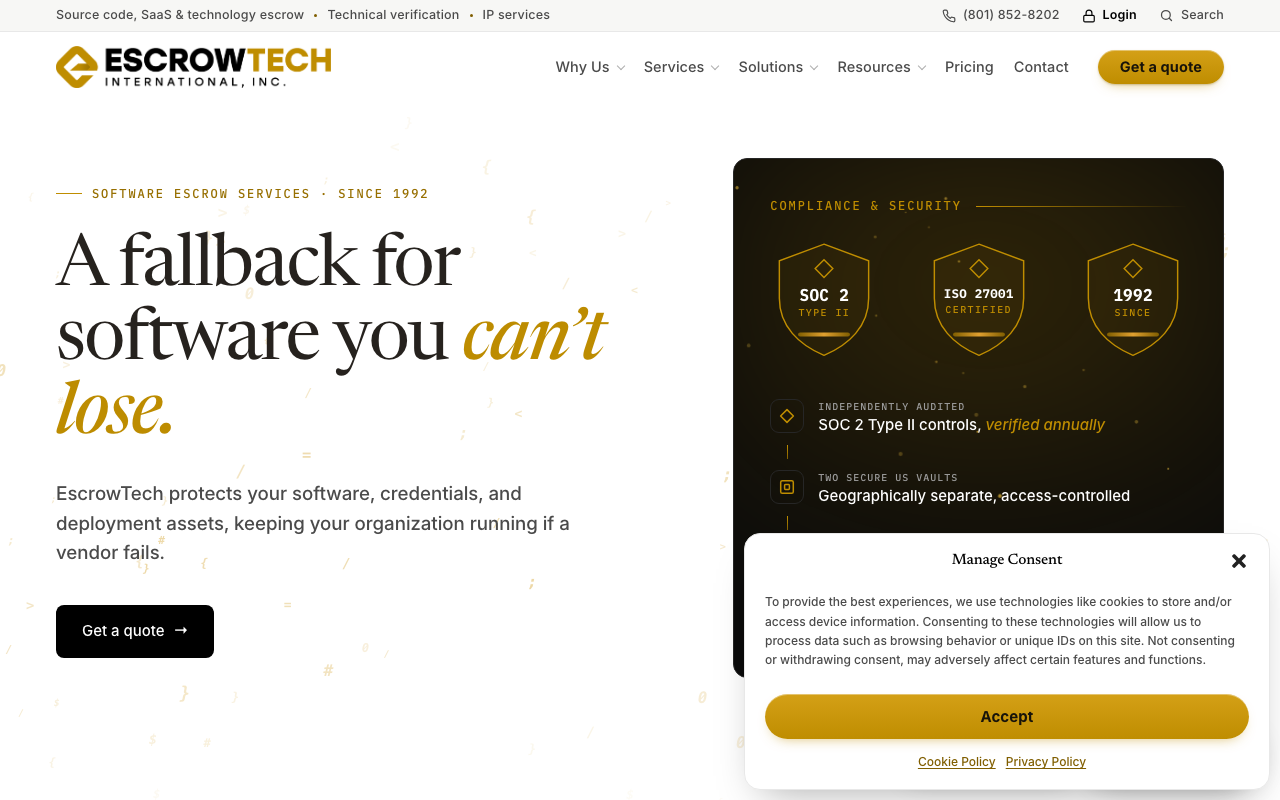
EscrowTech is not a development firm. It is a software escrow company in Lehi, Utah, operating since 1992. It belongs here because sometimes you cannot own the code: you license a vendor’s product, or a supplier will not transfer its source. Then the next best thing is a verified copy held by a neutral third party, released to you on agreed events.
Its site says it “protects your software, credentials, and deployment assets, keeping your organization running if a vendor fails,” and is clear about what escrow is not: “Depositing the code never transfers ownership.” Deposits are held in two US vaults, and developers verify them. Its published starting fees: $1,595 a year plus a one-time $995 setup fee, verification from $295, fees locked for three years.
Ideal for
Why they stand out
Escrow solves the case no development firm can: software you do not and will not own. EscrowTech publishes its prices and has developers verify what is deposited.
Pros
Cons
Verdict: pick EscrowTech when you depend on software you cannot own, and want a verified copy you can get to if the vendor fails.
Only if the contract says so, so get the ownership clause in writing before work starts. Our master services agreement treats software we write for a client as “work for hire”, owned by the client, which is standard. Then ask what the code is built on. Most software written today relies on open-source libraries, and their licenses vary, so ask how the firm chooses libraries and how it checks the licenses before you sign.
In an account your company controls, from the first commit, with the firm invited in. Moving it later is possible but depends on the firm cooperating: GitHub’s documentation says that to transfer a repository “you must have administrator access to the repository,” and that “the original owner of the repository is added as a collaborator on the transferred repository” (GitHub Docs). If the repository starts in your account, there is nothing to transfer and nobody to ask. Ask for the full history, not a zip of the latest code: the history tells the next team why the code looks the way it does.
Its own pre-existing tools, libraries and know-how. That is normal: a firm cannot give every client the same library outright. Three things belong in writing before work starts: which pieces it keeps, by name; what license you get to them inside your product, and whether it expires or carries a fee; and whether the firm can reuse the code it wrote for you. Acquaint Softtech’s FAQ above rules reuse out entirely.
Read these six clauses in any software contract, ours included, before you sign. They come from what our ownership page puts in writing. Each has a pass and a fail.
| Result | What it usually means |
|---|---|
| Six passes | You own the product in practice, not only on paper. Staying is a choice. |
| Fails on 1, 2 or 5 | You may not own what you paid for. Fix this before signing. |
| Fails on 3, 4 or 6 | You own the code but leaving will be harder than it should be. Ask for the list, the license terms and the exit in writing. |
Read the contract first; if it is silent on ownership, call a lawyer before a new developer. If the code is yours but nobody on your side understands it, that is a takeover: see our roundup of firms that take over existing codebases and our software rescue page.
For a mobile or web app with your accounts set up right from day one, Chop Dawg. For the most detailed published handover and open pricing, Wavect. For a large team or industry depth, Chetu. For an offshore cost base with ownership in writing, SID or Acquaint Softtech, priced against each other. For software you cannot own, EscrowTech. If you want ownership, the firm’s exclusions and the exit all written down before you start, with a senior US team, start with us. Whoever you call, run the Ownership Clause Read on the contract. Weighing freelancers instead? Our Upwork alternatives and Toptal alternatives roundups cover that.
Do I own the code if I pay a software development company to build it? Only if the contract says so. Get the ownership clause in writing before work starts, and check when it takes effect, usually on payment of fees. Razoyo’s agreement treats software we write for a client as work for hire, owned by the client.
Which software development companies let you own the code and the repo? Of the firms in this roundup, Razoyo, Chop Dawg, Wavect, Chetu, SID and Acquaint Softtech all state on their own sites that you own the code or its IP. Razoyo, Chop Dawg and Wavect also say the repository and its full history are yours.
Should the repository be in my account or the agency’s? Yours, from the first commit, with the agency invited as a collaborator. Moving a repository later needs administrator access on GitHub, which means the agency has to cooperate. Ask for the full history, not a zip of the latest code.
What does a software firm usually keep after the project? Its own pre-existing libraries, tooling and know-how. Ask the firm to name those pieces in writing before work starts, and to license them to you for use inside your product with no expiry and no royalty.
What is “work for hire” in a software contract? Contract wording under which the software written for you belongs to you from the start, rather than to the firm that wrote it. It is standard, and Razoyo’s master services agreement uses it. Read it together with what the firm keeps and when ownership passes.
What happens to my code if I leave the development firm? That depends on the exit terms. Look for a notice period in weeks and a handover list: the repository with full history, rotated credentials for every account, documentation, the project board and a working deploy path. Razoyo’s retainers end on 30 days’ notice.
What is software escrow, and when do I need it? A neutral company holds a copy of a vendor’s source code and releases it to you on agreed events, such as the vendor failing. You need it when you depend on software you do not own. It does not transfer ownership.
If you are about to sign with a firm, or already have one and are not sure you could leave, that is a free 30 minute conversation with a senior person, not a sales rep. Bring the contract or the proposal. We will tell you what it says you own, what it leaves out and what to ask for, including when the honest answer is that your current firm’s terms are fine. Schedule Free Consultation.
Paul Byrne is President of Razoyo, a software engineering firm in The Colony, Texas taking prototypes and constrained systems into production since 2011.
These links open AI platforms with pre-written prompts about this page.
We use cookies to improve your experience. Do you accept?
To find out more about the types of cookies, as well as who sends them on our website, please visit our cookie policy and privacy policy.

