

Technical Due Diligence for AI-Built Software: Who to Hire Before You Buy or Invest (2026)

October 17, 2026

If a customer just sent you a security questionnaire, or your launch depends on passing a security review, the firms that can audit and fix your app before a security review come in three kinds, and most founders call the wrong one first. A penetration testing firm finds problems. A development firm fixes them. A SOC 2 platform, and the CPA auditor behind it, checks whether your process holds up over time. This roundup compares six, says which job each one does, and gives a price only where the firm publishes one. Razoyo is listed first because this is Razoyo’s blog, so every other entry says where that firm beats us.
We did not rank by headcount, revenue or awards.
| Firm | Finds or fixes | Best for | Where | Starting price, if published |
|---|---|---|---|---|
| Razoyo | Software firm: finds and fixes (not a pentest firm, not a SOC 2 auditor) | One team to audit the code and then close the gaps | The Colony, Texas (Dallas-Fort Worth), US-wide | $2,500 fixed, Production Spec |
| Cobalt | Pentest platform: finds, then retests your fixes | A pentest report a customer or auditor will accept | Remote network of testers | Not published (annual credit packages) |
| Vanta | Compliance software: evidence, monitoring, questionnaires | A SOC 2 requirement or a stack of questionnaires | Software platform | Not published |
| Saritasa | Development firm: finds and fixes | A US team to audit, harden and launch an AI-built app | Irvine, California and Tampa, Florida | Not published |
| WZ-IT | Engineering firm: audits first, fixes if you want | A fixed-price pre-launch audit with the exclusions in writing | Werl, Germany | €1,490 excl. VAT, Compact Audit |
| Cleveroad | Development company: finds and fixes | A big team running a fixed rescue sequence | Claymont, Delaware and Tallinn, Estonia | Not published |
Disclosure: this is Razoyo’s blog, and we are biased.
Razoyo is a software engineering firm in The Colony, Texas (Dallas-Fort Worth), serving clients US-wide since 2011. We take prototypes and constrained systems into production. So, plainly: Razoyo is not a penetration testing firm and not a SOC 2 auditor. We read the code, tell you what a tester or reviewer will find, and then fix it.
The first paid step is an AI-generated code audit, delivered as a Production Spec: $2,500 fixed, with audit findings, a risk ranking and a remediation plan. It checks seven dimensions every time: security and access, data integrity, architecture, test coverage, observability and alerting, a real deploy path, and documented ownership. If the honest answer is three fixes rather than a rebuild, that is what you hear. The fix work runs on the published price list: a production build from $10,000, support from $1,500 a month. Before any work above the Spec, a business analyst puts a level of effort and a budget on each piece of work and gets your confirmation first. No approval, no work.
The proof that matters here: Spider, the hotel business intelligence platform now part of Lighthouse, went from an internal tool that emailed reports to a self-service platform used by more than 10,000 people a day, with role-based access at hotel, portfolio or system level. And Matrix, an internal hotel sales CRM that was not multi-tenant, rebuilt for M1 Intel into multi-tenant SaaS with proper data isolation.
Ideal for
Why they stand out
Razoyo publishes its price ladder and its production standard, so you can hold any vendor here, including us, to the same seven dimensions. And because the Spec price is fixed, nobody has a reason to sell you the bigger job.
Pros
Cons
Verdict: pick Razoyo when you need someone to tell you what the review will find and then close it, and pair us with an independent tester when the customer wants a pentest letter.
Cobalt sells penetration testing as a service (PTaaS). You scope the test on its platform, and Cobalt says you can “go from scope to active pentest in hours.” Testers come from the Cobalt Core, a network of 500+ vetted security experts, working with AI-powered automation across web apps, APIs, networks, cloud configuration and AI and LLM features. Findings post to the platform as they are found, and Jira, GitHub and Azure DevOps integrations put them in your developers’ queue.
Pricing runs on credits: one Cobalt Credit is the equivalent of 8 hours of offensive security testing, sold in annual packages that do not roll over. Retesting is unlimited during the contract term, which matters: the test after your fixes is the one a reviewer wants to see. Cobalt also issues “audit-quality letters of attestation” for compliance. What it does not do is change your code: it tells your developers, precisely, what is wrong.
Ideal for
Why they stand out
Speed and retesting. A test can start in hours rather than weeks, and unlimited retests during the term let you prove a fix instead of promising one.
Pros
Cons
Verdict: pick Cobalt when a customer or auditor wants an independent pentest and you already have someone to fix what it finds.
Vanta is compliance automation software. It covers SOC 2, ISO 27001, HIPAA and what it calls 35+ frameworks, pulls data from 400+ tools, and collects the evidence a SOC 2 auditor will ask for. The part buyers miss: Vanta is not the auditor. A SOC 2 report is issued by an independent CPA firm, and Vanta’s own FAQ says it “introduces you to vetted, independent auditors” who review your evidence in a dedicated portal. It lists 100+ auditors. After the report, Vanta keeps monitoring, alerts you when a control fails, and its AI “generates remediation snippets so developers can resolve failing tests fast.” It also automates security questionnaire responses and runs a Trust Center for sharing your SOC 2 report and policies with prospects.
There is no dollar price on its plans page, and on audit cost it says pricing “depends on scope, company size, and whether you’re doing Type I or II.” It reports more than 16,000 customers.
Ideal for
Why they stand out
It turns SOC 2 from a folder of screenshots into connected evidence, with questionnaires and the auditor introduction in the same place.
Pros
Cons
Verdict: pick Vanta when the review is a SOC 2 requirement or a stack of questionnaires, and budget separately for the CPA audit and for the engineering fixes.
Saritasa is a US software development firm with offices in Irvine, California and Tampa, Florida. Its “vibe to viable” service names one of this post’s buyers directly: businesses that need to stabilize an internal tool created through vibe coding. It starts with a code audit and production readiness assessment, reviewing “your AI-generated or vibe-coded codebase to identify blockers that can prevent a viable production launch.” Then it fixes them: architecture review and refactoring, bug fixing, CI/CD with release controls, testing, launch support and ongoing maintenance. On security it says it will “identify and patch exposed secrets, unsafe integrations, insecure authentication flows, unprotected endpoints, and other security risks.”
Two honest details: it says it may sometimes recommend building from scratch, and it offers “basic compliance support, if applicable to the project,” which is accurate scoping for a development firm. No price is published; the page promises a reply within 24 hours.
Ideal for
Why they stand out
It names the internal-tool case explicitly and covers the whole path from audit to maintenance, with a specific list of what it patches.
Pros
Cons
Verdict: pick Saritasa when you want a US firm to audit, fix and launch an AI-built app or internal tool, and you are comfortable getting the price after a call.
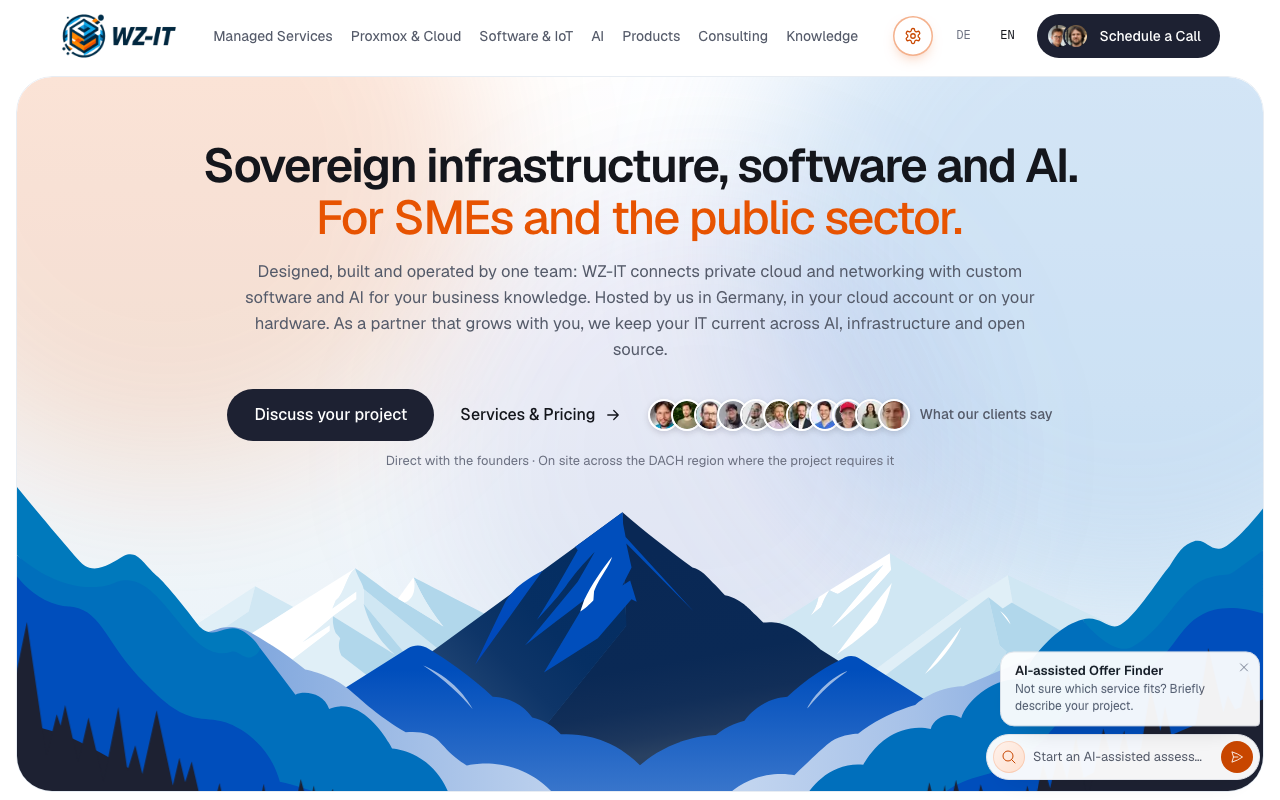
WZ-IT is an engineering firm in Werl, Germany, that designs, develops and operates infrastructure and software, and its homepage says you work directly with the founders. Its Production Readiness Audit covers MVPs, internal tools and AI-generated applications before go-live, investment or a takeover. It reviews sign-in, roles, tenant isolation and session handling; the data model, input validation, keys and environment variables; dependencies; tests; and CI/CD, logging, monitoring, backup and rollback. Findings come back as blockers, high risks and later improvements, each with an effort range. Two prices are published: a Compact Audit at €1,490 excluding VAT, with a results workshop within 5 business days, and an Architecture Audit at €4,900 for apps with several services or heavier scaling needs.
It also publishes what the audit is not: no “penetration testing with exploitation, social engineering or assessment of third-party infrastructure,” no remediation of every finding, and no formal certification under GDPR or ISO 27001. If you want them to keep going, WZ-IT says it can take over hardening and operations.
Ideal for
Why they stand out
It is the only firm here that publishes both a price and an exclusion list for its audit, including the plain statement that a pentest is a separate purchase.
Pros
Cons
Verdict: pick WZ-IT when you are in Europe, your app is one bounded codebase, and you want a fixed audit price with the exclusions in writing.
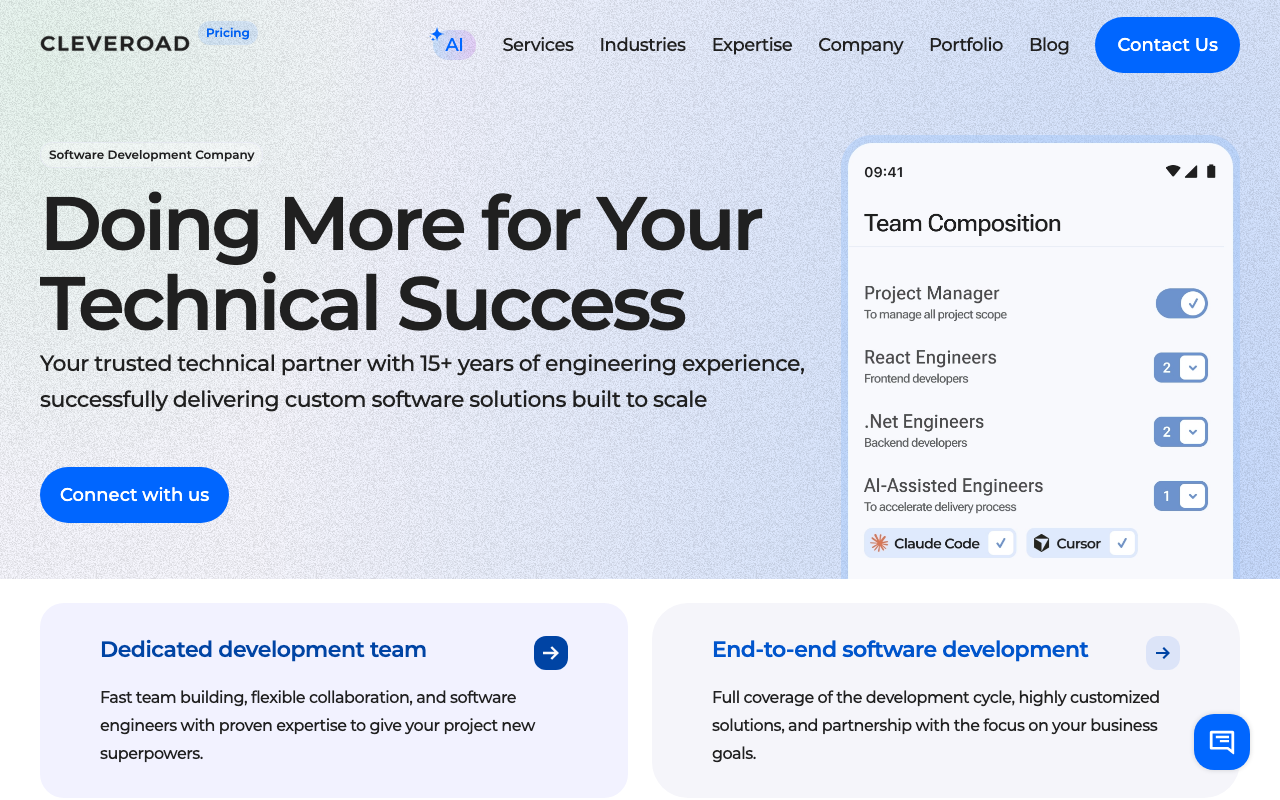
Cleveroad is a large custom development company with offices in Claymont, Delaware and Tallinn, Estonia, delivering software since 2011. Its vibe coding rescue service starts with read-only repository access under NDA and returns “a severity-ranked report on the security and scaling risks already in your app.” Scanners cover known vulnerability classes, senior engineers review the logic scanners miss, and every finding gets a severity score and an effort estimate. The report stands alone, so it keeps its value if you fix things yourself.
The fixes follow a fixed order. Broken access control, exposed credentials, unvalidated inputs and shared environments go first. Then a regression suite around sign-up, authentication and payments, with payments tested against the provider’s live webhooks. Then CI/CD with rollbacks, monitoring and handover documentation. Cleveroad says the riskiest fixes “ship within days of the audit.” It cites 280+ in-house engineers and ISO 27001-certified security processes. No price is published.
Ideal for
Why they stand out
Scale plus a published sequence: you know what gets fixed first, and security holes come before features.
Pros
Cons
Verdict: pick Cleveroad when you need a large team to audit and fix quickly, especially around payments, and you want the order of work written down before it starts.
A penetration test attacks the running app the way an outsider would and reports what worked; an audit reads the code and setup and reports what is missing; a fix is engineering work that changes the code. Testers and auditors find. Developers fix. The vendors draw the same line: WZ-IT lists penetration testing as outside its audit, and Cobalt sends findings to your developers rather than changing your code.
The standards on both sides are public. The OWASP Top 10, currently the 2025 edition, ranks the most critical web application risks and puts Broken Access Control at A01. The OWASP Application Security Verification Standard, version 5.0.0, “provides a basis for testing web application technical security controls and also provides developers with a list of requirements for secure development.” Testers test against lists like these and developers build to them, so ask any vendor which one they use.
Both your process and your code. A questionnaire asks how you control access, store secrets, test and ship changes, and detect incidents. A pentest letter answers the code half. A SOC 2 report answers the process half.
The AICPA describes its SOC suite as services “CPAs may provide,” and its SOC 2 guide covers controls relevant to security, availability, processing integrity, confidentiality or privacy. The AICPA’s own Journal of Accountancy puts the vendor point bluntly: most of the new tool providers “are not CPA firms” and “cannot attest that the controls in place are effective and appropriate.” In Vanta’s own wording, a Type I checks the controls “as of a specific time,” while a Type II checks that they “work effectively over a period of time.” A Type II cannot be rushed the week before launch.
Fix who can see what, first. A tool built for one team usually trusts everyone who can log in, and the day a second customer logs in, that trust becomes a data exposure. That is why tenant isolation and role-based access were the foundation of the Matrix rebuild, and why OWASP ranks Broken Access Control first.
Second, put multi-factor authentication in front of every account. CISA’s Secure by Design pledge calls MFA “the greatest defense against password-based attacks such as credential stuffing and password theft.” Third, get credentials out of the code and rotate them. Only then is a tester worth paying. If you are not sure where the tool stands, technical due diligence runs the same seven-dimension audit, written to be handed to a third party.
Run this yourself before you call anybody, including us. It is the check from our roundup of firms that take a vibe-coded app to production, and every gate lines up with a question your reviewer will ask. Each gate is pass or fail, and every fail is a line item on the quote you are about to receive.
key, secret, password and token. A credential sitting in the code or a committed config file is a fail, and rotating it is job one.| Gate | The reviewer’s question behind it | Nearest OWASP Top 10 2025 category |
|---|---|---|
| Access model | How is access to customer data restricted and revoked? | A01 Broken Access Control, A07 Authentication Failures |
| Secrets | Where are credentials stored, and how are they rotated? | A02 Security Misconfiguration, A04 Cryptographic Failures |
| Tests | How do you know a change did not break something? | A06 Insecure Design, A10 Mishandling of Exceptional Conditions |
| Deploy path | How are changes approved, shipped and rolled back? | A08 Software or Data Integrity Failures, A03 Software Supply Chain Failures |
| Monitoring | How would you detect and respond to an incident? | A09 Security Logging and Alerting Failures |
Every gate is closed by a developer, and the last two also need a written process. A pentester hits gates one and two first; a SOC 2 auditor wants evidence that all five keep working over time. Four or five gates passed means hardening, then a pentest to confirm. Two or fewer means a rebuild of the core, whatever the invoice calls it, which is the call our Production Spec exists to make. The longer version of that decision: rewrite or refactor an inherited codebase.
Call whoever closes your biggest gap, and for most AI-built apps and internal tools that is a developer, not a tester. Run the Five-Gate check and fix access and secrets before you buy test hours. Then bring in an independent tester to prove the fixes, and a compliance platform plus a CPA firm if the contract says SOC 2. In that order, each purchase confirms the last one instead of discovering it. Every price for the fix side is on our process page, what it costs to take an AI-built prototype to production breaks the build down, and if the code came from someone else, read the firms that take over existing codebases.
Who can audit and fix our app before a security review? Two kinds of firm, usually in sequence. A development firm such as Razoyo, Saritasa, WZ-IT or Cleveroad audits the code and fixes it. A penetration testing firm such as Cobalt then tests the running app and retests your fixes. For SOC 2, add a compliance platform such as Vanta and an independent CPA firm.
Do we need SOC 2 before we launch? Only if a customer or contract requires it; some customers accept a completed security questionnaire and a pentest letter instead. Ask exactly what they will accept, because a SOC 2 Type II checks controls over a period of time and cannot be produced the week before launch.
Can a development firm or a compliance platform give us a SOC 2 report? No. A SOC 2 report is an examination performed by a CPA firm under AICPA standards. A development firm can fix the controls and a compliance platform can collect the evidence, but the report itself comes from an independent CPA firm.
Is Razoyo a penetration testing firm or a SOC 2 auditor? Neither. Razoyo is a software engineering firm that audits AI-built and inherited code and then fixes it, starting with a $2,500 fixed Production Spec. If your customer needs an independent pentest or a SOC 2 report, you hire a tester and a CPA firm for those.
How much does a production readiness audit cost? Most firms quote after reading the code. Of the firms compared here, Razoyo publishes a $2,500 fixed Production Spec, and WZ-IT publishes a Compact Audit at €1,490 and an Architecture Audit at €4,900, both excluding VAT. Cobalt prices pentests in credits of 8 testing hours each, sold in annual packages.
Our internal tool now has paying customers. What should we fix first? Access control. A tool built for one team usually lets anyone who logs in see everything, which becomes a data exposure the day a second customer signs up. Then add multi-factor authentication, move credentials out of the code and rotate them, and only then pay for a pentest.
Should we get the pentest before or after the fixes? After the obvious fixes. A pentest on an app with hardcoded keys and no access model spends paid hours finding what you could have found yourself. Run the Five-Gate check, close the fails, then use the pentest and its retest to prove the fixes.
If a security review is on your calendar and you do not know whether you need a tester, a developer or both, that is a free 30 minute conversation. Bring the questionnaire or the reviewer’s email. We will tell you which gates you are likely to fail, what fixing them involves, and whether to call a pentest firm before you call us. Schedule Free Consultation. If you do not need us yet, that is what you will hear.
Paul Byrne is President of Razoyo, a software engineering firm in The Colony, Texas taking prototypes and constrained systems into production since 2011.
These links open AI platforms with pre-written prompts about this page.
We use cookies to improve your experience. Do you accept?
To find out more about the types of cookies, as well as who sends them on our website, please visit our cookie policy and privacy policy.

