

Your Internal Tool Now Has Paying Customers. What Should You Fix First? (2026)

November 18, 2026

Someone at your company spends half the week typing the same data into two systems, chasing approvals by email, and building the same report by hand. You want that work gone, so you are looking for a firm to turn a manual process into software. This roundup compares six options: three engineering firms, one low-code automation consultancy, one automation platform you run yourself, and Razoyo. Razoyo is listed first because this is Razoyo’s blog, so every other entry says where that option beats us.
One warning before the list. Automation that fails quietly is worse than the manual work it replaced, because nobody notices until it has caused damage. The check at the end of this post is built around that one problem.
| Option | What it is | Automation proof on its own site | Best fit | Published price |
|---|---|---|---|---|
| Razoyo | Software engineering firm, The Colony, Texas | Removed a monthly developer dependency from a warranty portal; automated compliance in its own checkout product | One recurring process that costs real hours and cannot be allowed to fail silently | Workflow Spec $2,500 fixed; MVP from $5,000; production build from $10,000 |
| Imaginovation | Custom software firm, Raleigh, North Carolina | A dedicated automation service covering workflows, bots, document processing and AI agents | Companies that want several processes scored and automated in a formal program | Not published |
| Mutually Human | Digital engineering firm, Grand Rapids, Michigan | Custom billing software that replaced a reseller’s monthly manual invoicing | Mid-size operators who want process workshops, then custom software and data work from one firm | Build prices not published; support plans from $1,800 a month |
| SOLTECH | Custom software, consulting and IT staffing firm, Atlanta | Intelligent process automation with monitoring and human review stations | Companies that may also need staff, Salesforce work or a project rescued | Not published |
| XRAY | Low-code workflow automation consultancy | Hourly and monthly automation work across tools such as Zapier, Make and Airtable; “Trusted by 200+ teams” | Teams whose tools already connect and who want to learn while it gets built | $250 an hour; packages from $1,000; design sprint $15,000 |
| n8n | Workflow automation platform, hosted or self-hosted | The product itself: workflows, logs, error workflows, AI agents | Teams with a technical person who will own every workflow | From 20 euros a month billed annually; free self-hosted Community edition |
Disclosure: this is Razoyo’s blog, and we are biased.
Razoyo is a software engineering firm in The Colony, Texas (Dallas-Fort Worth), serving clients US-wide since 2011. We take prototypes and constrained systems into production, and a manual process your business depends on is a constrained system: it works only because a person keeps it working.
Our manual operations page is written for the owner who says “My best person spends half the week re-keying data between systems.” We start with one number, not a sales call: the task your most expensive person repeats, multiplied by how often, multiplied by their loaded hourly cost. Then we take one workflow, build it with error handling, logging and a human in the loop, measure it against that baseline, and only then talk about the next one.
The closest proof is our warranty portal rebuild. A monthly data import could not happen without a developer. We designed the data so administrators and dealerships do that work themselves, and the portal has needed only moderate maintenance since. Spider, the hotel business intelligence platform now part of Lighthouse, moved re-indexing that took up to 24 hours to continuous updates and cut hosting costs by about 90%. AutomaticFFL, our own subscription product, moved firearms compliance checks out of merchants’ hands and into checkout.
Ideal for
Why they stand out
Razoyo publishes its prices, starts with one workflow, and refuses to build a chain that fails without telling anyone. A person who runs the process gets told the moment it needs them.
Pros
Cons
Verdict: pick Razoyo when you can name the process, it costs real money every month, and a quiet failure would hurt.
Imaginovation is a software development company in Raleigh, North Carolina, founded in 2011 by Michael Georgiou and Pete Peranzo. It builds AI, web, mobile and cloud applications, and business process automation is a full service line, not a footnote.
Its page opens with the exact buyer in this roundup: “If your operations still run on spreadsheets, manual approvals, follow-ups, and people moving data between systems, we fix that.” It describes automation as a stack of workflow orchestration, robotic process automation, document processing and AI agents, and lists areas from finance and accounting to inventory and IT.
The process is the strongest part of the page. It describes a seven-step framework that maps real workflows, scores each candidate process against cost, complexity and payback, and gives a go or no-go recommendation. Then it redesigns the process before building, on the line “Automating a broken process only creates faster failures.” We agree with that sentence. It builds in Power Automate, UiPath or custom code, says every workflow has full logging, and pilots with a single team or region before rollout.
Imaginovation says it cuts process cycle times “by up to 80%.” That is its own figure, and “up to” is doing some work, so ask for the number on a project like yours.
Ideal for
Why they stand out
Imaginovation scores each process for payback before building and runs a controlled pilot before rollout, and the method is on its public page for you to check.
Pros
Cons
Verdict: pick Imaginovation when you have a list of manual processes and want them ranked and worked through as a program.
Mutually Human calls itself “an AI-forward digital engineering firm.” It is headquartered in Grand Rapids, Michigan, with an office in Holland, and it sells across software, data and AI, with industry pages for manufacturing, healthcare, construction and financial services.
For this job, its intelligent automation work starts with a process discovery service, run by its RPA experts with your business teams. Your experts walk through their processes alongside engineers, and you get a prioritized backlog. That helps if your real problem is not knowing where to start.
Its case study on automating purchase orders describes a plain version of the problem. A reseller of subscription software handled invoicing and payment collection by hand every month. Mutually Human built custom software that connects the software provider, the invoicing system and the payment processor, so the whole billing process runs on its own.
It also sells data work and ongoing support, with plans from $1,800 a month, so the same firm can stay on after launch.
Ideal for
Why they stand out
Mutually Human pairs process walkthroughs with custom software and data engineering, so the backlog and the build come from the same people.
Pros
Cons
Verdict: pick Mutually Human when you want people to sit with your team, find the right process and then build it.
SOLTECH is a custom software company headquartered in Atlanta, founded in 1998, and it describes itself as an “award-winning, national, women-owned technology firm.” It offers custom software, technology consulting, IT staffing, Salesforce work, and AI and data engineering.
Its AI automation page promises to “turn repetitive workflows into resilient, AI-assisted processes.” The section on intelligent process automation describes modular services for classifying, extracting and deciding, “each with clear SLAs and monitoring,” with “human-in-the-loop stations” for exceptions. It tracks cycle time, accuracy and cost per transaction on dashboards.
The reason to pick SOLTECH over a pure engineering firm is range. It runs an IT staffing business alongside its software work, including contract and direct hire. It has a project rescue service and a Salesforce practice. If your manual process is tied to Salesforce, or you may want to hire your own people to run the system later, one firm can cover that.
Ideal for
Why they stand out
SOLTECH can build the automation, supply people to run it and rescue a project that has stalled. No other option here offers all three.
Pros
Cons
Verdict: pick SOLTECH when the process touches Salesforce, or when you want one firm for the build and the people.
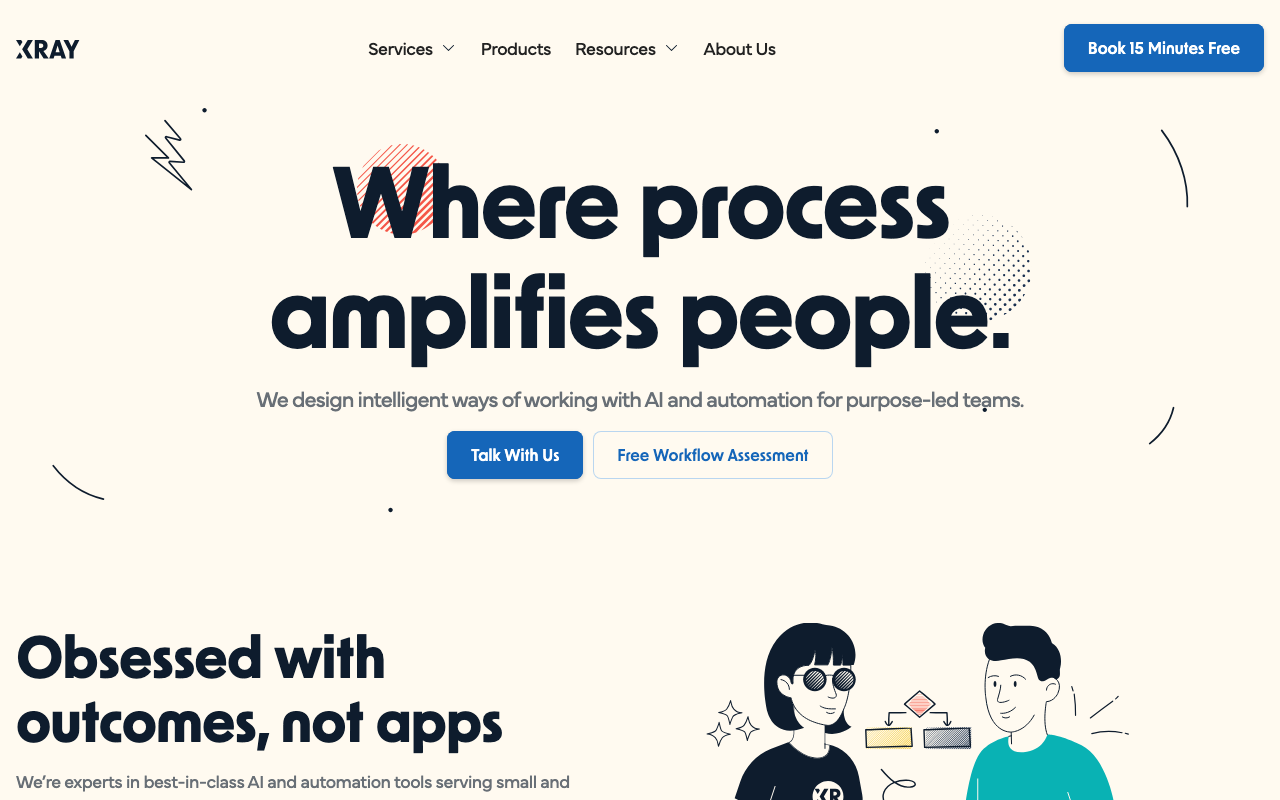
XRAY is not a software development firm in the usual sense. It is a workflow automation consultancy that works in the tools you already have: its hourly service names Zapier, Airtable, Make, Softr, Pipedream, Salesforce, HubSpot and others. It says it is “Trusted by 200+ teams,” and its people are workflow consultants and low-code engineers.
The pricing is unusually clear for this market. XRAY Hourly is a flat $250 an hour, sold as 4 hours for $1,000, 10 hours for $2,500 or 20 hours for $5,000. You work side by side with an engineer on a live call, and it says “You own all the accounts, code, and work that the engineer produces.” XRAY Monthly is the full-service option, starting with a Workflow Solution Design Sprint at $15,000, run in quarterly sprints.
The model has a real advantage: your team learns while it builds. The other side is that the result still runs on a chain of third-party tools, and you pay for each of them. So price a small custom build next to it. Agentic coding tools have made those far cheaper, and one is now often competitive or better.
Ideal for
Why they stand out
XRAY publishes its prices, sells in small blocks of hours and teaches as it goes, which makes it a low-commitment way to find out what a workflow needs.
Pros
Cons
Verdict: pick XRAY when your tools already connect and you want help and teaching, with a custom build priced alongside it.
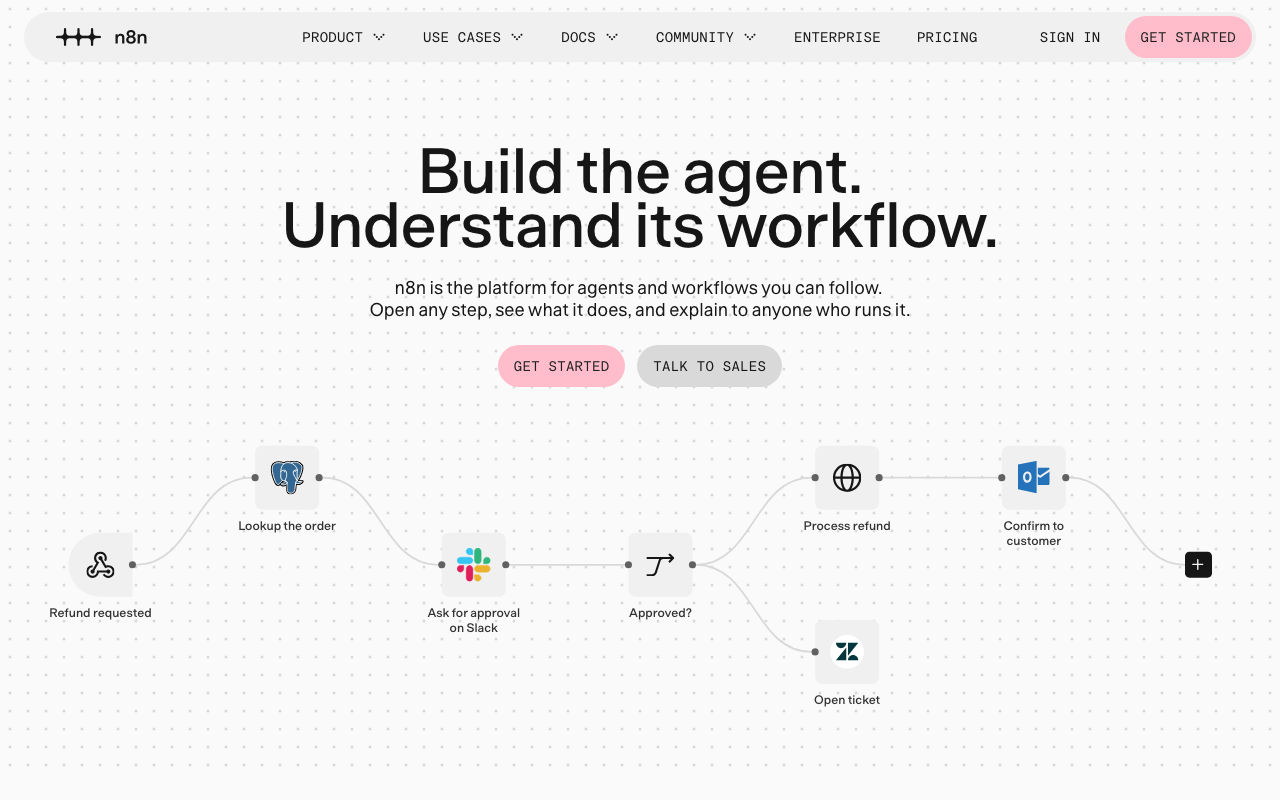
n8n is not a firm. It is a workflow automation platform for building automations and AI agents, hosted by n8n or run on your own servers. It is here because many readers have a capable person in-house.
Pricing is based on workflow executions, not steps or users: Starter is 20 euros a month billed annually for 2,500 executions, and Pro is 50 euros a month for 10,000. The Business plan is self-hosted, at 667 euros a month for 40,000 executions, and adds single sign-on, multiple environments and version control. A self-hosted Community edition is free, and the source code is on GitHub under n8n’s own sustainable use license. Self-hosting keeps your data in your own environment, which matters for some processes.
It also takes failure more seriously than many tools. Its site says you can spot errors and re-run just the step that broke, and its docs describe error workflows that control how n8n responds when a run fails. That helps only if someone sets it up, and only if someone reads the alert.
That someone is the real cost. A platform gives you the parts, and a person on your team has to own every workflow from then on. Price that person’s time, then price a small custom build next to it: agentic coding tools mean a custom build is now often competitive or better.
Ideal for
Why they stand out
n8n prices by completed run, can be self-hosted, and shows you what each step did.
Pros
Cons
Verdict: pick n8n when a named person on your team will own it, and you have priced the alternative.
Automate the one with the biggest number, not the one that annoys you most. Our manual operations page gives the math: the task your most expensive person repeats, times how often, times their loaded hourly cost.
Here is a worked example. Employers in US private industry paid an average of $46.89 per hour worked in June 2026, counting wages and benefits. Ten hours a week of re-keying at that average is about 43 hours a month, or roughly $2,030 a month and $24,400 a year. Your best person probably costs more. That is the number that gets budget, and it tells you how much of a build the process can pay for.
Google’s site reliability engineers have a useful word for this work: toil, which they describe as work that tends to be “manual, repetitive, automatable.” If a task grows in step with your volume, it will need another hire before anything else.
For one workflow, expect a first paid step in the low thousands and a build from about $5,000 to $10,000 and up. The published numbers in this roundup show the range:
| Route | Published starting cost | What keeps costing you |
|---|---|---|
| n8n Starter, built by your own person | 20 euros a month, billed annually | That person’s time, for as long as it runs |
| XRAY Hourly, one focused automation | $1,000 for 4 hours | Your tool subscriptions; more hours as things change |
| XRAY design sprint | $15,000 | The next sprint, if you continue |
| Razoyo Workflow Spec, then a build | $2,500 fixed, then MVP from $5,000 or production build from $10,000 | Support from $1,500 a month, if you want it |
| Imaginovation, Mutually Human, SOLTECH | Build prices not published | Ask about support and any bot licenses |
Compare any quote with your number from the section above, over three years. A build that costs more on day one can still be the cheaper route if nobody has to babysit it.
A tool can do the job when every system already has a connector, the volume is modest, and a named person will own it. It runs out when a system has no good API, when the process needs its own database or user accounts, or when a failure has to be caught and handled rather than noticed later.
Do not assume the tool is the cheap route. Agentic coding tools have changed the price of a small custom build, so price both before you decide. If the process really lives in spreadsheets, read how to replace a business-critical spreadsheet and our spreadsheets to platform page. If the job is joining data from several systems, our comparison of integration and data platform firms goes deeper. If your team needs a screen to work in, see firms that build internal tools and portals.
If people re-key data because your software cannot do something, an automation on top only hides the limit. Our platform limits page covers that case. If nothing repeats yet, start with custom systems instead.
Ask these six questions of any proposal, whether it is ours, a firm’s or something your own person built. They come from what we build and refuse to build on our manual operations page. Each has a pass and a fail.
Microsoft’s retry pattern guidance is a good plain reference for question 3: retry the failures that are temporary, and when a failure is not, stop and report it rather than carrying on.
| Result | What it usually means |
|---|---|
| Six passes | A serious proposal. Compare it on price. |
| Fails on 1 or 2 | Nobody has scoped this yet. Get a number before you sign anything. |
| Fails on 3, 4 or 5 | It will work in the demo. Expect a quiet failure later. |
| Fails on 6 | You are swapping a key person for a key vendor. |
For a list of processes to rank and work through as a program, call Imaginovation. To have people sit with your team and find the right process first, call Mutually Human. If it touches Salesforce, or you want staff as well, call SOLTECH. If your tools already connect and you want to learn, book a few hours with XRAY. If you have a technical person who will own it, try n8n. If you can already name the process and a quiet failure would hurt, talk to us.
Who can turn a manual process into software? Custom firms such as Razoyo, Imaginovation, Mutually Human and SOLTECH build it for you. XRAY automates it in low-code tools you already use. n8n is a platform your own technical person can use. The right choice depends on how much a failure would cost and who will own it.
How much does it cost to automate a manual business process? Published starting points range from 20 euros a month for n8n, plus your own person’s time, to $1,000 for four hours with XRAY, to a $2,500 Razoyo Workflow Spec followed by an MVP from $5,000 or a production build from $10,000. Compare any quote with what the process costs you each month.
Should I use Zapier or n8n, or build custom software? Price both. A tool can work when every system has a connector, volume is modest and a named person will own it. A custom build fits when the process needs its own data or users, or when failures must be caught. Agentic coding tools mean a small custom build is now often competitive or better.
What is the biggest risk in automating a process? Silent failure. Automation that breaks without telling anyone is worse than the manual process, because nobody notices until it has caused damage. Ask every firm what happens when a step fails, where it is logged and who gets told.
What is the difference between RPA and custom software? RPA bots work through the screens of your existing applications, the way a person would. Custom software connects systems directly or replaces the manual step. Bots can help with old systems that have no good API, but ask what the licenses cost each year.
Will I own the automation when it is finished? Ask before you sign. At Razoyo, once fees are paid you own the code we write for you. XRAY says you own the accounts, code and work its engineers produce. On any platform, check what happens to your workflows if you stop paying.
If a manual process is eating your best person’s week, Schedule Free Consultation. It is 30 minutes with a senior engineer, not a sales rep. Bring your most expensive manual workflow, and the rough number if you have it. We will tell you what automating it takes and what it would cost, and whether one of the tools above would do the job.
Paul Byrne is President of Razoyo, a software engineering firm in The Colony, Texas taking prototypes and constrained systems into production since 2011.
These links open AI platforms with pre-written prompts about this page.
We use cookies to improve your experience. Do you accept?
To find out more about the types of cookies, as well as who sends them on our website, please visit our cookie policy and privacy policy.

