



How to Choose a B2B Ecommerce Platform Without Wasting 200K on the Wrong One

May 7, 2026
March 17, 2020 by Paul Byrne

Unlike other articles squarely aimed at digital commerce merchants, this is more personal. I’m not a healthcare expert but do have a useful perspective. Here’s what you need to know about me:
There are a lot of misconceptions about the Italian healthcare system to clear up before moving forward.
I’ve seen some commentary on the Italian healthcare system which usually refers to it as a single payer system. The truth is more complicated (isn’t it always) than that.
Italians pay for their healthcare through taxes. The government owns and operates most healthcare facilities, including hospitals.
Regions or Provinces generally fund hospitals from national tax allocations. Some benefit from religious (usually Catholic) or other non-profit funding much like some hospitals (Scottish Rite, Parkland - in Dallas, Mount Sinai in New York) in the US.
Italian doctors in private practice are paid either by the government or private health insurance (or cash). In most cases, citizens do not have to pay anything for a visit to a physician. Americans with health insurance would consider what the state covers is pretty basic.
Pharmacies accept ‘tickets’ kind of like prescription insurance in the US where the insured pays a fixed amount based on the schedule for medicine and the insurer (the government) pays the rest.
As mentioned above there is also a separate, private healthcare system. Doctors in private practice may work in both; those employed at hospitals generally cannot.
Of course, the tapestry of Italian healthcare is far more sophisticated than that. I just thought it would be useful to understand the basics.
Northern Italy wishes they had reacted more quickly than they did. As soon as health officials realized what was happening, they quickly locked down the south as well.
Northern Italy is more affluent and enjoys more healthcare capacity due to private healthcare facilities. After seeing the massive overwhelming of private and public healthcare in the north, panic struck the south.
With fewer facilities, machines and staff, managing the crisis will be impossible. In fact, Italians are fully expecting healthcare facilities in the south to reach the breaking point even after implementing extreme lockdown measures.
Despite all of this, the north is suffering unimaginably. At the time of this writing the situation is especially critical in Bergamo, one of Italy’s most affluent cities. They don’t even have enough coffins to bury the dead and essentially cremating everyone. Even so, public officials bemoan the fact that the bodies are piling up faster than they can process them.
Roberto Burioni - explaining COVID19
Italy is fortunate to have many, many dedicated public and private health officials and practitioners. In many areas, including research, you will often see Italian doctors breaking new ground.
One of these men, Roberto Burioni, is well-known for his stance against the anti-vaccination movement. Burioni’s credibility in this crisis also stems from his bell ringing. As far back as early January he was urging officials to cut off travel from China. If they had followed his advice they would have saved themselves a world of pain.
During the crisis he has done everything he can to provide truth and calm to the Italian people including tirelessly vloging, blogging, appearing on TV, and acting as a trusted clearinghouse for information. I’m jealous we do not have such a person (sorry, Fauci, you don’t hold a candle to him).
He presents the truth authoritatively but without judgement. He is clear on what the medical community knows and what it doesn’t. He calmly presents the path ahead. I would hazard to say he is the most quoted man in Italy right now. Yet, he does not come across as self-important.
Burioni’s work and communication have inspired and informed other countries who are a few weeks behind Italy in absorbing the tragedy.
Despite seeing hopeful numbers from some of the early infection sites, the north of Italy is bracing for more. Trying to imitate the success of the Chinese the Italians are building a temporary hospital at the Fair of Milan. I’ve been to the site many times over the years. It’s a complex of large, cavernous buildings that, during lockdown, is of little use.
Their goal is to have 500 extra beds and staff to complement. At best, the facility will be open next week. By comparison, Italy is registering 300 to 500 deaths due to corona virus each day and over 2,000 new cases.
Italy, though ahead of the United States, expects this to continue for some time. We have some advantages over Italy including a more sparse population, stronger economy and more healthcare resources, at least in some respects.
However, in this case we are more like Italy than not.
Americans did not take the threat seriously, and many still do not. While they were closing schools in Texas, parents were taking kids to the movies, amusement parks and public attractions with far higher person-to-person contact. I’m still amazed at the number of friends we have who opted to depart on vacations, even cruises, just a few days ago.
Americans are skeptical of public institutions and public health. Italians are used to being screwed over by their government no matter who is in power. Seems the same here. Unfortunately, our Federal Government is showing fewer and fewer reasons to trust it in this crisis.
Interestingly, as state and local governments have provided stronger leadership in the US so have the Regional presidents and provincial governments in Italy.
For example, the US federal government decided to limit ports of entry and heavily screen travelers coming into the US. On the surface this was a good idea. This lead to heavily-crowded customs areas where the virus was sure to spread. The hand-wringing, lack of planning and finger pointing deflates trust in both the current and potential future administrations.
While many do the right thing through social distancing, many do not, with a variety of rationale. Some are healthy and at low risk, others say we’re all going to get it anyway, yet others simply bury their heads in the sand. While I’m a pretty optimistic person and strong supporter of social distancing, I believe that our social distancing measures will be moderately effective at best.
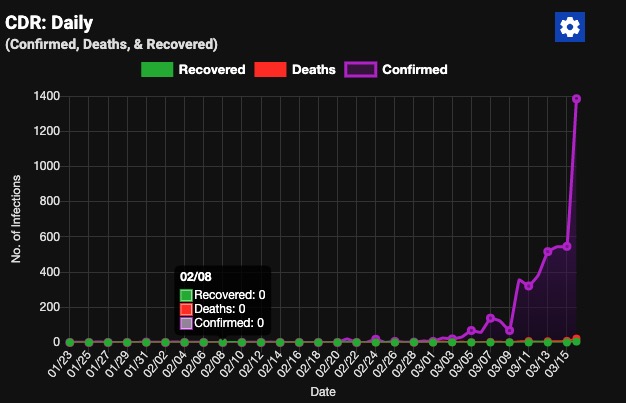
US infection curve
Like the US, Italy had and has a woeful shortage of testing capacity. This means that reports on numbers are entirely unreliable. Like in the early days of China reporting the numbers, we will see a spike as testing comes online. In fact, yesterday’s results are already showing a spike in the US.
The same dynamic Italy is facing between north and south is playing out here already. Densely populated areas like New York, Chicago, Seattle, San Francisco, and Los Angeles are affected first. They are also the most capable of dealing with it.
The virus spreads quickly in urban centers and eventually overwhelms health resources. This has played out in the cities mentioned above. However, rural health services will collapse almost immediately.
We will see an explosion of homeopathic cures. Just waiting for the COVID pack to show up on Goop.
Already happening. It will be within our own country and between countries. A quick look at the news will tell you this is already happening.
The markets only reflect expectations on profit. We’ve already lost years of gains in the market. The markets will recover eventually but many Americans will not. Small businesses will close. Owners who guaranteed debt with assets (like their home) will pay the consequences for years to come.
With their credit in ruins, some talented entrepreneurs will be unable to start a new businesses. Some good business plans will not weather the difficult stretch.
After all the doom and gloom, what could I possible see as hopeful?
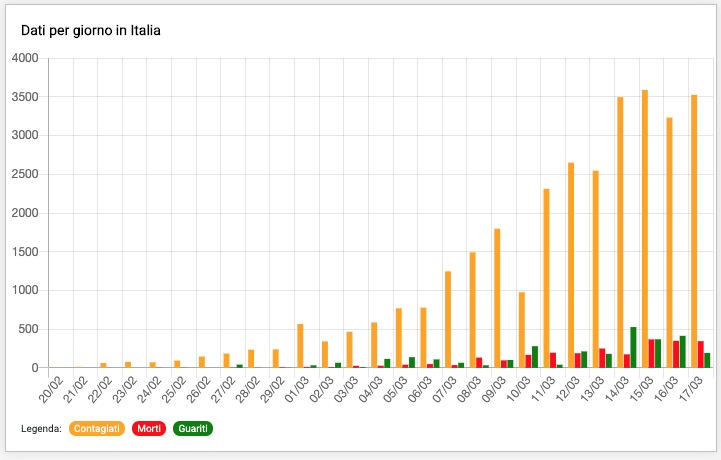
The yellow bars show newly infected. Red is deaths, green is healed.
While it is too early to be sure, Italy’s infection rate appears to be slowing. We know that some of the hotspots in Italy have seen NO new infections for several days.
We live supercharged, over-stimluated lives focused on the wrong things. This time together may help us feel closer to the people closest to us. A report from China showed an uptick in divorces after couples spent too much time together in lockdown. That may be true but I feel many more couples and families will pull closer together.
After 9/11, lines formed outside blood banks because people instinctively saw that as a tangible way to help. We will find ways to help each other.
To date healthcare and medical reform in the US has been like watching a tennis match where one side gets an advantage but nobody ever wins. Those of us watching are the big losers.
I think this tragedy will finally help us find some common ground in terms of the role of the federal government in crisis, the realization that we have to protect ourselves from a dependence on China for medicines and equipment, and other issues seem to offer hope for a common ground. Maybe we’ll even reform HIPPA into something that makes sense.
Crises lay bare gaps for entrepreneurs to fill in. I don’t yet know where the opportunities will lie but they will come. We’re Americans after all. When we get pushed around we get down to business. It’s what we do.
Amazon.com is already reporting they are hiring 100,000 to help due to the immense uptick in their business. Other merchants will see fewer results. Many China-dependent merchants are already showing strains in their supply chains. However, I think the overall effect on B2C merchants will be positive as they sell through inventory as long as the supply recovery doesn’t take too long.
These links open AI platforms with pre-written prompts about this page.
We use cookies to improve your experience. Do you accept?
To find out more about the types of cookies, as well as who sends them on our website, please visit our cookie policy and privacy policy.


