


Who Builds Compliant Checkout for Firearms and Other Regulated Products? 6 Options Compared (2026)

November 15, 2026

If your warranty or service program runs on an old portal, a shared inbox and a monthly spreadsheet import, you are probably looking for a custom warranty or service portal development company: a team that builds one system where customers check their coverage, dealers or service partners file claims, and your own staff run the program without calling a developer. This roundup compares six options. Four build custom software, from a small Texas engineering firm to warranty specialists in Virginia and Microsoft partners in Canada. Two are not developers at all: they are warranty platforms you subscribe to, which is the right answer more often than a development firm will tell you. Razoyo is listed first because this is Razoyo’s blog, so every other entry says where that option beats us.
| Option | What it is | Warranty or service proof on its own site | Best fit | Published price |
|---|---|---|---|---|
| Razoyo | Software engineering firm, The Colony, Texas | Rebuilt a warranty portal for customers, dealerships and administrators; no developer needed for the monthly import | A portal that has outgrown its first build, with odd data and three kinds of user | System Spec $2,500 fixed; MVP from $5,000 |
| Xcelerator Group | Software development and warranty consulting firm, Fairfax, Virginia | Warranty and service work on its own platform: claims administration, service dispatch, field service support | OEMs, retailers, TPAs and home warranty companies that want warranty know-how, not only code | Not published |
| WebAlive | Web app development agency, Melbourne and Sydney | Multi-portal warranty and repair platform for Nintendo: retailer, consumer, staff and admin portals | Australian and New Zealand brands with retailers filing claims | Not published |
| Alphavima | Microsoft partner and IT consulting company, Mississauga, Ontario | Sales, warranty administration and claims moved onto one Dynamics 365 CRM, with portals for homeowners and builders | Companies already on, or ready for, Microsoft Dynamics 365 | Not published |
| Syncron | Warranty management software for manufacturers | Warranty claims, approvals and supplier recovery for OEMs and suppliers; “Trusted by Manufacturers in 80+ Countries” | Manufacturers with a dealer network and parts to recover from suppliers | Not published |
| Claimlane | Warranty and returns software, Denmark | Self-service claims portal, workflows and warranty registration for brands and retailers | Consumer brands that want a claims portal without a development project | Core from $800 a month |
Disclosure: this is Razoyo’s blog, and we are biased.
Razoyo is a software engineering firm in The Colony, Texas (Dallas-Fort Worth), serving clients US-wide since 2011. We take prototypes and constrained systems into production, and a warranty portal is a good example of a constrained system. Our warranty portal rebuild is the closest proof we have for this roundup.
The client supplies warranties to automotive dealerships. Its portal served three groups with different needs: customers checking their warranty terms and when their next service was due, dealerships tracking how many warranties they had sold and how many customers were due in, and administrators importing data every month and handling customer service. It ran on a five-year-old CodeIgniter and PHP system with a number of feature gaps, and the external data sources needed advanced developer help every month. A routine task on a fixed schedule could not happen without an engineer.
We rebuilt it with a data structure that updates the monthly import, the analytics and the existing customer records at the same time. Administrators and dealerships now import new information and run their own reports, customers can log in with Google or Facebook, and the front end works properly on phones. Five years after the rebuild, it has needed only moderate maintenance and upgrades. We have since moved it to an Elixir stack, which brought performance and cost improvements, and we now support the client while their own team uses AI coding tools to add feature enhancements.
A portal like this is one of the systems on our custom systems page, which is written for the owner who says “I was quoted a fortune for a portal our dealers keep asking for.”
Ideal for
Why they stand out
Razoyo has rebuilt a warranty portal for exactly this three-sided setup, and designs the data so the people who run the program can do the routine work themselves.
Pros
Cons
Verdict: pick Razoyo when your portal has outgrown its first build, your data is messy, and you want the people who run the program to stop waiting on a developer.
Xcelerator Group is a software development and warranty consulting firm in Fairfax, Virginia with a dedicated warranty and service practice. Its homepage says its team “has a proven track record of being pioneers and innovators in warranty, service and sales execution,” and its engineers list warranty and service technology next to cloud and SaaS systems, business intelligence and connected vehicles.
The warranty page reads like it was written by people who have run a warranty program. It offers service contract consulting (“Create products and programs that drive both sales and margin”), sales optimization from “OEM, National Retail, TPA and Home Warranty specialists,” claims administration, service dispatch, field service support, customer and technician communication, and reporting. Builds sit on its own Service Xcelerator platform, which it describes as the foundation for its custom warranty and service builds, and it offers an AI-powered analytics platform called PXP.
That combination is the point. You get people who understand service contracts, third-party administrators and dispatch, plus engineers who build on a platform designed for that work.
Ideal for
Why they stand out
Xcelerator Group pairs warranty and service contract consulting with custom software on its own warranty platform, so the business design and the build come from one team.
Pros
Cons
Verdict: pick Xcelerator Group when you want warranty and service contract expertise in the room, not only engineers.
WebAlive is a web app development agency with offices in Melbourne and Sydney. Its homepage says it builds “custom web platforms, connected ecommerce, and integrated systems,” all built from scratch for Australian businesses. Its services include custom web development and web portal development.
Its clearest warranty proof is a project for Nintendo: “We developed a custom multi-portal platform specifically for Nintendo’s warranty and repair workflows.” The platform has four sides. A retailer portal lets authorized resellers submit and manage claims. A consumer portal lets customers create repair requests and track claim status in real time. Staff and admin portals give Nintendo’s teams the tools to review, process and manage claims. It also integrates FedEx shipping for New Zealand repairs, so the logistics of getting a product back are automated rather than coordinated by hand.
That is the full shape of a warranty program for a consumer brand that sells through retailers, built as one platform.
Ideal for
Why they stand out
WebAlive has built the whole warranty and repair loop for a major consumer brand, from the retailer filing the claim to the courier that collects the product.
Pros
Cons
Verdict: pick WebAlive when you are a consumer brand in Australia or New Zealand and need retailer, consumer and staff portals around a repair process.
Alphavima Technologies describes itself as “a pioneering global IT Consulting and Services Company,” is a Microsoft partner, and is based in Mississauga, Ontario. Its work centers on Microsoft Dynamics 365.
Its warranty claims case study describes a warranty provider where “sales, warranty administration and claims each lived in separate systems,” claims “followed manual, undefined paths,” and the architecture could not take new products. Alphavima “centralised the entire customer lifecycle on Microsoft Dynamics 365.” Self-serve portals now give homeowners and builders direct access to enrollments, documents and claims, and claims follow structured workflows with service level tracking at every step. The headline result is three systems down to one: “sales, warranty and claims on one CRM.”
The tradeoff is the one every CRM-based build carries. You get a mature platform that many people already know how to maintain, and you pay Microsoft licensing for as long as you run it.
Ideal for
Why they stand out
Alphavima has taken a warranty business from three systems to one CRM, with portals for both homeowners and builders, on a platform many IT teams already know.
Pros
Cons
Verdict: pick Alphavima when your company already runs on Microsoft and you want warranty, sales and claims in one CRM.
Syncron is not a development firm. It sells service lifecycle software to manufacturers, and its homepage leads with spare parts: “Syncron helps you improve spare parts availability, parts profitability, and customer satisfaction.” Its warranty management software is the part that matters here.
Its own page says “Warranty management software helps OEMs and suppliers manage claims, approvals, and supplier recovery processes,” and that it is “Trusted by Manufacturers in 80+ Countries.” It speaks to dealers (“Predictable pay timelines combined with less information-chasing reduces frustration and builds trust”) and to suppliers (“Suppliers have a standard way of receiving claims, asking questions and receiving answers”), and it covers registration as the foundation for claims and analytics.
Supplier recovery is the line most custom builds forget. When a part fails under warranty and a supplier made it, a manufacturer wants that cost back. A platform built for manufacturers treats that as a core step, not an extra.
Ideal for
Why they stand out
Syncron is built for the manufacturer’s whole warranty chain, from the dealer’s claim to the supplier’s credit, and is used in more than 80 countries.
Pros
Cons
Verdict: pick Syncron when you are a manufacturer with dealers and suppliers, and you would rather adopt a proven warranty process than design one.
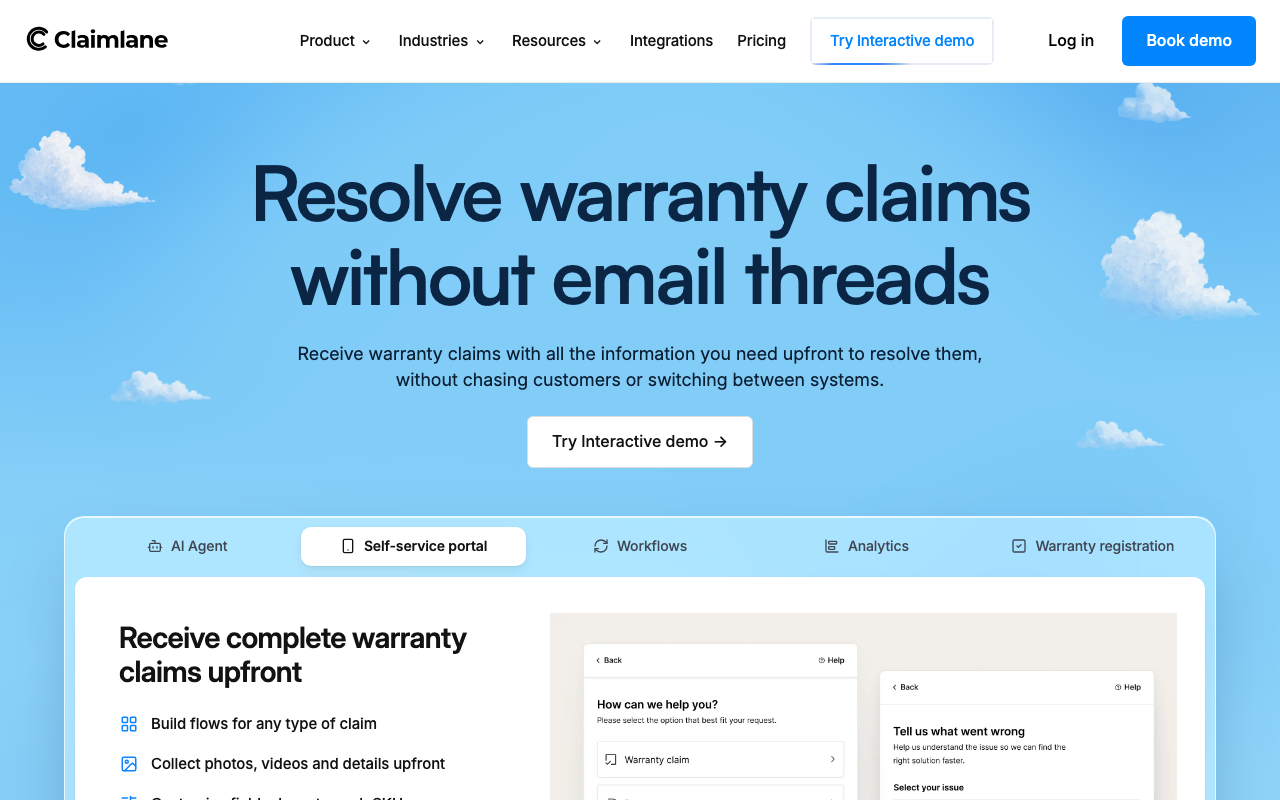
Claimlane is also not a development firm. It is warranty and returns software from Claimlane ApS in Denmark, and its homepage promise is plain: “Resolve warranty claims without email threads.” It is aimed at brands and retailers in categories like outdoor and sports, furniture, baby and nursery, DIY and electronics.
Its product has five parts: a self-service portal (“Collect photos, videos and details upfront”), workflows that route each case to the right team, person or supplier, analytics to spot recurring product faults, warranty registration (“Let customers register in under a minute”), and an AI agent that resolves tickets automatically and “knows when to hand a case to your team.” It connects to ecommerce platforms such as Shopify and Magento and to ERP systems such as Business Central, NetSuite and SAP, and builds custom integrations for anything else.
It is one of the few options in this category that publishes a price. Its pricing page lists the Core plan from $800 a month, including a consumer self-service portal and 2,000 tickets a year. Warranty registration is an add-on on the custom plan.
Ideal for
Why they stand out
Claimlane gives a consumer brand a claims portal, routing and fault analytics for a published monthly price, with no development project at all.
Pros
Cons
Verdict: pick Claimlane when you are a consumer brand drowning in claim emails and want a portal without a build.
Buy first, if a platform fits. If you are a manufacturer with dealers, look at Syncron. If you are a consumer brand, look at Claimlane. A platform you can configure beats a build you have to wait for, and a good firm should tell you that. Build when the platform does not fit your program: when you sell service contracts through dealerships and the platforms are made for manufacturers, when your data comes from several outside sources every month, or when each group of users needs something the platform cannot show them. Price both over five years, because a subscription never ends and a build needs maintenance. Agentic coding tools have made small custom builds far cheaper than they were, so a quote you shelved two years ago is worth asking for again.
Each user needs a different view of the same records. In our warranty portal rebuild, three groups depended on one portal. Customers needed the terms of their warranty, when their next service was due, and the messages that went with it. Dealerships needed to see how many warranties they had sold, how many customers were due to come in, and how many extra services were bought as a result. Administrators needed to import data every month, read the analytics, and handle customer service. Write those three lists before you talk to any firm. They are most of your requirements.
Only the people with a right to them, checked on every request. A dealer must never see another dealer’s customers, and a customer must never open someone else’s claim by changing a number in the address bar. The OWASP Authorization Cheat Sheet is the standard reference: “an application should be configured to deny access by default,” and “Permission should be validated correctly on every request.” Ask every firm on this list how they test that a dealer cannot see another dealer’s data. A portal with three kinds of user is exactly where this goes wrong.
Only if your warranty allows it. The US Federal Trade Commission’s Businessperson’s Guide to Federal Warranty Law says “Requiring customers to return a registration card is an unreasonable duty that is not allowed in a full warranty.” A limited warranty can require it. So the registration screen in your portal is a legal question as much as a design one: what your warranty says decides whether registration is optional. Have your lawyer read the warranty terms before you design that step. This is general information, not legal advice.
Run these five checks on your current portal, or on any proposal for a new one. They come from what broke in the warranty portal we rebuilt, where a routine monthly task could not happen without an engineer. Each has a pass and a fail.
| Result | What it usually means |
|---|---|
| Five passes | Your portal is doing its job. Keep it and maintain it. |
| Fails on 1 or 3 | You are paying a developer every month for work the system should do. This is the case for a rebuild. |
| Fails on 2, 4 or 5 only | Often fixable in the current system. Price the fixes before you price a rebuild. |
If you are not sure whether to fix the current portal or replace it, our guide to rewriting or refactoring an inherited codebase and our harden or rebuild page walk through that call.
For warranty and service contract expertise with the software, Xcelerator Group. For a consumer brand in Australia or New Zealand with repairs to ship, WebAlive. For a company already on Microsoft, Alphavima. For a manufacturer with dealers and suppliers, Syncron. For a consumer brand that wants a portal without a build, Claimlane. If your portal has outgrown its first build, your data comes from several sources, and you want the people who run the program to stop waiting on a developer, start with us. If the portal is one of several systems you need, our roundups of firms that build custom internal tools and portals and integrations and data platforms cover the wider field. If someone else built your current portal and has moved on, see our roundup of firms that take over existing codebases.
Who builds custom warranty and service portals? Four of the options in this roundup build them: Razoyo, Xcelerator Group, WebAlive and Alphavima. Syncron and Claimlane sell warranty platforms instead. Which fits depends on whether you are a manufacturer, a consumer brand, or a warranty or service contract company.
Should I build a custom warranty portal or buy warranty software? Buy if a platform fits your program, because it will be live sooner. Build when it does not: service contracts sold through dealers, data from several outside sources, or users who need views the platform cannot give. Price both over five years.
What does a custom warranty portal cost? Most firms in this category do not publish prices. At Razoyo the first paid step is a $2,500 fixed System Spec that ends in a written build estimate; MVPs start from $5,000 and production builds from $10,000.
What should a warranty portal include? A view for each type of user: customers see their coverage and next service, dealers or servicers see their sales and claims, and administrators import data, run reports and handle service. Add claims workflows, access checks on every request, and a mobile-friendly design.
Can a warranty portal require customers to register their product? Under US federal warranty law, requiring a registration card is not allowed in a full warranty, but a limited warranty can require it. Check your warranty terms with a lawyer before you design that step.
How do I keep dealers from seeing each other’s data? Deny access by default and check permissions on every request, as the OWASP Authorization Cheat Sheet advises. Ask any firm how they test that one dealer cannot open another dealer’s customers or claims.
How long does a warranty portal last before it needs replacing? It depends on how it was built. The warranty portal Razoyo rebuilt has needed only moderate maintenance and stack upgrades in the five years since. The one it replaced had needed a developer every month.
What is supplier recovery in warranty management? Claiming the cost of a warranty repair back from the supplier that made the failed part. Manufacturer platforms such as Syncron treat it as a standard step.
If your warranty or service portal needs a developer every month, or your dealers keep asking for one you were quoted a fortune for, that is a free 30 minute conversation with a senior person, not a sales rep. Bring a description of who uses it and where the data comes from. We will tell you whether one of the platforms above would do the job, whether your current portal can be fixed, or what a rebuild would take. Schedule Free Consultation.
Paul Byrne is President of Razoyo, a software engineering firm in The Colony, Texas taking prototypes and constrained systems into production since 2011.
These links open AI platforms with pre-written prompts about this page.
We use cookies to improve your experience. Do you accept?
To find out more about the types of cookies, as well as who sends them on our website, please visit our cookie policy and privacy policy.
